Back to all blogs
Discover practical integrity metrics to help you flag interview fraud risks to CHRO and audit teams confidently and calmly.

Abhishek Kaushik
Dec 2, 2025

TL;DR
Interview fraud is no longer occasional or anecdotal.
It is:
Measurable
Trend-based
Preventable with the correct controls
The CHRO and audit teams do not want:
Technical detail
Candidate-level accusations
Emotional narratives
They want:
Risk levels over time
Signal detection trends
Policy control effectiveness
Operational confidence that exposure is decreasing
Your job is to convert raw proctoring signals into leadership-ready integrity metrics.
Why Reporting Interview Fraud Matters
If hiring fraud is not measured:
It gets normalized
Managers become inconsistent in enforcement
Talent quality becomes unpredictable
Audit exposure increases across regions
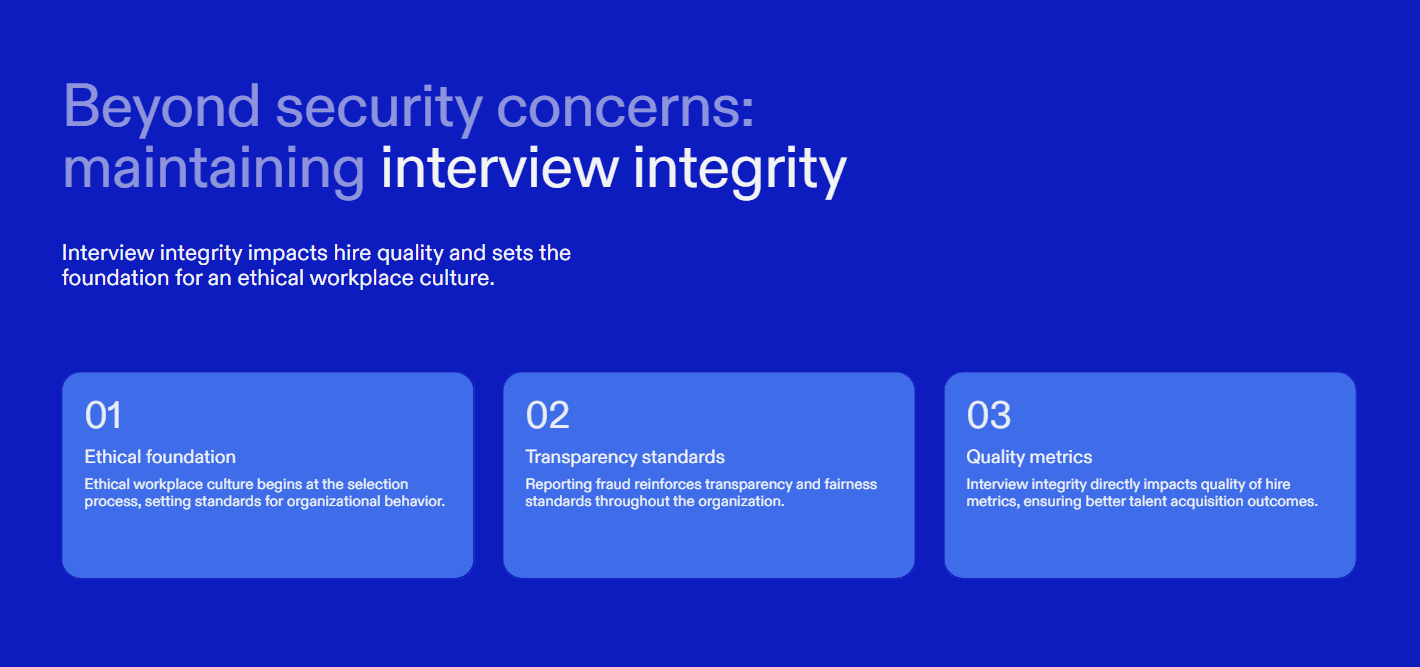
Interview integrity is not just a security concern.
It is a quality of hire and ethics concern.
The Four Signals That Matter to Leadership
Do not report:
Face detection alerts
Tab-switch counts
Webcam anomalies
Audio waveform irregularities
These overwhelm and confuse.
Report these four leadership-grade metrics instead.
Metric | Meaning | Why It Matters |
|---|---|---|
Verified Identity Rate | Percentage of interviews where the same person verified and attended | Indicates impersonation risk |
Environment Trust Score | Level of control and compliance during the session | Indicates operational discipline |
Real-Time Knowledge Signal | Ability to answer follow-up questions without script or prompting | Indicates true skill vs coached |
Fraud Intervention Incidents | Cases requiring escalation or secondary verification | Indicates risk to hiring quality |
These are simple, explainable, trending, and defensible.
How to Calculate Each Metric
1. Verified Identity Rate
If this is below 95 percent, impersonation risk is high.
2. Environment Trust Score
Weighted index of:
Background consistency
Multi-face detection
Audio conversation fingerprints
Screen-share behavior
Score should be presented as:
Avoid raw numbers. Executives need classification, not telemetry.
3. Real-Time Knowledge Signal
Measure:
Ability to explain decision reasoning
Ability to adapt solutions when constraints change
Ability to answer non-scripted follow-ups
Record outcome as:
This metric correlates strongly with quality of hire.
4. Fraud Intervention Incidents
Count interviews that required:
Re-verification
Re-interviewing
Case review
Compliance documentation
Do not report to managers at candidate level.
Only report aggregate exposure trend.
This tells the CHRO:
Risk direction
Policy effectiveness
Regional or role hotspots
How to Present the Metrics to CHRO and Audit
Use this narrative format:
This keeps discussion:
Strategic
Calm
Forward-moving
Reporting Cadence
Audience | Frequency | Level of Detail |
|---|---|---|
Hiring Managers | Monthly | Team-level practices |
People Ops Leadership | Quarterly | Policy and enablement |
CHRO + Audit + CFO | Twice Yearly | Risk exposure trend and control strength |
You are not reporting incidents.
You are reporting risk maturity over time.
Example Slide Titles (Copy-Paste for QBR Deck)
Interview Integrity: Current State and Trend
Identity and Authenticity Controls Overview
Real-Time Knowledge Demonstration Outcomes
Fraud Intervention Trend and Region Distribution
Recommended Next Controls to Reduce Risk Further
Short. Specific. Actionable.
Conclusion
Reporting interview integrity is not about proving fraud.
It is about proving control strength.
When you show:
Verified identities
Trusted environments
Real-time reasoning
Declining intervention incidents
You send a signal:
Our hiring process is disciplined, consistent, and resilient.
This builds:
CHRO confidence
Audit confidence
Leadership trust in talent quality