Back to all blogs
Break down the cues that reveal true candidate capability and prevent AI-generated answers from skewing your evaluations.

Abhishek Kaushik
Dec 3, 2025
TL;DR
AI can now:
Generate polished explanations
Produce working code
Provide structured behavioral responses
Outline system architectures
So answer quality is no longer the primary hiring signal.
To measure real skill, you must evaluate:
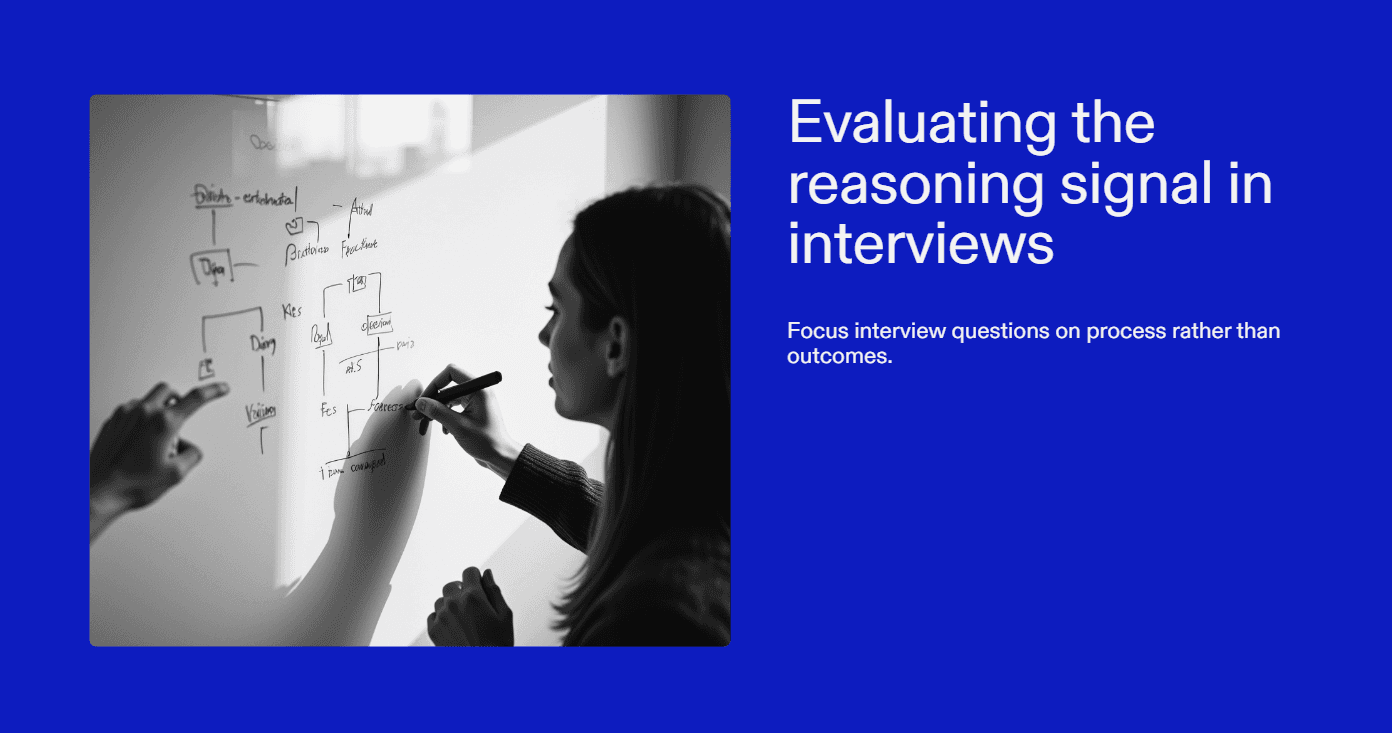
How candidates think
How they adapt
How they handle uncertainty
How they explain decisions
This is the reasoning signal, and it cannot be outsourced to AI.
The Root Problem
If your interview only measures:
Correctness
Confidence
Fluency
then AI can pass the interview without the candidate having the skill.
To measure real ability, you must make the interview measure thinking, not remembering.
The Core Framework
Real skill can be measured using three checks:
Check | What It Reveals | Why AI Fails Here |
|---|---|---|
Paraphrasing | True understanding | AI repeats patterns, not meaning |
Tradeoff reasoning | Decision logic | AI provides options but not grounded reasoning |
Constraint shifting | Adaptability | AI answers collapse when assumptions change |
If a candidate can do these three, they understand the work.
If they cannot, they are relying on remembered words or generated patterns.
Step 1: The Paraphrase Check
Ask:
Explain this problem in your own words.
Real Skill Signals:
Clear, simple explanation
Identifies core constraints
Describes mental model
AI-Powered Answer Signals:
Overly formal language
Vague phrasing
No constraint awareness
Reason: Real understanding compresses. AI expands.
Step 2: The Tradeoff Check
After the candidate describes their solution, ask:
What other approaches did you consider and why did you choose this one?
Real Skill Signals:
Discusses performance, cost, reliability, complexity
Can compare pros and cons meaningfully
AI-Powered Answer Signals:
Provides a list of options with no clear selection criteria
Avoids describing what they would sacrifice or optimize
High-performing engineers consistently reference tradeoffs, not just solutions.
Step 3: The Constraint Shift Check
Ask:
If one key assumption changed, how would your approach change?
Examples:
The dataset is now streaming instead of batch.
Latency requirement is half of what you assumed.
Traffic is 10 times higher than expected.
Real Skill Signals:
Candidate adapts
Explains new failure modes
Revises architecture or algorithm logically
AI-Powered Answer Signals:
Repeats original solution
Adds vague scaling language
Changes answer without reasoning context
This is the single strongest authenticity indicator.
The Code Interview Version
Do not evaluate:
Final code output
Library choice
Syntax accuracy
Evaluate:
How they debug
How they refactor
How they reason about complexity
Ask:
Show me where this code could break and how you would test it.
Real engineers answer immediately.
AI-dependent candidates struggle.
The Behavioral Interview Version
Do not evaluate:
Story polish
Structure
Confidence
Evaluate:
Ownership
Emotional recall detail
Personal accountability
Ask:
What changed during the project and why?
Real memories always contain change.
AI-generated stories rarely do.
How Sherlock AI Helps
Sherlock AI detects:
Background whisper coaching
Identity inconsistency
Scripted narrative pacing
Copy-paste and code authorship anomalies
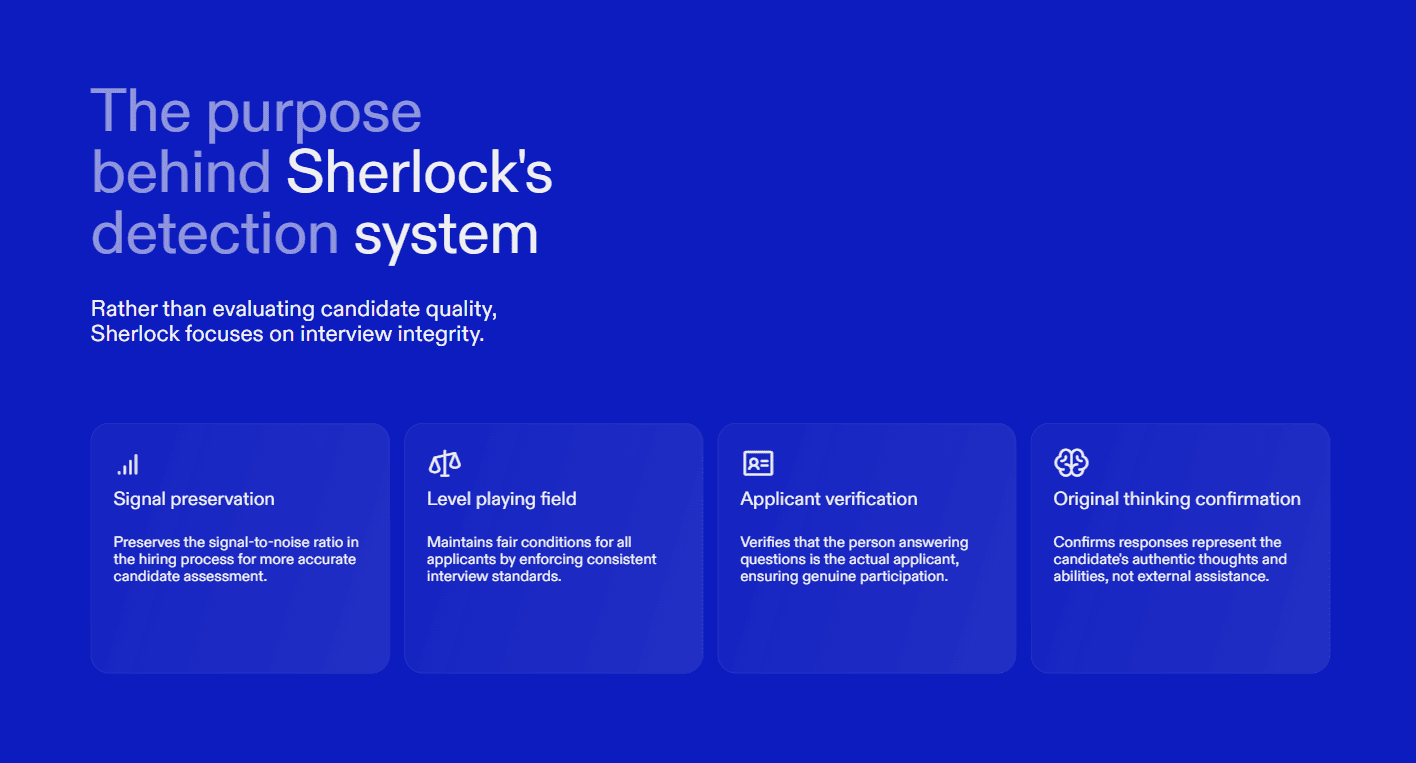
Sherlock AI does not decide whether the candidate is good.
It ensures:
The person answering is the applicant
The thinking is their own
This keeps interviews fair and high-signal.
Example Scorecard Language (Copy-Paste)
If concerns arise:
This protects fairness and audit safety.
Conclusion
AI did not eliminate skill.
It eliminated lazy evaluation of skill.
To measure real capability:
Evaluate reasoning
Evaluate adaptability
Evaluate decision logic
Not:
Polished language
Memorized frameworks
Working code alone
This is how hiring remains accurate in the AI era.