Back to all blogs
Understand the common warning signs of dishonesty in interviews and how to verify information without making assumptions or harming candidate trust.

Abhishek Kaushik
Dec 5, 2025

People do not reveal deception through blinking or posture.
They reveal it through inconsistencies in reasoning, ownership gaps, and inability to adapt when details change.
The strongest signals are cognitive, not behavioral.
To detect dishonesty fairly, interviewers should:
Ask ownership-specific follow-ups
Observe how answers change when conditions shift
Listen for reasoning vs recitation
Compare consistency across rounds
Use tools like Sherlock AI to highlight authorship and continuity signals
What Lying in Interviews Usually Looks Like
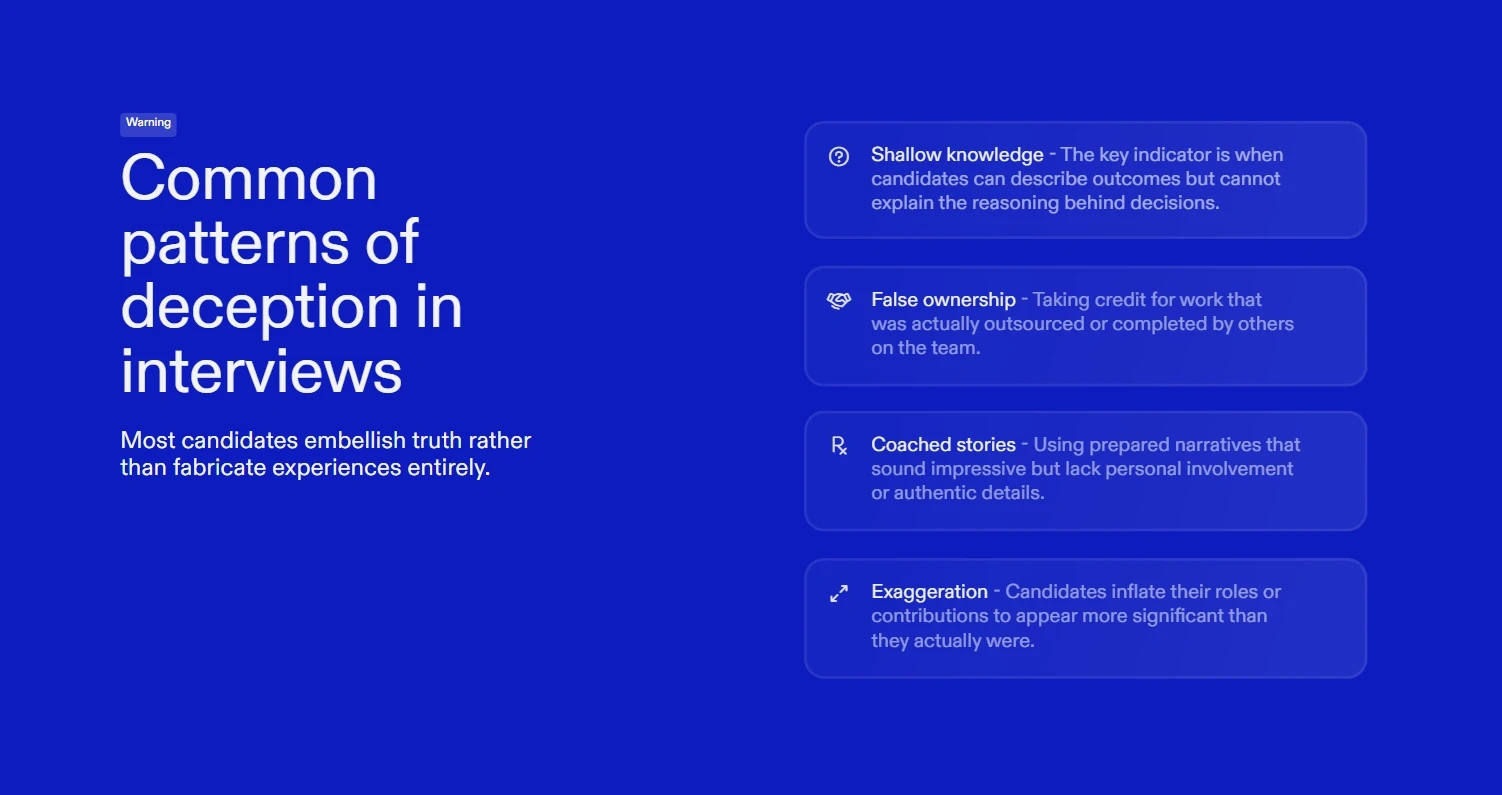
Most candidates who lie are not fabricating entire experiences.
They are:
Exaggerating their contribution
Outsourcing work but claiming ownership
Using coached or memorized stories
Repeating frameworks without understanding
The key signal:
They can describe the outcome
but cannot explain the thinking behind it.
The Three Core Signals of Honesty vs Invention
Signal | Honest Candidate | Dishonest or Scripted Candidate |
|---|---|---|
Ownership | Speaks in "I" when appropriate and "we" when appropriate | Uses "we" to avoid specifying responsibility |
Reasoning | Explains why they made decisions | Describes what happened without reasoning |
Adaptability | Adjusts answers when constraints change | Breaks down, resets, or freezes when scenario shifts |
These patterns are consistent across industries and seniority levels.
Adaptability under constraint correlates strongly with real experience.
Five Interview Techniques That Reveal Truth Without Bias
1. Ask “How Did You Decide?”
Deceptive candidates can describe tasks.
They cannot describe decision-making.
Good follow-up:
What options did you consider and why did you choose that one?
2. Change One Constraint in the Scenario
Example:
What if the timeline was half as long?
Honest candidates adapt their reasoning.
Scripted candidates restart the answer entirely.
3. Ask for a Self-Critique
If you could redo this project, what would you change?
Honest candidates reflect easily.
Fabricators struggle because the story was memorized for perfection.
4. Check Ownership Depth
Who was opposed to your decision and how did you convince them?
If they cannot name real friction or conflict, they likely did not own the decision.
5. Listen for “From Lived Experience” Language
Honest candidates speak in:
Specifics
Time-based memory markers
Narrative micro-details
Scripted candidates speak in:
Frameworks
Generalizations
Corporate phrases
Where Sherlock AI Helps
Sherlock AI strengthens detection without requiring interviewer suspicion.
It observes:
Reasoning continuity across questions
Identity and authorship consistency across stages
Voice and timing patterns associated with hidden prompting
Coherence breakdown when unexpected follow-ups are introduced
Sherlock AI does not guess intent.
It identifies signal authenticity.
This protects:
Honest candidates
Interviewer fairness
Company hiring accuracy
What Not to Do
Avoid:
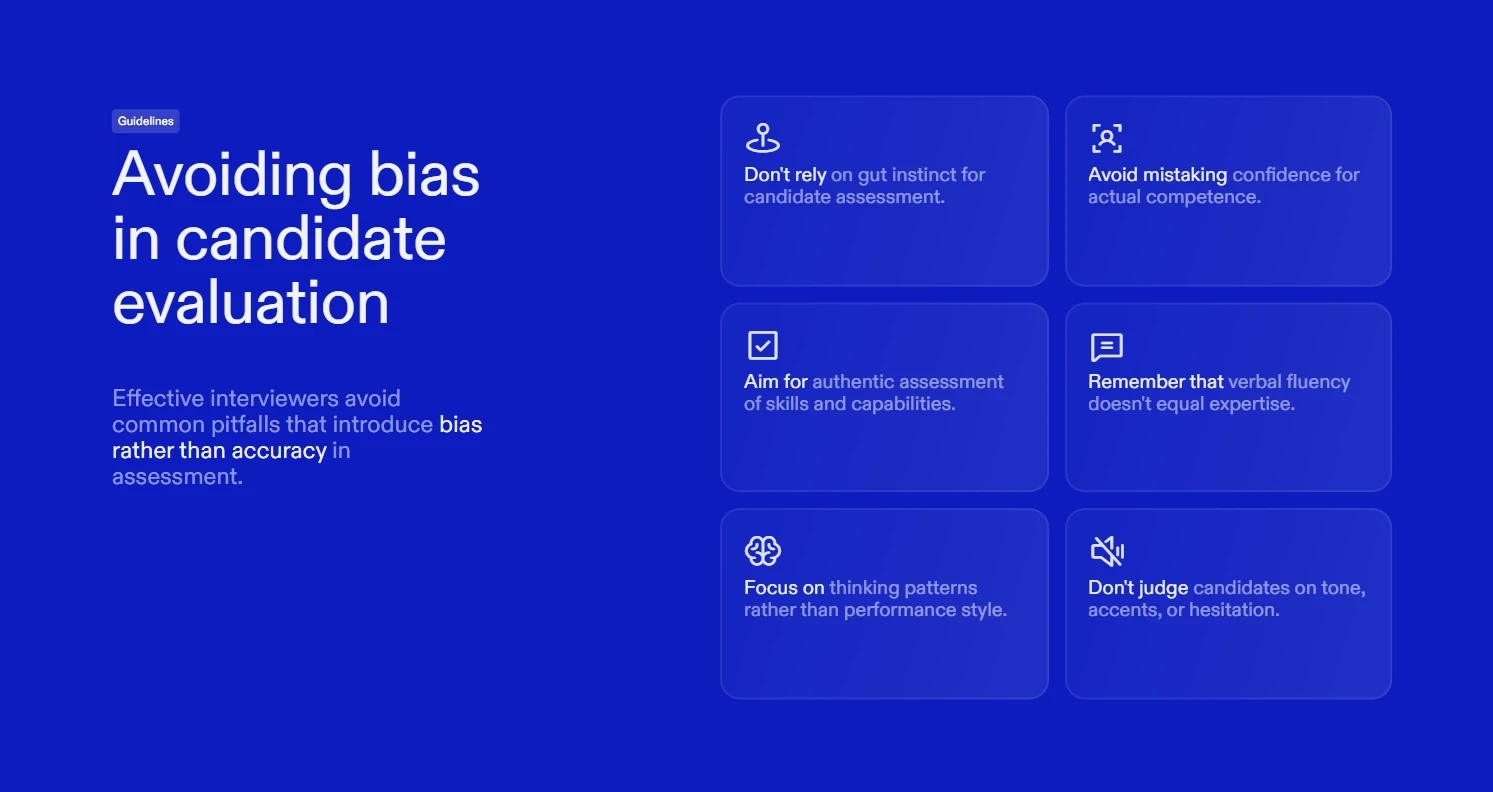
Judging tone, accents, posture, or hesitation
Mistaking confidence for competence
Assuming fluency equals expertise
Using gut instinct as a primary evaluator
These create bias, not accuracy.
Lies reveal themselves in thinking, not performance style.
Conclusion
You do not need to catch candidates lying.
You only need to:
Evaluate reasoning under change
Test ownership through follow-ups
Compare stories across time
Use tools that maintain identity and authorship integrity
Truth is stable.
Fabrication collapses under curiosity.
Sherlock AI ensures the interview reflects the candidate’s own mind, not a script or unseen assistant.