Back to all blogs
Learn fair, evidence-based ways to spot coached interview answers and assess real ownership, reasoning, and adaptability in candidates.

Abhishek Kaushik
Dec 26, 2025

TL;DR
Interview coaching companies teach candidates:
Highly structured frameworks
Polished “impact stories”
Memorized success narratives
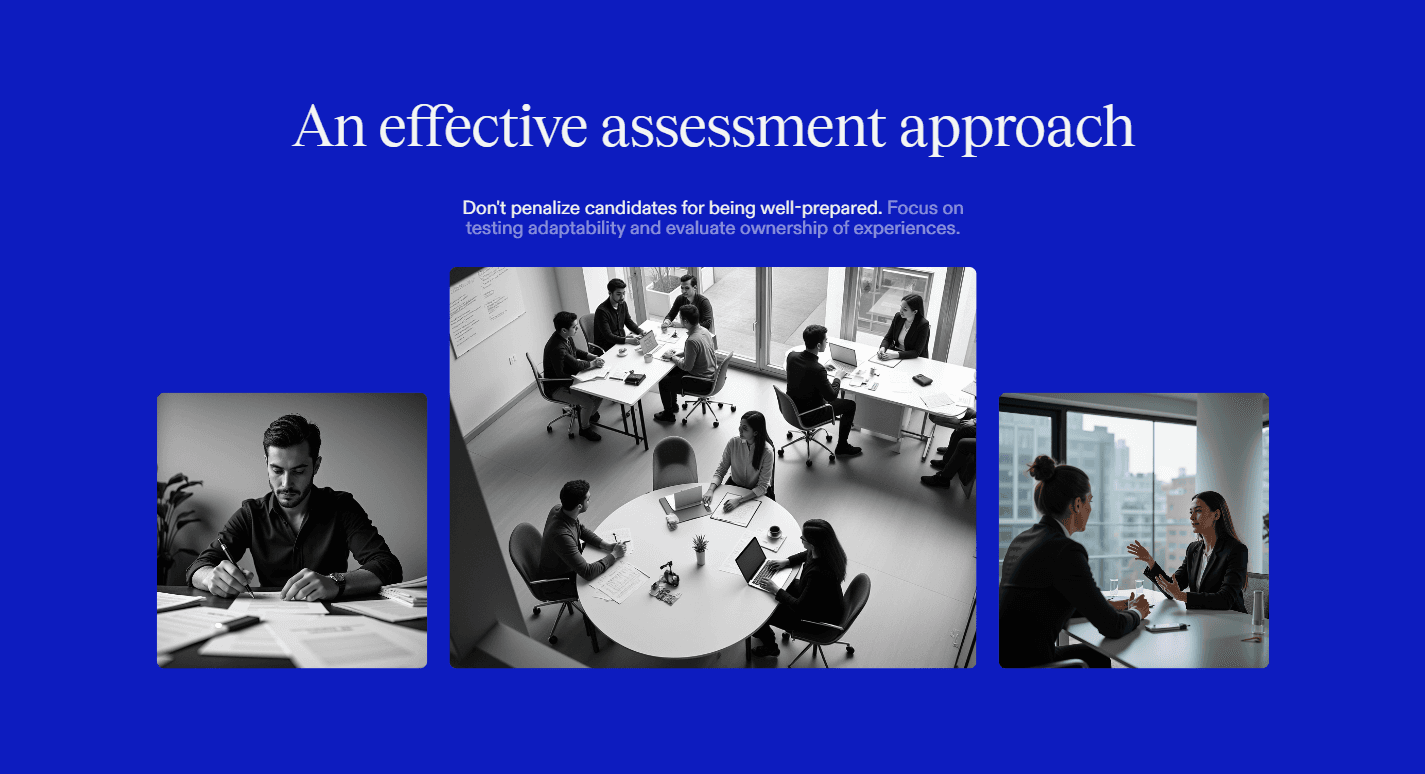
This creates candidates who sound confident and strategic, even without the underlying experience.
The danger is not that candidates are preparing.
Preparation is normal.
The danger is:
When the interview becomes a performance of memorized stories rather than a demonstration of real reasoning.
The solution is not to penalize Polish.
The solution is to test for adaptability and ownership.
Why Coaching Factories Have Exploded
Remote work opened global competition.
Candidates are now trained to:
Speak in frameworks like STAR, PARA, SOAR
Give perfect, narrative-shaped answers
Avoid revealing uncertainty
Appear “executive-ready” even at junior levels
According to WiseGuy Reports, the global interview-coaching market was valued at US$935.9 million in 2024 and is projected to grow significantly, reflecting the rapid expansion of coaching services and their influence on candidate preparation.
This means polished storytelling is no longer a signal of ability.
The Goal Is Fairness, Not Gatekeeping
We do not want to penalize:
Non-native English speakers trying to be clear
First-generation professionals seeking mentorship
Candidates who prepare diligently
We only want to prevent:
Passing candidates who can recite but cannot solve
Rewarding performance fluency over problem-solving depth
So the detection method must be:
Neutral
Consistent
Evidence-based
Not:
Intuitive
Style-judging
Personality-driven
How to Identify Coaching Without Bias
Coached answers have three common traits:
Signal Pattern | Coached Response | Real Experience Response |
|---|---|---|
Structure | Very polished, follows a template with no deviation | Structured but contains human irregularities |
Confidence | Consistent tone, rehearsed pacing | Variable tone as they think and recall |
Complexity | Clean narrative arc, no friction points | Messy details, uncertainty, real challenges |
This is not about how they sound. It is about whether the story flexes under probing.
The Four Questions That Reveal Coached Answers
1. The Ownership Clarifier
Which part did you personally decide or lead?
Coached Candidate
Repeats “we” language
Gives broad outcomes
Avoids personal decisions
Real Candidate
Can describe:
Their decision points
Why did they choose specific approaches
How others depended on them
2. The Timeline Reconstruction
Walk me through the steps in order, including any rework.
Coached Candidate
Gives:
Summary
Framework
Outcome
Real Candidate
Gives:
Sequencing
Dependencies
Delays
Initiation triggers
3. The Constraint Reveal
What got in the way?
Real work always collides with:
Deadlines
Stakeholders
Data gaps
Systems limitations
Coached answers avoid this because they present clean wins.
4. The Adaptation Test
This is the strongest fraud-resistant signal.
What changed, and how did you adjust?
Real experience changes. Scripts do not.
Why This Is Bias-Safe
These questions:
Do not rely on the communication style
Do not rely on accent or fluency
Do not rely on personality alignment
Do not reward extroversion
They test thinking, not polish.
This protects:
Global talent
Neurodivergent candidates
Introverts
Candidates from non-Western communication norms
While still filtering out scripted responses.
What to Document in ATS Notes
Use structured evidence statements:
If answers collapse under follow-up:
No emotion.
No accusation.
Just signal.
Conclusion
We should not punish preparation. We should not reward performance theater.
The purpose of interviewing is:
To understand how someone thinks
To assess how they work when conditions change
To validate that the experience they describe is theirs
When interview coaching factories make candidates sound similar, the winning teams will be those who evaluate:
Ownership
Reasoning
Adaptation
Not narrative polish. True fairness is achieved by evaluating an authentic cognitive signal, not style or confidence.