Back to all blogs
Discover how to spot genuine technical expertise in short interviews with targeted questions and simple evaluation methods.

Abhishek Kaushik
Dec 2, 2025


TL;DR
Technical depth is not about:
Using advanced jargon
Talking confidently about architecture
Listing technology stacks
Technical depth is revealed through:
How candidates think
How they debug
How they adapt when constraints shift
How they explain the tradeoffs behind decisions
You can evaluate depth without long interviews by using:
A micro-problem
A decision explanation prompt
A constraint-change follow-up
This takes 12 minutes and exposes true skill.
Why Long Interviews Fail and Short Ones Can Work Better
Most companies run:
60–90 minute interviews
Multi-stage loops
System design chalk-talks
Coding challenges
But none of that guarantees that you see how the candidate thinks.
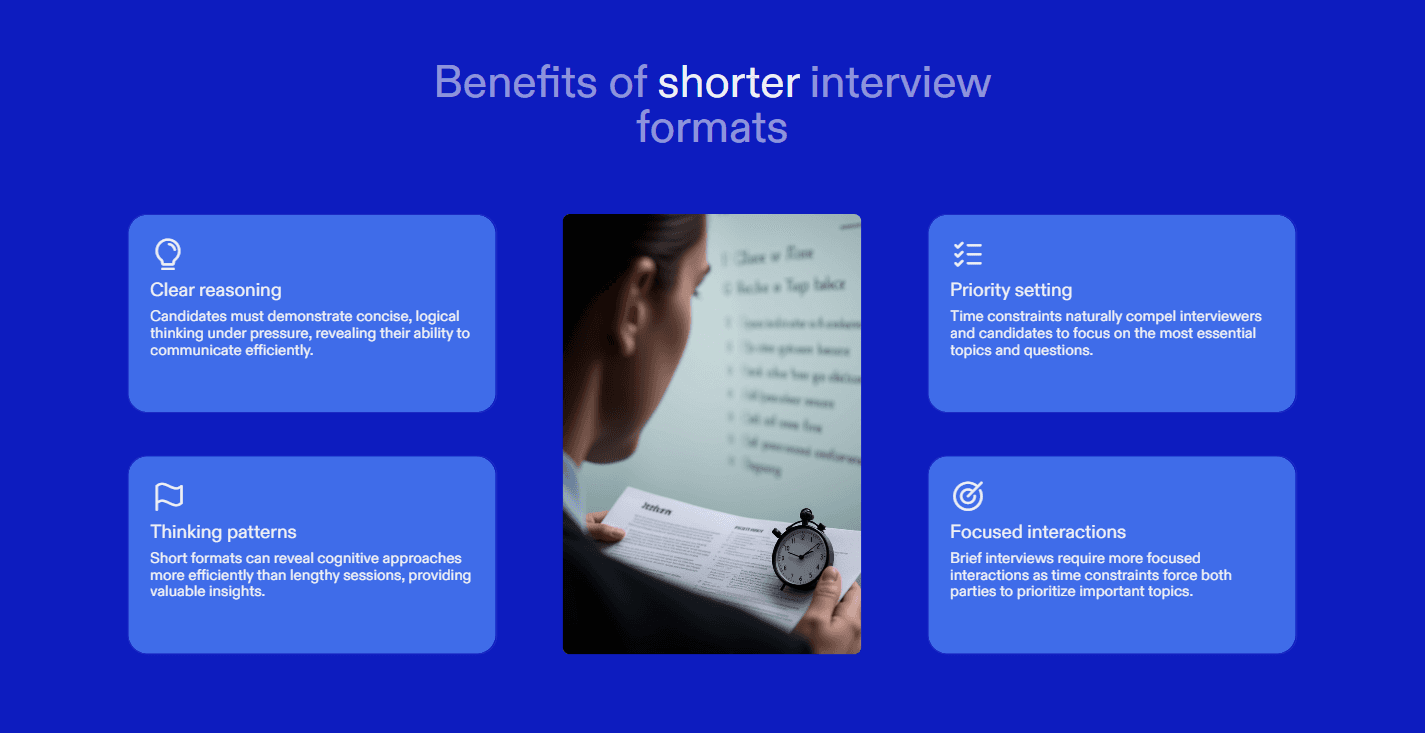
Meanwhile, short interviews force:
Focus
Prioritization
Clarity of reasoning
Depth is visible in the thought process, not the final answer.
The Three-Part Depth Evaluation Framework (12–20 minutes)
Step | Purpose | Time |
|---|---|---|
Micro Problem | Establish baseline thinking | 3–6 minutes |
Decision Reasoning | Understand why choices were made | 4–7 minutes |
Constraint Shift | Test adaptability and real understanding | 4–7 minutes |
Let’s break it down.
Step 1: Start with a Micro Problem
A good micro problem:
Is small enough to solve quickly
Contains just enough complexity to require thinking
Avoids boilerplate or language trivia
Example (Backend or Data):
How would you design rate limiting for an API endpoint?
Example (Frontend):
How would you architect a component that displays live data with partial updates?
Example (ML):
How would you handle distribution shift in a model deployed to live traffic?
You are not evaluating correctness.
You are evaluating:
Approach
Decomposition
Identification of constraints
Step 2: Ask the Decision Reasoning Question
Once they present an approach, ask:
Why did you choose that approach instead of another reasonable alternative?
This reveals:
Depth of mental model
Understanding of tradeoffs
Familiarity with real-world system behavior
Strong Signal:
Candidate discusses:
Performance
Failure modes
Developer ergonomics
Operational reality
Cost
Weak Signal:
Candidate repeats:
Tutorial patterns
Generic LinkedIn architecture answers
Reasoning > Vocabulary.
Step 3: Apply the Constraint Shift
This is where depth is exposed.
Say:
Now assume one of your original assumptions is no longer true. What changes?
Examples:
Traffic doubles
Latency budget is cut in half
Cost must be reduced by 40 percent
Writes become 10 times more frequent
You now need multi-region failover
Strong Candidate:
Revises design logically
Explains new tradeoffs
Shows adaptability
Weak Candidate:
Repeats same architecture
Panics
Over-generalizes
Becomes vague
Technical depth is how they adapt, not how they start.
The Depth Signal Markers
Signal | Meaning |
|---|---|
Mentions constraints | Has built real systems or debugged them |
Talks about tradeoffs unprompted | Has engineering maturity |
Changes approach when assumptions change | Understands systems, not templates |
Clarifies state and consistency needs | Has genuine technical depth |
Uses simple explanations | Actually understands the topic |
If someone needs jargon to sound smart, they are covering a gap.
Experts explain simply.
How to Score It in ATS Notes (Bias Safe)
If depth was not demonstrated:
This avoids:
Confidence bias
Communication style bias
Personality bias
Why This Works in Under 20 Minutes
Because seniority is:
Pattern recognition
Tradeoff awareness
Constraint sensitivity
Not:
Speaking fluency
Diagram beauty
Code golf performance
Depth shows up fast.
Shallow understanding collapses fast.
The interview simply needs to create the collapse point.
Conclusion
You do not need:
Longer interviews
More stages
Trick questions
You need:
Smaller problems
Better probing
Constraint shifts
Evidence-based scoring
Once interviewers stop evaluating stories and start evaluating thinking, hiring becomes:
More accurate
More fair
Much faster
Technical depth is a reasoning pattern.
Reasoning patterns reveal themselves quickly.