Back to all blogs
A practical guide to detecting invisible AI apps in interviews, from behavioral signals to AI-powered tools that stop stealth interview cheating.

Abhishek Kaushik
Feb 6, 2026
The rise of invisible AI tools that assist candidates during interviews has transformed a niche concern into a mainstream hiring challenge.
Recruiters across industries report that about one in five candidates show signs of AI-generated help during interviews, and nearly a third of interviewers at top companies like Meta and other FAANG-adjacent firms have caught or strongly suspect AI-assisted cheating.
Part of what makes this new breed of cheating so potent is its lack of visible indicators. Invisible AI assistants can run in the background, use audio prompts, or overlay responses without detection by screen sharing.
In this environment, recruiters must go beyond conventional proctoring and learn to spot the subtle footprints that invisible AI leaves behind. This guide will walk you through exactly how to detect invisible AI during interviews, so your hiring decisions reflect genuine talent and not advanced automation.
What “Invisible AI” in Interviews Really Looks Like
Invisible AI tools are software assistants that help candidates during live interviews without showing anything on screen or being obvious to the interviewer. They’re fundamentally different from simply browsing ChatGPT in another tab or using a second device, they hide themselves from detection while feeding responses to the candidate.
What Invisible AI Apps Are
Invisible AI apps include:
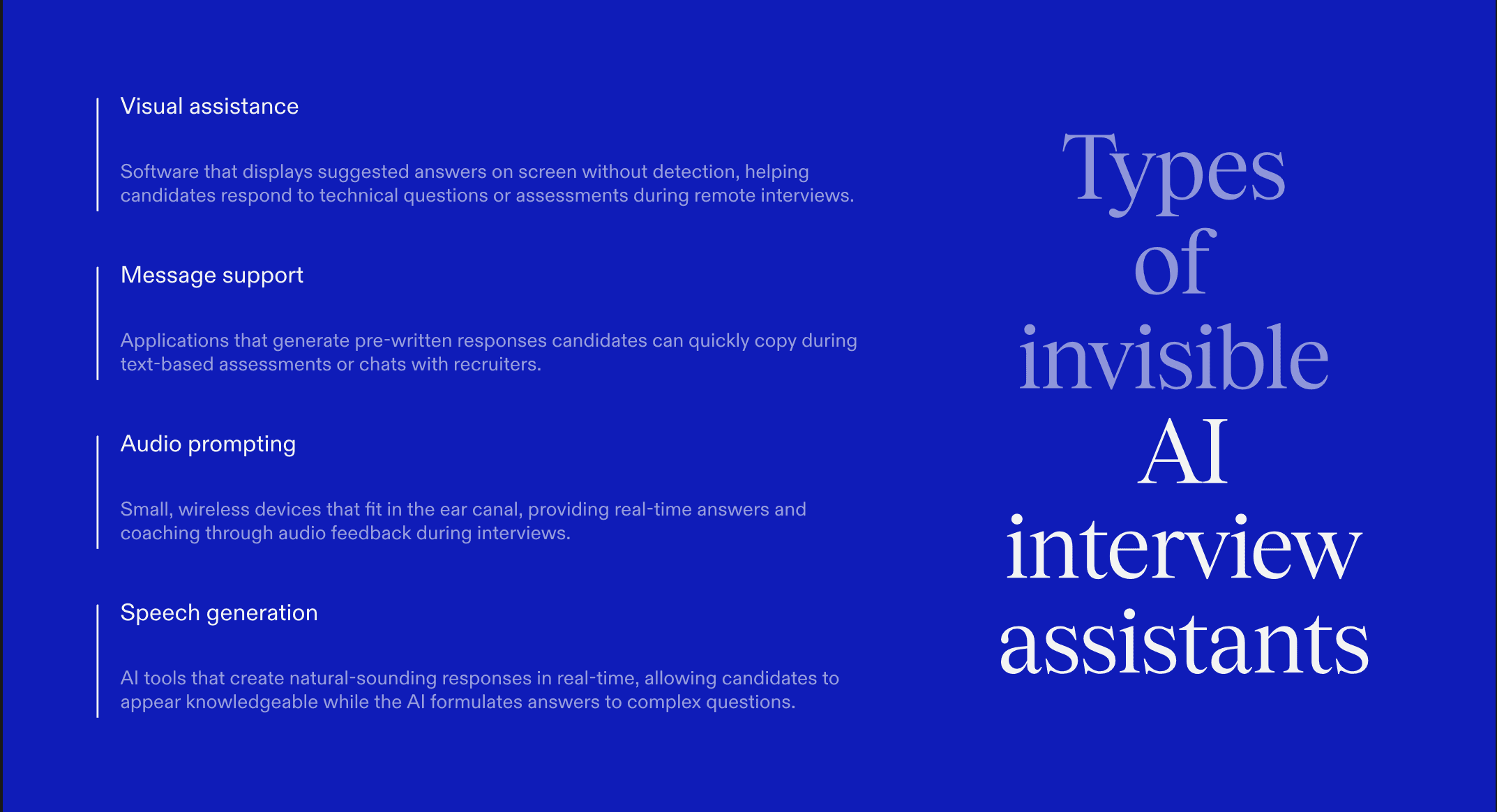
Hidden AI copilots that run outside of browsers and are not captured by screen sharing. These can feed real-time answers or code suggestions directly into the candidate’s workflow without visible windows.
Background LLMs, where a local AI model listens (via audio or transcripts) and generates appropriate replies silently.
Silent speech-to-text + answer generators, interpreting audio and sending back polished responses instantly.
Second-screen AI setups, where a phone/tablet runs an AI assistant that the candidate discreetly watches or listens to, sometimes without the interviewer noticing. Community reports highlight second-screen usage as a common cheating strategy.
Example tools: Platforms marketed as “undetectable” interview aides claim they stay invisible to shared screens and standard proctoring.
How These Tools Operate Without Visible UI
Invisible AI tools avoid detection using techniques like:
Operating at the OS level, bypassing browser capture APIs so their interfaces aren’t transmitted during screen share.
Transparent overlays that display only to the candidate but are ignored by screen recording.
Audio routing tricks, where AI responses come through low-volume channels or hidden virtual audio devices.
Background scripts and processes that read microphone input and generate text responses without triggering visible UI elements.
Because these methods operate below the surface of usual interview software (Zoom, Teams, Meet), simple screen share warnings or browser lockdowns can’t detect them.
Difference Between Visible Cheating Tools vs. Stealth AI
Feature | Visible Tools | Invisible AI |
|---|---|---|
Shows UI on screen | Yes | No |
Captured in screen share | Usually | Rarely/Not at all |
Detected by standard proctoring | Often | Hard |
Requires additional device | Sometimes | Not necessarily |
Traditional cheating tools like browsing ChatGPT in another tab or using a second screen are easy to spot through screen sharing or asking candidates to reveal their desktop. Stealth AI apps, however, are designed to blend into the background and avoid these controls entirely.
Behavioral Signals That Reveal Invisible AI Use
Invisible AI tools are designed to be unseen, but they still influence timing, behavior and language patterns. Combined, these indicators help recruiters and interviewers spot AI-assisted responses even when nothing on screen betrays their use.
1. Unrealistically Fast, Perfectly Structured Answers
When candidates respond with near-flawless, fully structured answers mere seconds after a question is asked, it’s a red flag. Human cognition typically involves processing time, even for experts. If answers sound polished too fast, AI may be drafting them behind the scenes.
What to look for:
Complete answers with perfect grammar + examples
Overly formal structure (“Firstly… secondly… finally…”)
Zero filler language
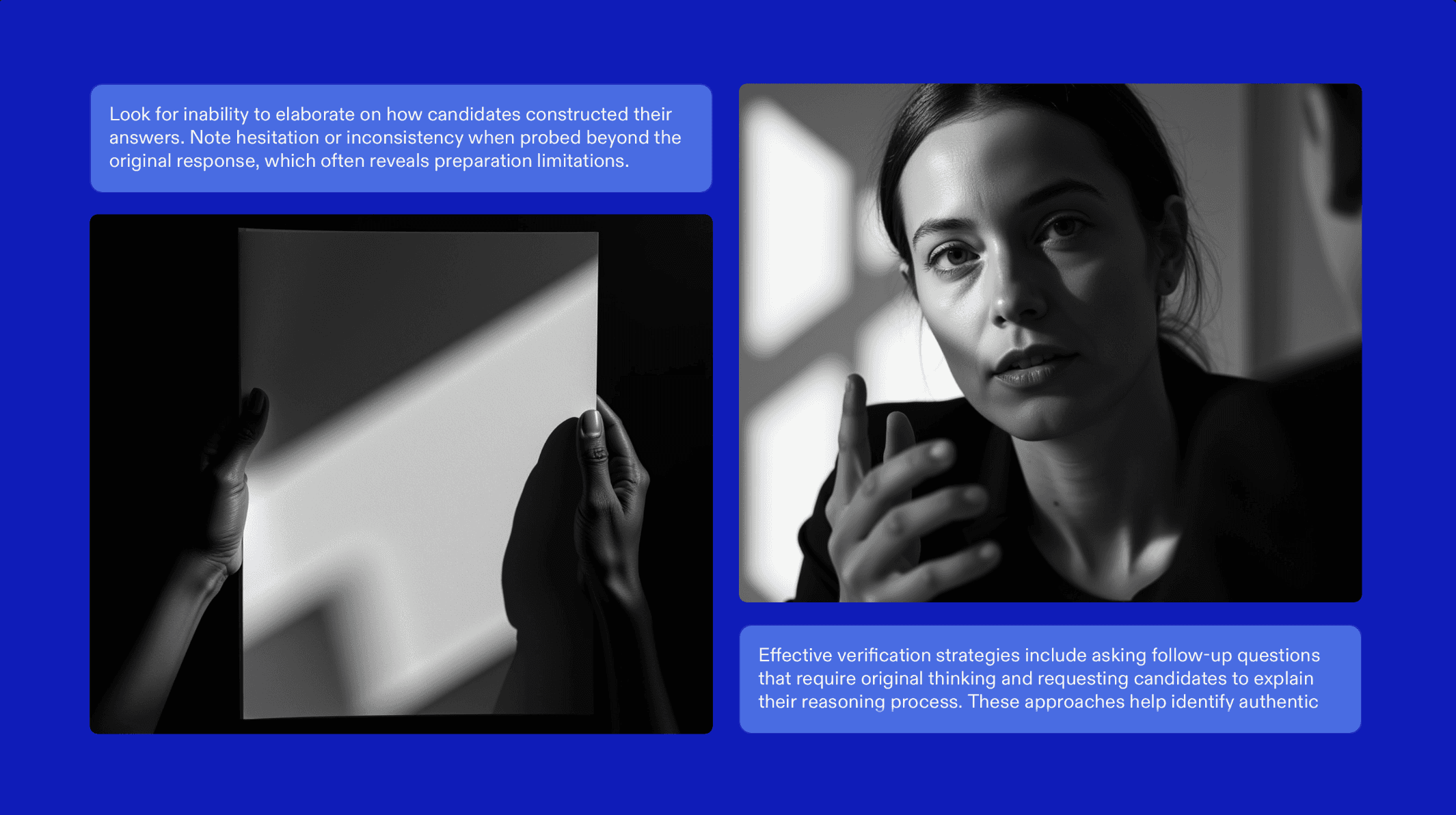
Tip: Ask follow-ups that probe reasoning. If they can’t explain how they built the answer, it may be AI-generated.
2. Zero Hesitation Even on Complex or Unfamiliar Questions
Humans pause, reflect, and sometimes rethink answers, especially when the topic is complex or new. Candidates using invisible AI often answer instantly, with no stutters or hesitation, even on edge cases.
Signs include:
Immediate answers to niche or highly technical prompts
No self-corrections or thoughtful pondering
Same tone regardless of question difficulty
3. Sudden Improvement Compared to Resume or Pre-Screen
If someone’s live performance dramatically outshines their past test scores, coding samples, or resume claims, that’s suspicious. Invisible AI tools can inflate performance in sessions without leaving a trace.
Compare:
Pre-screen coding tests vs. live technical answers
Writing samples vs. live verbal explanations
4. Inconsistent Tone Between Casual and Technical Responses
Humans generally maintain some consistency in voice, phrasing, and expression. Yet candidates assisted by AI may show polished technical language but informal or awkward casual speech.
Patterns to notice:
Technical responses sound like polished documentation
Conversational replies are very different in structure and vocabulary
5. Lack of Natural Thinking Pauses or Self-Corrections
Real people think out loud, backtrack, say “hmm”, and refine. Invisible AI users often don’t show these subtle human artifacts, their answers are too clean.
Human signs usually include:
Hesitation (“Let me think…”)
Mid-sentence edits
Self-questioning before finalizing an answer
How Recruiters Can Actively Detect and Prevent Invisible AI
Recruiters are no longer just fighting visible cheating. Invisible AI demands a new playbook that combines smarter interview design, AI-aware formats, and platform-level intelligence. The goal is not just to catch misuse, but to make AI-assisted cheating ineffective by design.
Here is how hiring teams can take back control.
1. Adaptive Questioning
Instead of static questions:
Dynamically modify questions based on candidate responses
Shift context mid-answer
Ask “why” and “how” follow-ups that require reasoning, not recall
This breaks AI’s ability to pre-generate or pattern-match answers.
2. Real-Time Problem Variation
Use:
Variable constraints
Randomized datasets
Changing parameters
Even if AI assists, it struggles when the problem evolves in real time.
3. Explanation-Based Follow-Ups
Force candidates to:
Justify assumptions
Walk through trade-offs
Explain failures or alternatives
AI can generate outputs, but explaining decision logic in a consistent human manner is significantly harder.
4. Whiteboarding
Asking candidates to build solutions step-by-step exposes:
Their thinking process
Mistakes and corrections
True depth of understanding
Invisible AI excels at answers, not human reasoning flow.
5. Live Debugging
Have candidates:
Debug broken code
Identify edge cases
Fix logic errors under time pressure
AI-generated help becomes much less effective when the problem is imperfect and evolving.
6. Scenario-Based Reasoning
Instead of “What is X?”, ask:
“What would you do if…”
“How would this break in production?”
“How would you redesign this for scale?”
This shifts evaluation from output quality to judgment quality.
Sherlock AI: Detecting Invisible AI in Real-Time Interviews
Sherlock AI is designed specifically to detect stealth AI usage and modern interview fraud that traditional monitoring cannot catch.
Key Features:
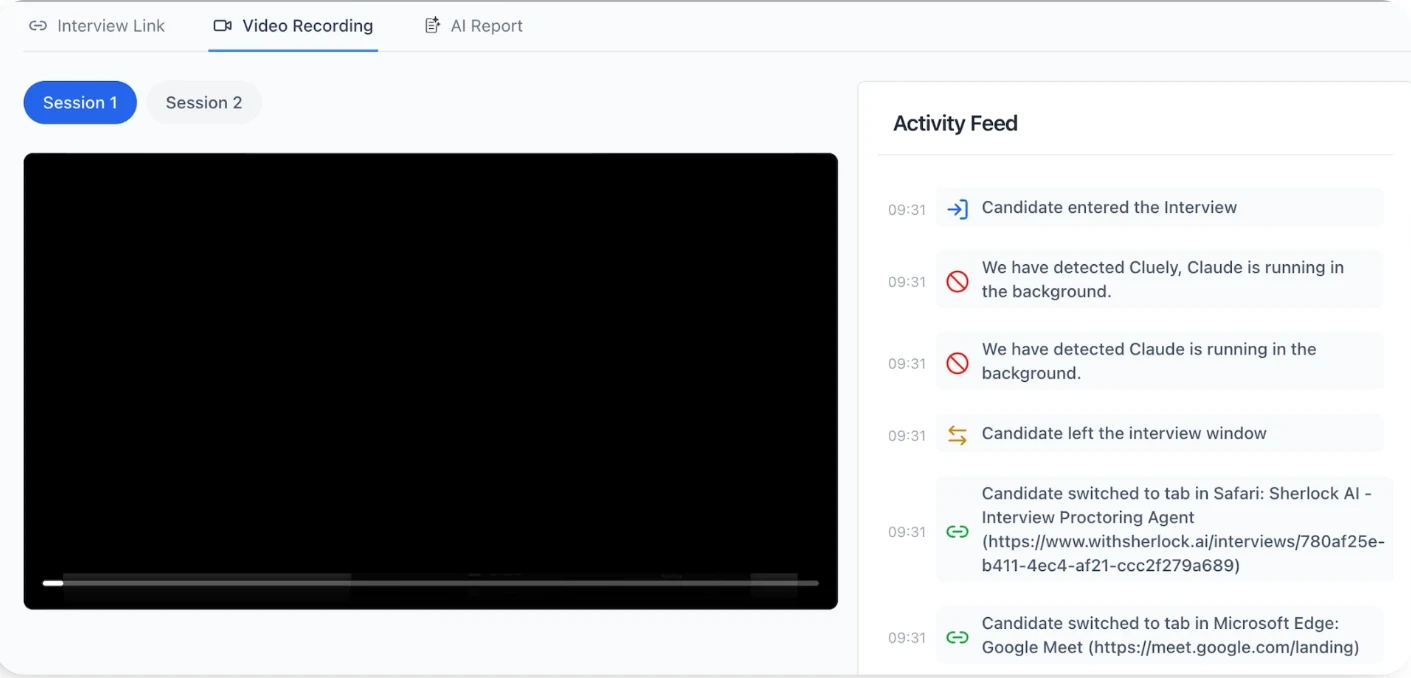
AI Copilot Detection: Identifies candidates using hidden AI copilots and real-time LLM assistants even when no UI or browser activity is visible.
Background AI Monitoring: Detects AI tools running silently in the background, including OS-level assistants and invisible overlays that bypass traditional proctoring.
Proxy Candidate Detection: Flags cases where a proxy or external party is feeding answers or controlling parts of the interview session.
Deepfake & Synthetic Identity Detection: Identifies deepfake video, face swaps, and synthetic identities used to impersonate candidates during interviews.
Audio Path & Voice Manipulation Analysis: Detects virtual audio routing, AI voice bots, and manipulated audio streams commonly used by invisible AI setups.
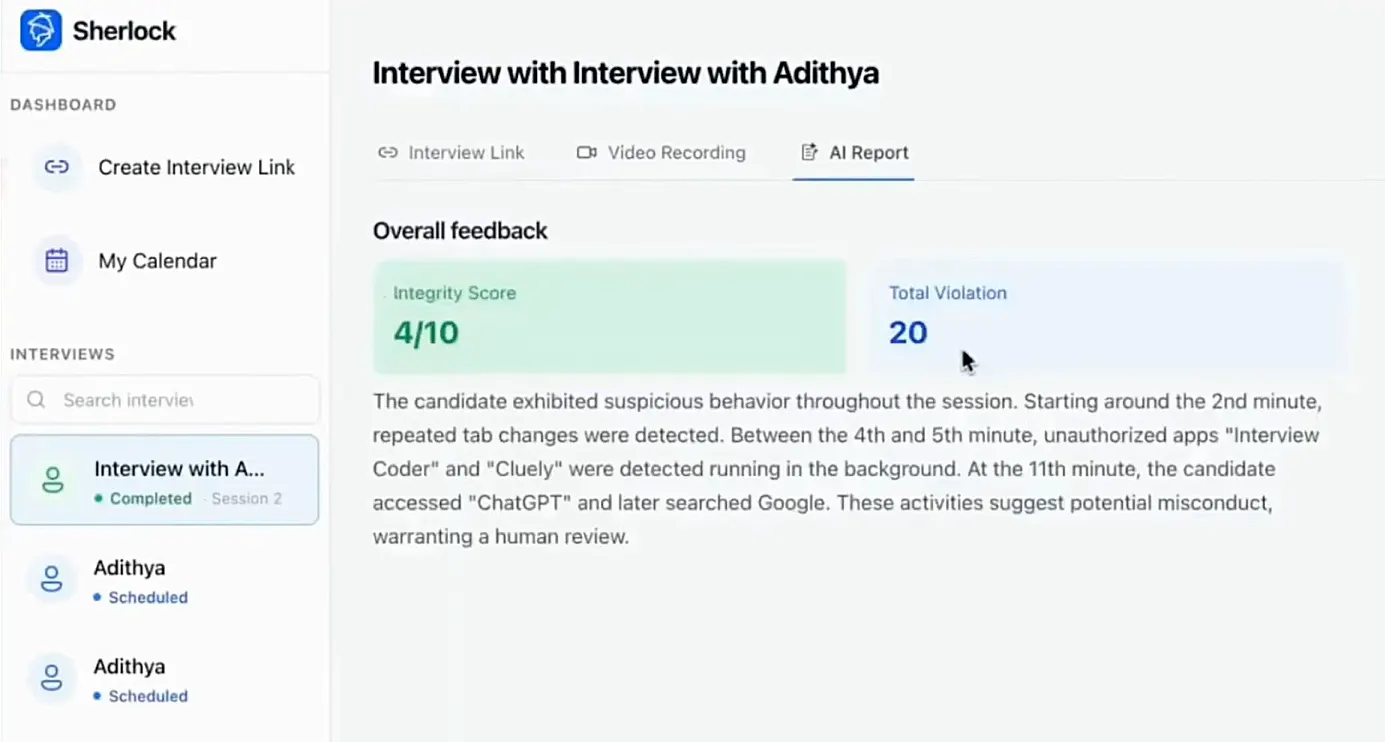
Response Pattern & LLM Signature Analysis: Analyzes language structure, entropy, and timing patterns to match outputs with known AI-generated response profiles.
Screen, Process & Overlay Surveillance: Monitors background processes, hidden apps, and transparent overlays that evade browser-based monitoring.
Latency & Cognitive Mismatch Detection: Flags unnatural response timing and cognitive patterns inconsistent with human reasoning speed.
Session Risk Scoring Engine: Assigns dynamic integrity scores to each interview based on combined behavioral and system-level signals.
Post-Interview Forensic Intelligence: Enables answer similarity detection, linguistic fingerprinting, and cross-session fraud pattern discovery.
Why Sherlock AI Succeeds Where Traditional Proctoring Fails
Traditional tools ask:
“Is the candidate switching tabs or opening a website?”
Sherlock AI asks:
“Does this behavior look human or AI-assisted?”
By focusing on behavioral intelligence instead of surface activity, Sherlock AI is built for the era of invisible AI, voice bots, silent copilots, and background LLMs.
Conclusion
Invisible AI has fundamentally changed how interview cheating works, but it does not have to change how confidently you hire. By combining smarter interview design, AI-aware formats, and AI-powered monitoring like Sherlock AI, recruiters can move beyond surface-level proctoring and detect what truly matters: whether a candidate’s performance is human or AI-assisted. In a world of hidden copilots, proxies, and deepfakes, interview integrity is no longer about watching screens, it is about understanding behavior.