Back to all blogs
Understand how interview fraud contributes to bad hires, wasted resources, and operational issues that quietly accumulate over time.
Abhishek Kaushik
Dec 9, 2025
Hiring fraud is not just a recruiting issue.
It is a performance, retention, and organizational trust issue.
When a candidate:
Uses a proxy interviewer
Uses hidden AI prompting
Repeats memorized scripts they cannot actually execute
The short-term result looks like a successful hire.
But the long-term result is:
Lower productivity
Increased rework and dependency
Team morale damage
Leadership frustration
Higher churn and replacement cost
Sherlock AI prevents these mis-hires by verifying identity and ensuring reasoning comes from the candidate’s own mind.
How Hiring Fraud Creates Mis-Hires
A mis-hire occurs when:
The person who passes the interview is not the person who performs the work.
Fraud introduces signal distortion at the exact moment when hiring decisions are being made.
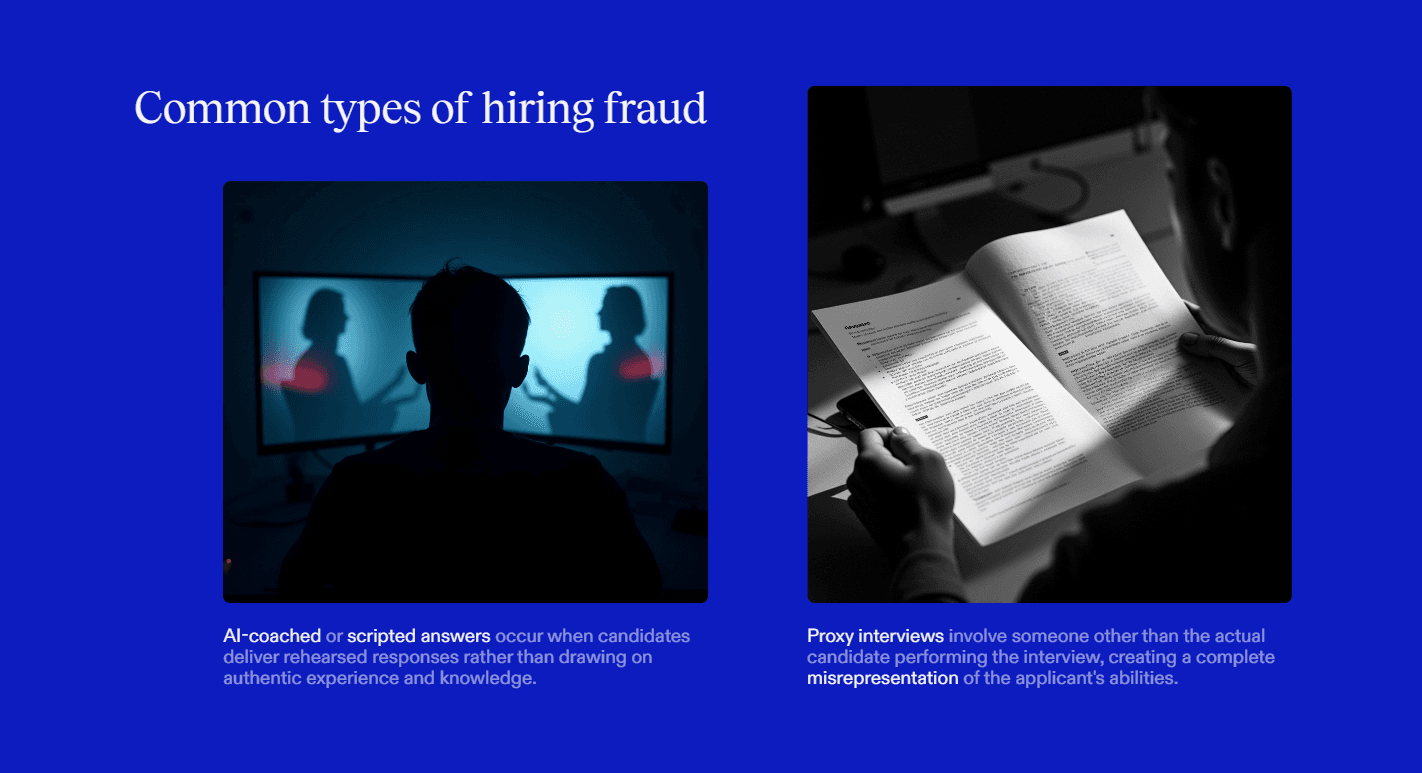
Two common forms:
Proxy Interviews
Someone else performs the interviewAI-Coached or Scripted Answers
Candidate relies on rehearsed reasoning, not real experience
Both lead to the same result:
The interview signals do not reflect real capability.
The Hidden Costs That Follow
1. Rework and Shadow Support
When a fraudulent hire cannot complete tasks independently:
Senior engineers begin stepping in
Managers spend more time unblocking
Work slows down across the team
This is expensive because:
Highly paid contributors get pulled into remediation work
Strategic output is delayed
2. Loss of Trust and Morale
Teams notice skill gaps before leadership does.
When strong contributors see weak hires being protected:
Discretionary effort decreases
Internal respect erodes
High performers exit first
This is not a skill problem.
It is a cultural confidence problem.
3. Increased Turnover Costs
A mis-hire almost always leads to:
Performance management cycles
Coaching plans
Reassignment or quiet offloading
Replacement hiring
Each replacement costs:
Recruiting resources
Interviewer time
Lost roadmap progress
Turnover costs are typically 3x the role’s salary, not including opportunity cost.
4. Manager and Interviewer Burnout
When fraud goes undetected:
Interviewers begin to doubt the hiring process
Managers lose faith in Talent teams
Escalations increase
Blame cycles begin
This increases:
Stress
Conflict
Cross-functional friction
Left unchecked, this becomes cultural rot.
5. Brand Damage in Talent Markets
Once teams or candidates believe:
This company has low hiring standards
the top talent leaves the pipeline.
This is extremely hard to reverse.
Real Example: The “Silent Velocity Collapse”
A fintech startup hired a “senior data engineer” who used a proxy in the live technical interview.
During employment:
They produced minimal working code
They relied on teammates for debugging and architecture decisions
System migrations stalled, sprint cycles extended
Two senior engineers left due to increased load
The team velocity dropped by 38 percent over three quarters
Leadership initially thought the issue was team culture.
Root cause was misrepresentation at interview.
Sherlock AI prevents this by ensuring:
Identity consistency across rounds
Reasoning continuity under varying prompts
Authorship integrity during technical explanation
How Sherlock AI Prevents Mis-Hires and Hidden Cost Spiral
Sherlock AI ensures:
Integrity Layer | Business Outcome |
|---|---|
Identity verification | Proxy interviewing prevented |
Reasoning pattern detection | Scripted and coached answers exposed |
Authorship continuity checks | Real skill confirmed across stages |
Automated notes and scorecards | Higher accuracy and defensibility |
The result:
Fewer mis-hires
Higher team performance
Faster time-to-autonomous output
Stronger trust in the hiring process
This restores signal quality, which restores team confidence.
Conclusion
Hiring fraud is not a minor compliance issue.
It is a major talent, performance, and culture risk.
Mis-hire cost is not just salary.
Mis-hire cost is:
Lost momentum
Lost contributors
Lost trust
Reputation decline
Interview integrity is now a financial and cultural safeguard.
Sherlock AI protects this integrity at scale.