Back to all blogs
Learn how to validate candidate ownership with simple prompts to ensure you're hiring engineers who truly drive results, not just participate.

Abhishek Kaushik
Dec 26, 2025
Most engineering interview loops assume that if a candidate describes a project, they own it.
But ownership cannot be inferred from:
Job titles
Years of experience
Company logos
Project outcomes
Storytelling fluency
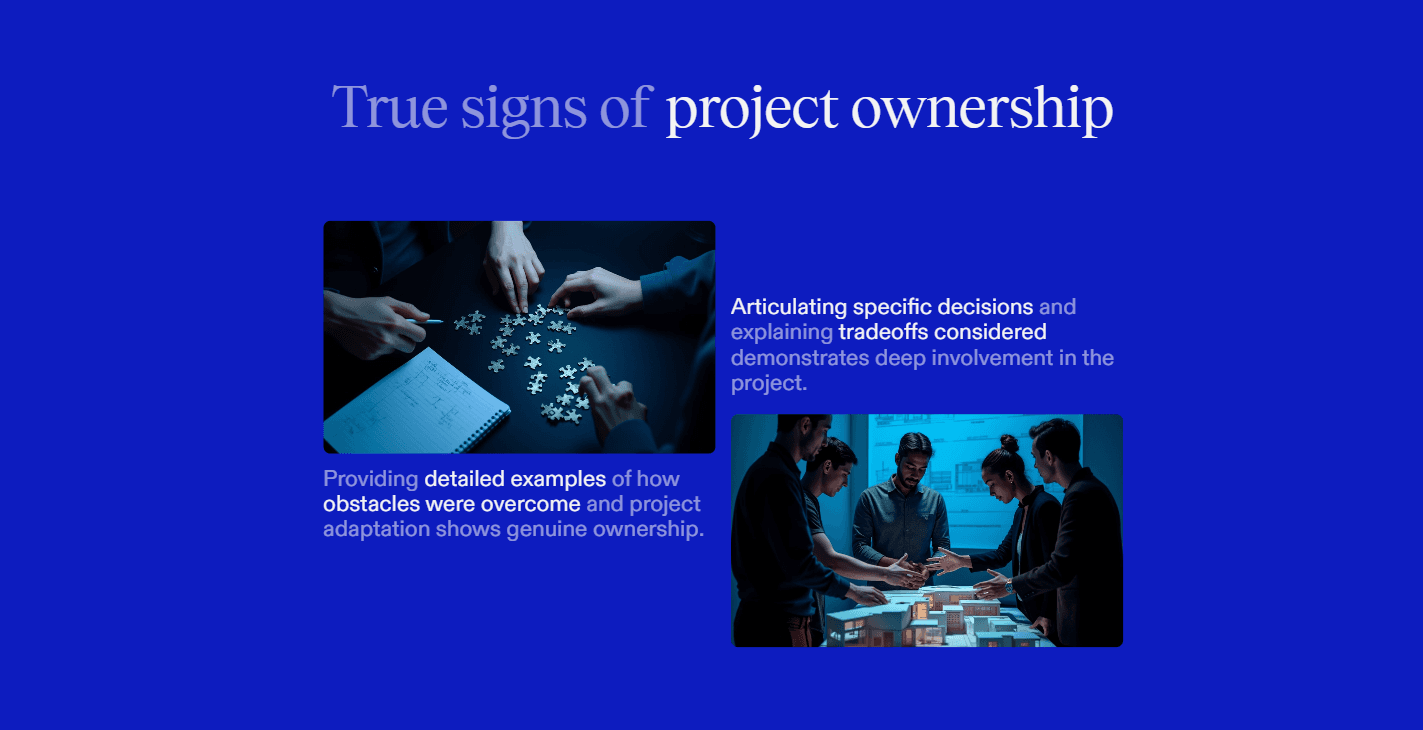
Ownership must be demonstrated through:
Decisions made
Tradeoffs chosen
Adaptations handled when things changed
The good news:
You do not need more interviews to validate this.
You only need better follow-up prompts during the interviews you already run.
Why Ownership Matters More Than Task Participation
The biggest hiring mistake in engineering is:
Selecting people who participated in good work instead of people who drove good work.
Participation = I was present.
Ownership = I shaped the result.
Teams with low-ownership engineers ship slower because decisions stall waiting for someone else to lead.
So the interview must distinguish between contributors and drivers.
Research supports this by showing that ownership significantly improves team effectiveness, proving that taking ownership matters far more than simply participating.
The Ownership Validation Principle
Ownership is revealed through:
Decision-making
Tradeoff reasoning
Adjustment under pressure
Not through:
Descriptions of what the team did
Technology name-dropping
Polished project summaries
So your interviewers need to learn to probe for decision nodes.
The Three Ownership Verification Prompts
Use these in any project discussion, system design interview, or code walkthrough.
Prompt 1: Decision Clarity
Which part of this solution did you personally decide?
Look for:
Clear articulation of decision points
Why were those decisions made
How alternatives were considered
Red flags:
“We decided as a team.”
“The architect chose that.”
“It was already determined when I joined.”
Prompt 2: Tradeoff Explanation
What other approaches did you consider, and why did you choose this one?
Real ownership requires:
Evaluating alternatives
Justifying direction
Understanding the impact of different choices
Memorized or coached answers:
Present only the final answer
Avoid discussing alternatives
Cannot explain why the choice mattered
Prompt 3: Adaptation Under Change
What changed and how did your approach have to adjust?
Every real engineering project experiences change:
Scope shifts
Latency surprises
Budget constraints
Performance regressions
Incident recovery learning
If no change is described, the candidate likely was not leading.
How to Validate Ownership in System Design Interviews
Replace:
“Tell me how you would design X.”
With:
“Walk me through a time you actually built something similar.”
Then apply the three prompts above.
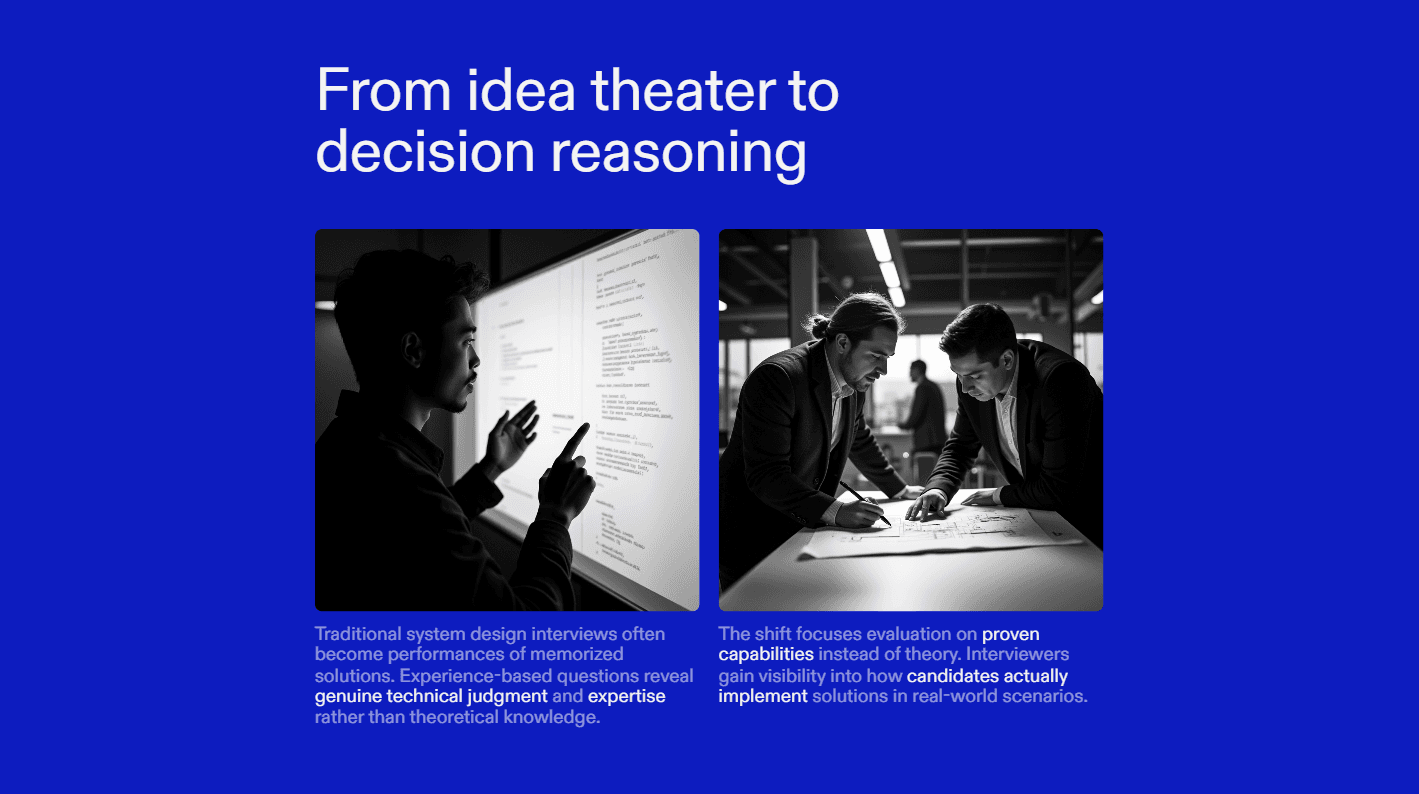
This shifts system design interviews from:
Idea theater
ToReal decision reasoning
How to Validate Ownership in Code Interviews
Ask candidates to:
Explain why you wrote the solution in this way instead of another reasonable approach.
Then ask:
What would break if we changed one of the assumptions?
Ownership shows up not in code correctness but in:
Understanding failure points
Understanding data movement
Understanding performance interactions
How to Validate Ownership in Behavioral Interviews
Behavioral questions become effective when you anchor the conversation to decisions, not outcomes.
Replace:
Tell me about a time you led something
With:
Tell me about a time you made a decision other people disagreed with.
This reveals:
Confidence
Influence
Principle-based reasoning
True ownership behavior.
How to Document Ownership in ATS Notes (Bias Safe)
If ownership cannot be validated:
This protects:
Fairness
Auditability
Manager trust
The Best Part: This Adds Zero Time to Your Process
You are:
Not adding interviews
Not adding steps
Not adding tools
You are:
Redirecting questions from what happened to how the candidate thought
This is the fastest possible quality upgrade in technical hiring.
Conclusion
Ownership is the real signal of engineering maturity.
It reveals:
Judgment
Responsibility
System thinking
Ability to drive outcomes in real constraints
Validating ownership does not require complexity.
It requires:
Better prompts
Better listening
Better documentation
Once your interviewers learn to evaluate decision-making, your hiring process becomes:
More accurate
More fair
More predictable
More scalable
Ownership is how great engineering cultures sustain themselves.