Back to all blogs
AI interview cheating is quietly driving bad hires and hurting business performance. Learn how to detect and stop it early.
Abhishek Kaushik
Feb 10, 2026
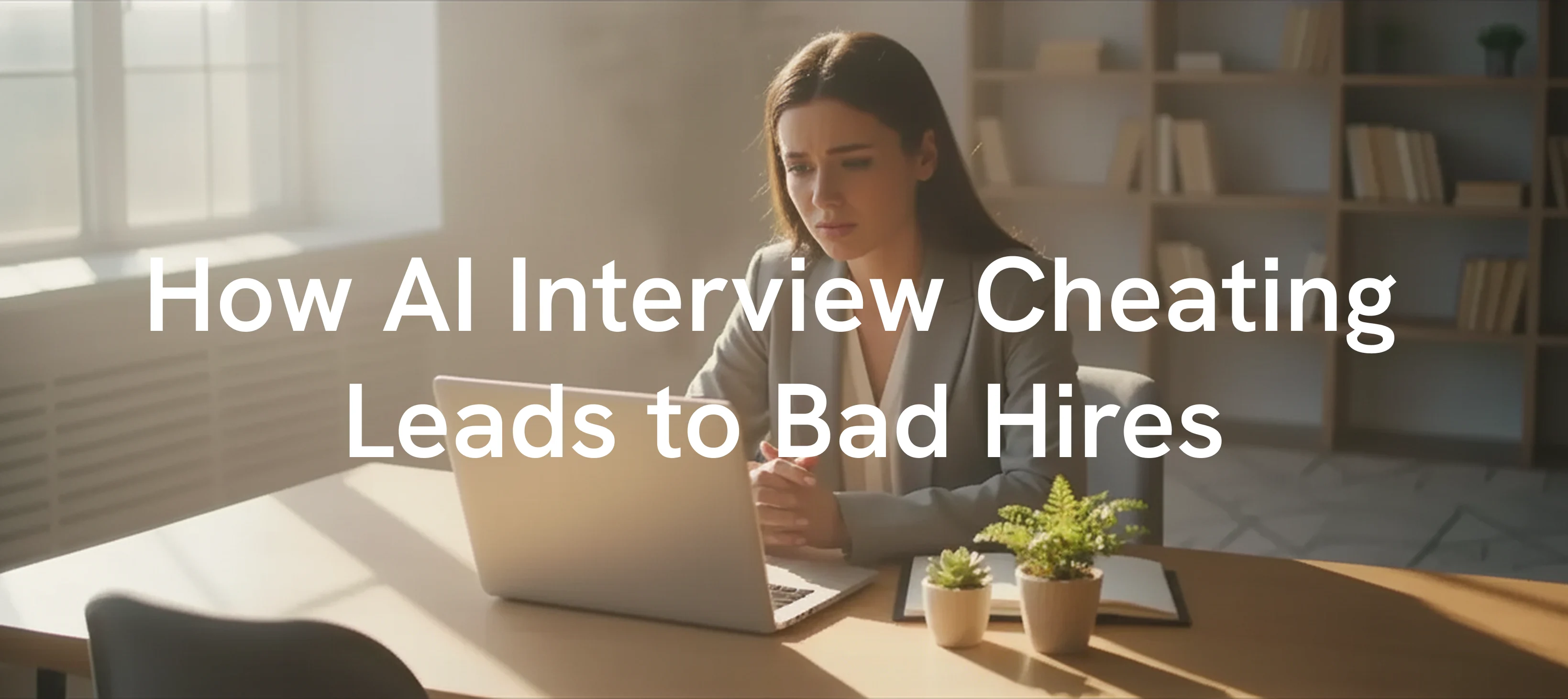
The rise of artificial intelligence has introduced an unexpected problem: AI-assisted interview cheating is undermining the integrity of recruitment and contributing to costly bad hires. A survey of verified professionals found that about 1 in 5 employees admitted to using AI tools during job interviews, with over half agreeing that such assistance has become the “new norm” in recruitment.
Broader industry research shows that 72% of recruiters report encountering AI-generated fake resumes, portfolios, or credentials, and recruiters have even encountered deepfake or identity fraud during video interviews.
When candidates use AI to inflate their interview performance, organizations end up hiring people with misrepresented skills or capabilities. This causes firms to face underperformance, onboarding setbacks, and team disruption down the line.
In this blog, we’ll explore why AI interview cheating leads to bad hires, and what modern hiring teams must do to protect the fidelity of their talent pipelines.
How AI Interview Cheating Distorts Hiring Signals
Bad hires begin when interviews stop reflecting real skill.
The moment AI starts shaping candidate responses, the interview ceases to be a measure of human capability and becomes a test of who has the better AI setup.
1. AI inflates candidate performance
Modern AI cheating isn’t about looking up answers mid-call anymore. Candidates now use:
AI copilots that listen to questions and generate answers in real time
Hidden LLMs running in the background with audio-routing and screen overlays
Second-screen or parallel device setups feeding candidates polished responses instantly
These tools allow candidates to perform far above their true skill level not because they understand the problem better, but because AI is solving it for them.
2. Apparent competence vs actual capability
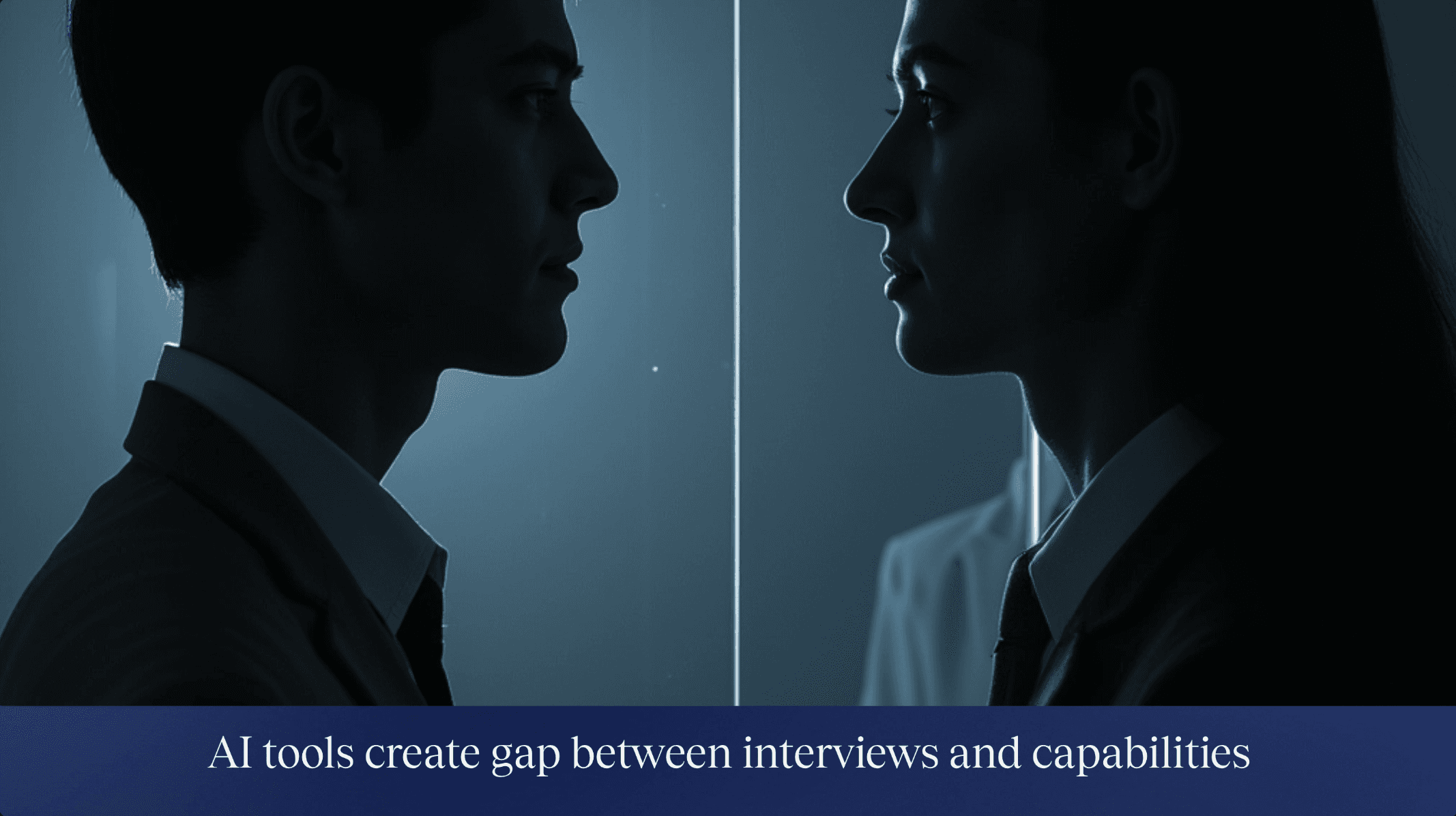
This creates a dangerous gap between:
Apparent competence: What the interviewer sees - articulate, confident, technically sound responses
Actual capability: What the candidate can truly do independently on the job
In traditional hiring, performance in interviews roughly correlated with on-the-job success. AI breaks this relationship. A candidate can now sound senior while performing at a junior level once hired.
3. Good questions are no longer enough
For years, companies improved hiring by:
Using structured interviews
Asking scenario-based questions
Adding technical and behavioral rounds
But AI now:
Generates model answers for even complex, open-ended questions
Adapts instantly to interviewer follow-ups
Mimics natural language patterns convincingly
This means that even well-designed questions no longer guarantee authentic signals because the answers may not belong to the candidate at all.
Direct Business Cost of Bad Hires Caused by AI Cheating
AI-assisted interview cheating is a measurable business risk.
When candidates use AI to inflate their interview performance, hiring teams can end up onboarding people whose real capabilities don’t match expectations. The consequence? Damage that shows up in productivity, team performance, costs, and long-term revenue.
1. AI-Assisted Candidates Fail in the Real World
Candidates who relied on AI to navigate interviews often struggle once in role. They may be unable to independently solve problems they once “answered” smoothly, leading to:
Increased dependency on teammates
Delayed ramp-up times
Poor performance when AI isn’t readily available
This gulf between interview performance and real on-the-job capability fuels wasted time and effort.
2. Quantifying the Cost of a Bad Hire
Bad hires are expensive even before factoring in AI-specific cheating.
According to the U.S. Department of Labor, a bad hire can cost your business 30 percent of the employee’s first-year earnings. Some human resources agencies estimate the cost to be higher, ranging from $240,000 to $850,000 per employee.
These figures underscore that bad hires are material operational risks.
3. Impact on Time-to-Productivity
Even good hires typically take weeks to fully ramp up. Research suggests employees may take around 24 weeks to reach optimum productivity in their first year.
When a hire underperforms due to misrepresented ability, this ramp-up period gets stretched, pulling down team velocity and delaying deliverables.
4. Team Performance Drag and Morale
Poor performers affect everyone around them. Studies show:
Teams with one underperformer can see 30–40% lower overall productivity.
Bad hires contribute to stress and disengagement among coworkers, with many teams reporting measurable morale decline.
These impacts make it harder for teams to hit targets, innovate, and retain top talent.
5. Rework, Missed Delivery, and Customer Impact
When work quality is compromised, the cost multiplies:
Projects slip timelines
Customers experience delays or service issues
Teams spend time correcting errors rather than building new value
Underperforming employees can even damage client relationships, leading to lost revenue, a loss that hits both short-term results and long-term reputation.
6. Attrition and Rehiring Costs
A bad hire often requires replacement twice: once for the original hire and again for the replacement. Recruiting alone can cost thousands per role, and replacing a departure can reach 6–9 months of the employee’s salary in total turnover cost.
7. Remote Hiring Amplifies the Risk
Remote hiring environments make these costs scale faster than ever.
A recent industry report found that 59% of managers have suspected candidates of using AI or deceptive tactics during hiring, and only about 19% feel confident their current processes would reliably catch fraudulent applicants.
That means hiring teams may be letting through high proportions of candidates whose real competence will never materialize, magnifying all the costs above.
Why Traditional Proctoring No Longer Works
Most companies still rely on a combination of resumes, interviews, coding tests, and video proctoring to ensure candidate quality. Unfortunately, these controls were built to catch traditional fraud, not AI-mediated deception.
Resumes are easily AI-generated or enhanced, often containing projects, skills, or experience the candidate cannot demonstrate independently.
Coding tests and take-home assignments are widely solved using AI tools, especially when unsupervised or asynchronous.
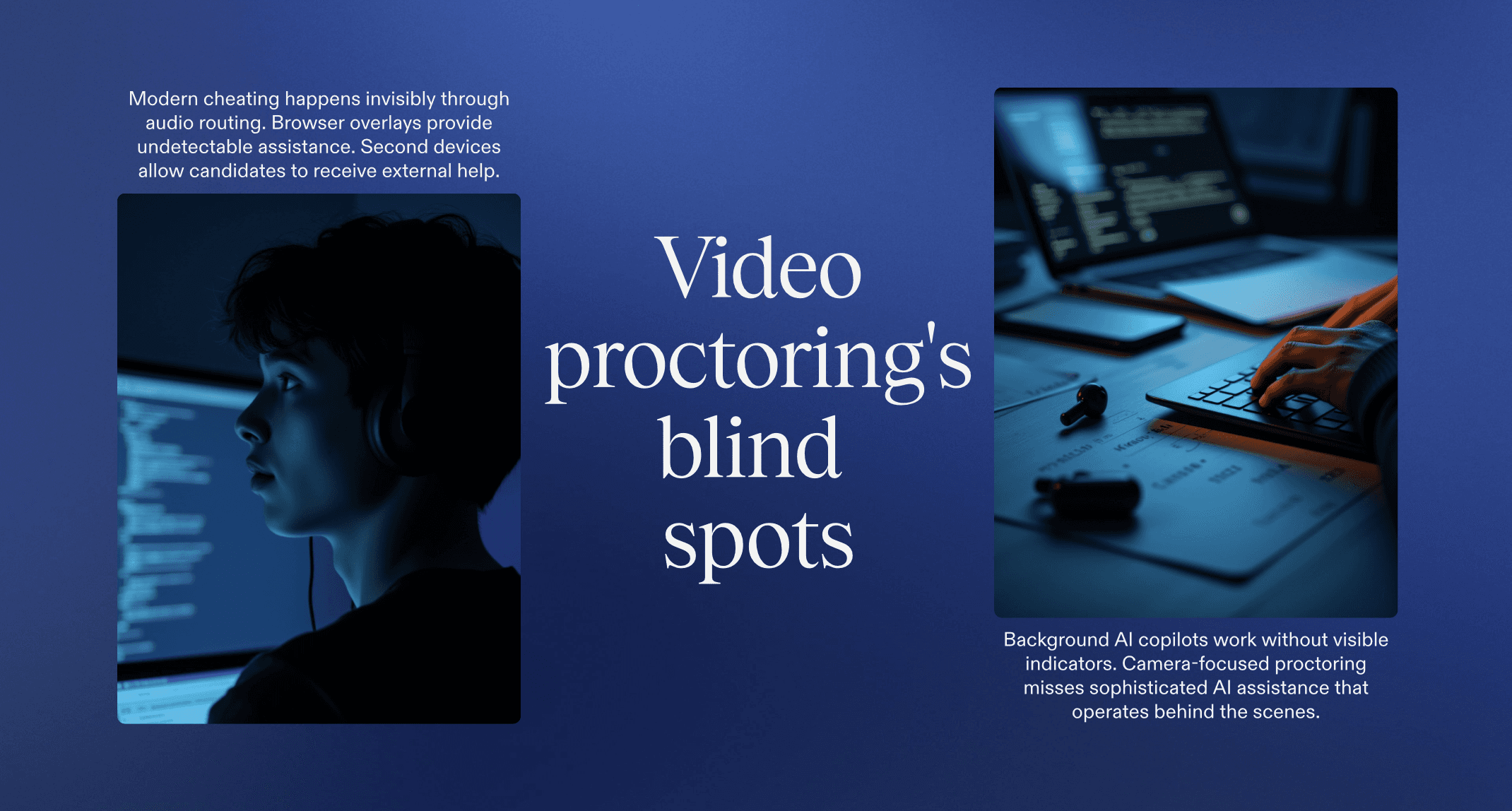
Video proctoring and camera-on policies focus on visible behavior, but AI cheating increasingly happens invisibly through audio routing, browser overlays, second devices, and background copilots.
In an AI-powered world, preventing bad hire is about validating that the answers truly belong to the candidate.
Because once a bad hire enters your company:
The cost is locked in
The disruption has begun
And the damage is already done
The only scalable solution is stopping bad hires before they cross the offer stage and that requires systems built to catch AI-era fraud.
Sherlock AI: The Ultimate Solution to Prevent AI-Driven Bad Hires
Sherlock AI doesn’t rely on surface-level signals. It focuses on behavioral truth, using multiple layers of detection that modern AI cheating cannot easily bypass.
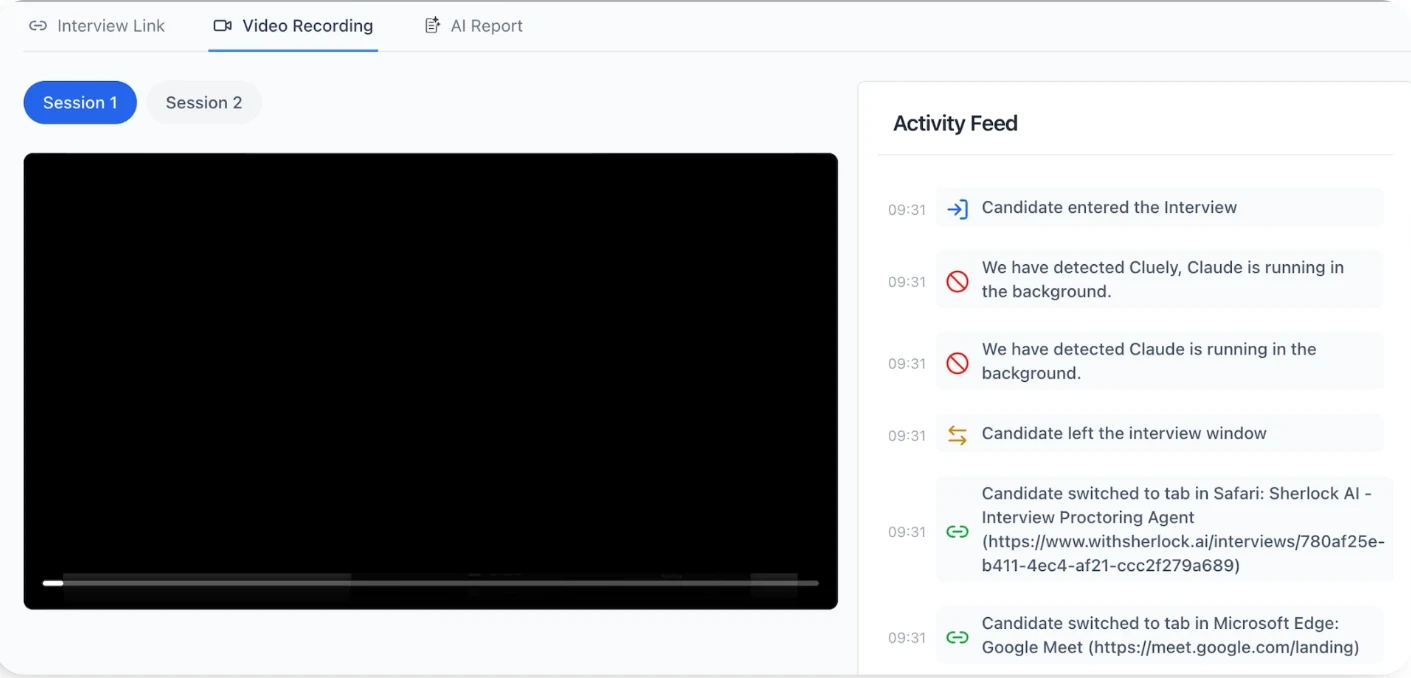
Unlike tools that operate before or after interviews, Sherlock AI works inside the interview itself, where the actual hiring signal is formed. It sits silently in Zoom, Microsoft Teams, or Google Meet and continuously validates that what you’re seeing and hearing truly comes from the candidate
Key Features:
In-Interview AI Fraud Detection: Monitors interviews live inside Zoom, Teams, and Google Meet to detect cheating as it happens.
Impersonation & Proxy Detection: Identifies stand-ins, deepfake attempts, and identity inconsistencies across interview rounds.
External Assistance Detection: Flags real-time AI usage, second-screen prompting, background LLMs, and hidden copilots.
Voice & Identity Consistency Tracking: Ensures the same candidate is present throughout the interview with stable voice and identity patterns.
Response Authenticity Analysis: Detects scripted, AI-generated, or templated answers that lack human originality.
Behavioral Signal Analysis: Evaluates response timing, hesitation patterns, and cognitive load to distinguish genuine thinking from AI-mediated replies.
Skill Misrepresentation Detection: Identifies mismatches between claimed expertise and demonstrated ability during live questioning.
Non-Intrusive & Invisible Operation: Runs silently without interrupting interviews or degrading candidate experience.
Works Across Interview Formats: Supports technical, behavioral, and leadership interviews.
Real-Time Alerts & Risk Scoring: Provides recruiters with actionable fraud signals and interview integrity scores.
Post-Interview Forensics & Audit Trail: Enables compliance, internal review, and hiring decision justification.
Enterprise Scalability: Supports high-volume remote hiring without sacrificing detection accuracy.
AI has changed how candidates present themselves. Sherlock AI changes how companies verify them.
In short, Sherlock AI doesn’t just catch cheating, it restores reliability to hiring decisions in an AI-disrupted world.
Conclusion
AI has changed what interviews reveal and what they can hide. When candidates use AI to inflate their performance, bad hires stop being random mistakes and start becoming systemic risks.
The only way forward isn’t better questions, but better verification.
Sherlock AI ensures hiring decisions are based on real human capability, not AI-assisted performance - protecting teams, performance, and long-term growth.
Because in the AI era, hiring right matters more than hiring fast.