Back to all blogs
Understand how humans and AI will work together in future job interviews, and what this shift means for fairness, efficiency, and candidate experience.

Abhishek Kaushik
Dec 3, 2025

AI is not replacing interviews.
AI is changing what interviews measure.
The question is no longer: Can the candidate answer well?
The real questions are:
Does the candidate understand the work behind the answer?
Does the candidate adapt when the situation changes?
Is the candidate actually the one doing the thinking?
AI can elevate strong candidates and camouflage weak ones.
The future of interviewing requires balanced collaboration:
Human judgment focused on reasoning and decision-making
AI assistance focused on documentation, fairness, and integrity
Sherlock AI plays the role of the integrity layer that keeps this collaboration honest.
The Hiring Signal Is Changing
Before AI, interviews used to measure:
Skill recall
Verbal clarity
Confidence
Familiarity with frameworks
Ability to perform under pressure
AI has made these signals less predictive.
Today:
A candidate can sound correct but not be capable.
A candidate can produce working code without being able to fix or adapt it.
A candidate can tell a perfect leadership story generated from a coaching script.
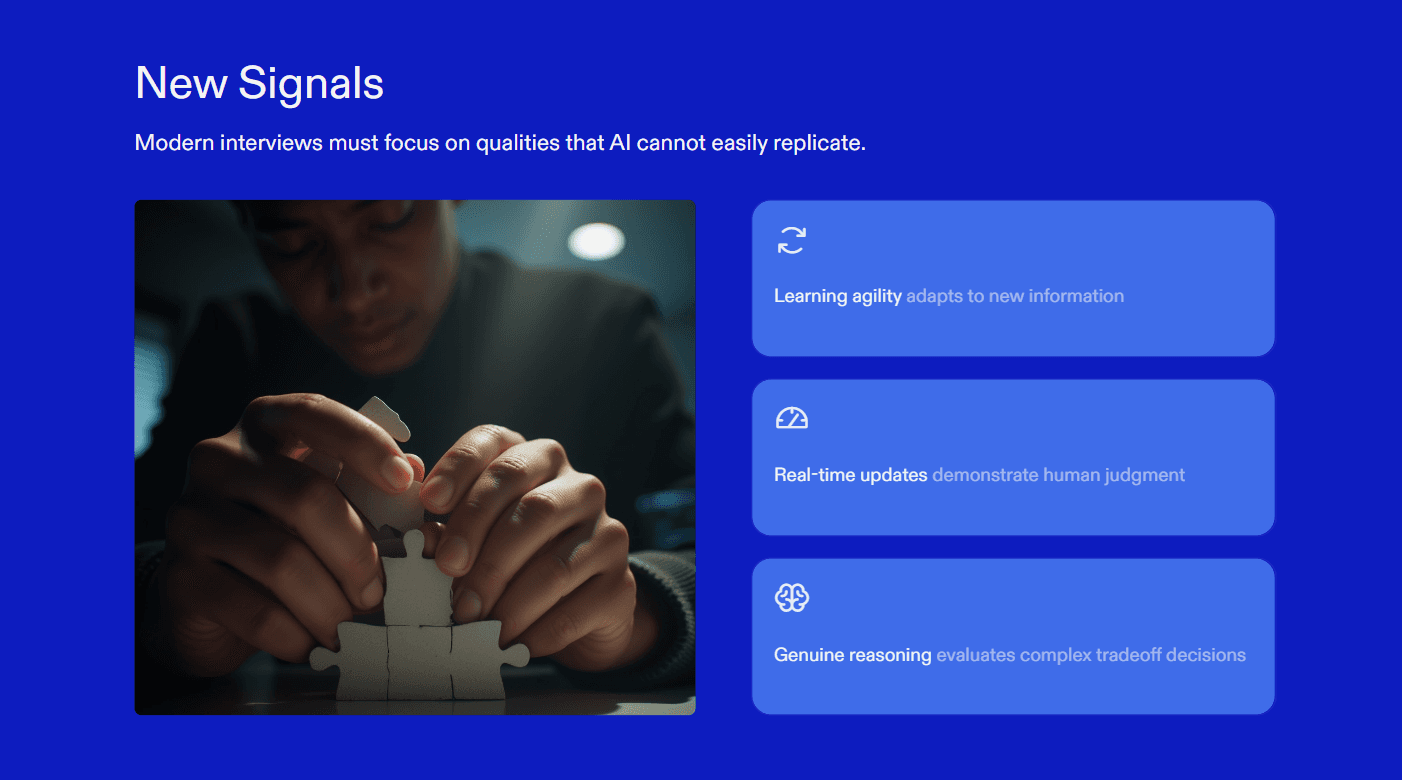
So interviews now need to measure something else:
Real reasoning
Tradeoff thinking
Learning agility
Ability to update mental models in real time
These are signals that AI cannot replicate convincingly.
The Human Role: Listening for Reasoning Patterns
Human interviewers are uniquely good at:
Detecting judgment
Understanding motivations
Evaluating sense-making
Interpreting nuance in how decisions are made
Humans are not good at:
Note-taking while thinking
Maintaining structured evaluation under pressure
Consistency across interviews
Spotting subtle coaching or proxy behaviors
So humans should not carry the cognitive load of:
Data capture
Enforcement
Pattern comparison
Fraud detection
Humans should carry:
Interpretation
Curiosity
Follow-up question elegance
Insight extraction
This is how interviews become deep and meaningful again.
The AI Role: Integrity, Structure, and Transparency
AI is exceptionally good at:
Capturing complete interview transcripts
Extracting decision points
Summarizing reasoning patterns
Detecting unusual behavioral or authorship signals
But AI should not:
Decide who to hire
Score humans directly
Replace judgment or context
The AI layer should:
Preserve identity continuity
Highlight reasoning authenticity
Show where answers collapse under change
Support interviewer awareness, not replace it
This is what Sherlock AI is designed to do.
Where Sherlock AI Brings Balance
Sherlock AI does three things that restore fairness without reducing humanity:
1. Protects Identity and Authorship
Confirms the candidate is the one actually thinking and responding
Detects whisper coaching, proxy collaboration, or deepfake masking
This protects honest candidates, not companies alone.
2. Reveals Reasoning vs Recitation
Sherlock AI surfaces:
Where the candidate is thinking
Where the candidate is repeating
Sherlock AI does not punish AI use.
It distinguishes between AI as a support and AI as a substitute for cognition.
3. Frees Interviewers to Actually Listen
With:
Note automation
Structure prompts
Tradeoff evaluation cues
Interviewers no longer split attention between:
Evaluating
Typing
Tracking criteria
Remembering follow-ups
They can listen deeply, which is where real signal comes from.
The Human + AI Collaboration Loop
Step | Human Does | AI Does |
|---|---|---|
Understand context | Defines what matters in the role | Provides guided question flow |
Ask questions | Follows curiosity | Tracks structure and time |
Evaluate reasoning | Looks for judgment and adaptability | Highlights coherence breaks |
Make decision | Chooses based on evidence | Summarizes patterns neutrally |
AI supports rigor.
Human supports meaning.
This produces:
Better hires
Lower bias
Higher trust
Stronger cultural alignment
The Shift Recruiters and Hiring Managers Must Make
Recruiters will win by:
Learning to recognize reasoning signals
Asking adaptive follow-up prompts
Guiding managers away from "confidence = competence"
Hiring managers will win by:
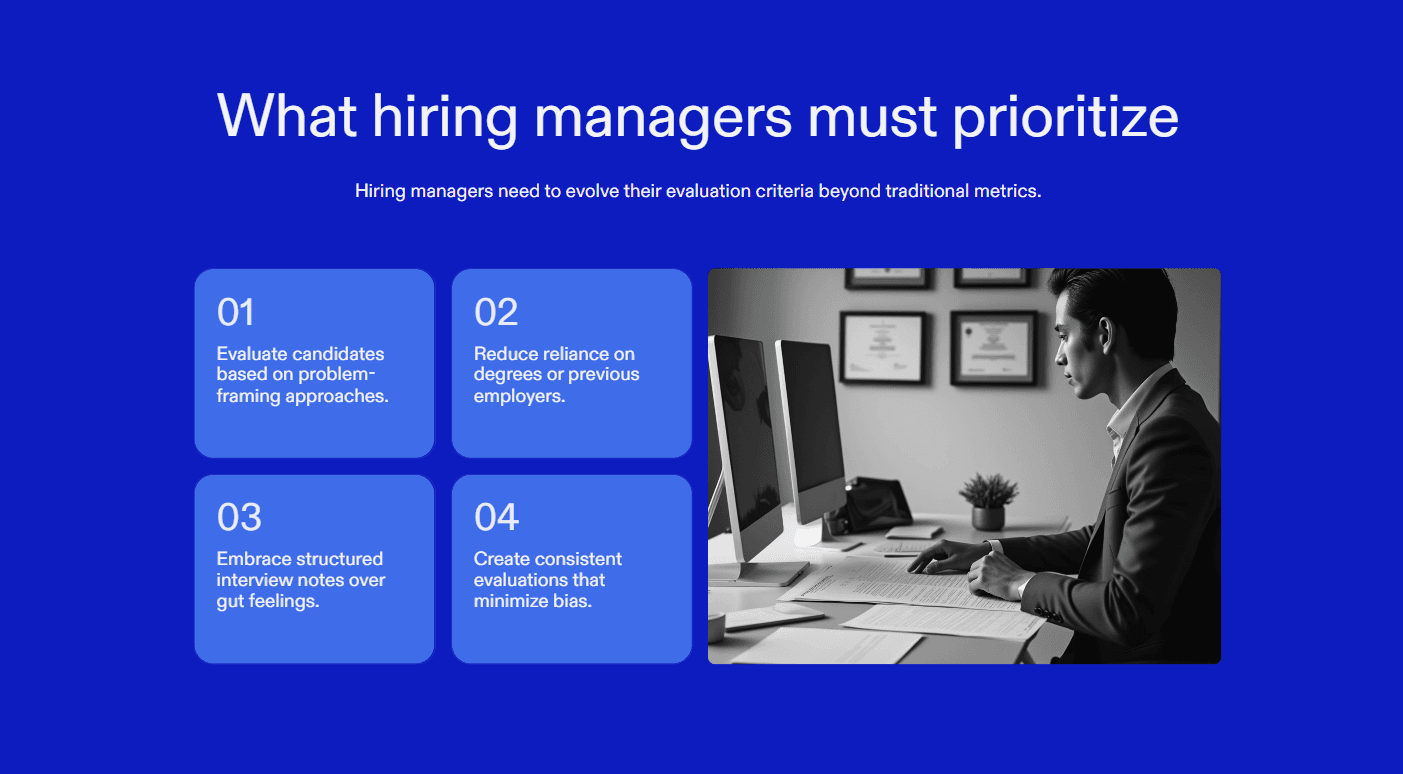
Prioritizing mental models and problem framing
Reducing overreliance on resume proxies
Trusting structured interview documentation
The organizations that shift earliest will outperform.
Conclusion
The future of interviewing is not:
Human-only
AI-only
It is:
Humans evaluating reasoning
AI maintaining integrity and consistency
Sherlock AI creates the trust layer that makes this sustainable:
Candidates feel respected
Interviewers feel supported
Decision-making becomes evidence-based
This is not just more efficient hiring.
This is more human hiring.