Back to all blogs
Gain insight into virtual non-verbal behaviors that may suggest dishonesty and how to assess them fairly during interviews.

Abhishek Kaushik
Dec 5, 2025
Most guides on detecting dishonesty focus on facial expressions, eye contact, or posture.
These signals are highly unreliable in virtual environments and vary across cultures, neurotypes, and stress responses.
Real indicators of dishonesty come from cognitive and coordination patterns:
Breakdown in reasoning when details change
Inconsistent ownership language
Micro-delays associated with unseen coaching
Difficulty re-explaining concepts in different words
The goal is not to catch someone.
The goal is to understand whether the thinking being presented is actually their own.
Sherlock AI assists by analyzing continuity, authorship consistency, and reasoning structure.
First, What Not to Do
Do not assume dishonesty based on:
Eye contact
Accent
Nervousness
Webcam setup
Filler words
Pauses
These vary by:
Culture
Disability and neurodivergence
Language familiarity
Stress response profiles
There is no scientifically reliable correlation between eye movement and deception.
So we use cognitive and behavioral evidence, not vibe-based interpretation.
The Reliable Signals to Observe in Virtual Interviews
1. Ownership Language
Dishonest or embellished responses often avoid clear responsibility.
Honest Candidate | Dishonest or Scripted Candidate |
|---|---|
"I decided to" | "We moved forward with" |
"The part I owned was" | "The team handled that" |
"I made the call because" | "The decision was made" |
This pattern shows ownership vs deflection.
2. Response Continuity
In virtual interviews, watch how answers unfold when conditions shift.
Ask:
What if a key constraint changed?
Honest candidates:
Adapt fluidly
Maintain narrative coherence
Scripted candidates:
Restart the entire story
Lose sequence
Revert to memorized frameworks
This tests real mental modeling vs rehearsed storytelling.
3. Micro-Timing Irregularities Suggesting External Prompting
Remote interviews can mask hidden collaboration.
Signals include:
Slight latency before answering predictable questions
Sudden speech fluency shifts mid-sentence
Frequent downward glances toward a second screen
Typed or whispered cues in sync with answer phrasing
Sherlock AI detects:
Timing anomalies
Context-switch lag patterns
Voice rhythm mismatches
This reduces the burden on interviewer assumptions.
4. Explaining the Same Concept Twice in Different Words
Ask:
Could you explain that another way?
Honest candidates:
Reconstruct reasoning easily
Simplify or expand naturally
Scripted candidates:
Repeat the same phrases verbatim
Struggle to adapt to new wording
Lose thread coherence
This reveals internalized understanding vs performed recall.
5. Consistency Across Interview Stages
Dishonest answers often collapse later when:
A different interviewer asks the same topic
The candidate has to show practical reasoning
Constraints shift during a scenario exercise
Sherlock AI maintains identity and reasoning continuity across rounds.
This removes:
Bias
Guessing
Accusation-based detection
Why These Cues Work
Deception in interviews is cognitively expensive.
It requires monitoring:
The story being told
The story previously told
The version believed the interviewer wants
Real experience is easy to retrieve.
Invented or coached experience is hard to update.
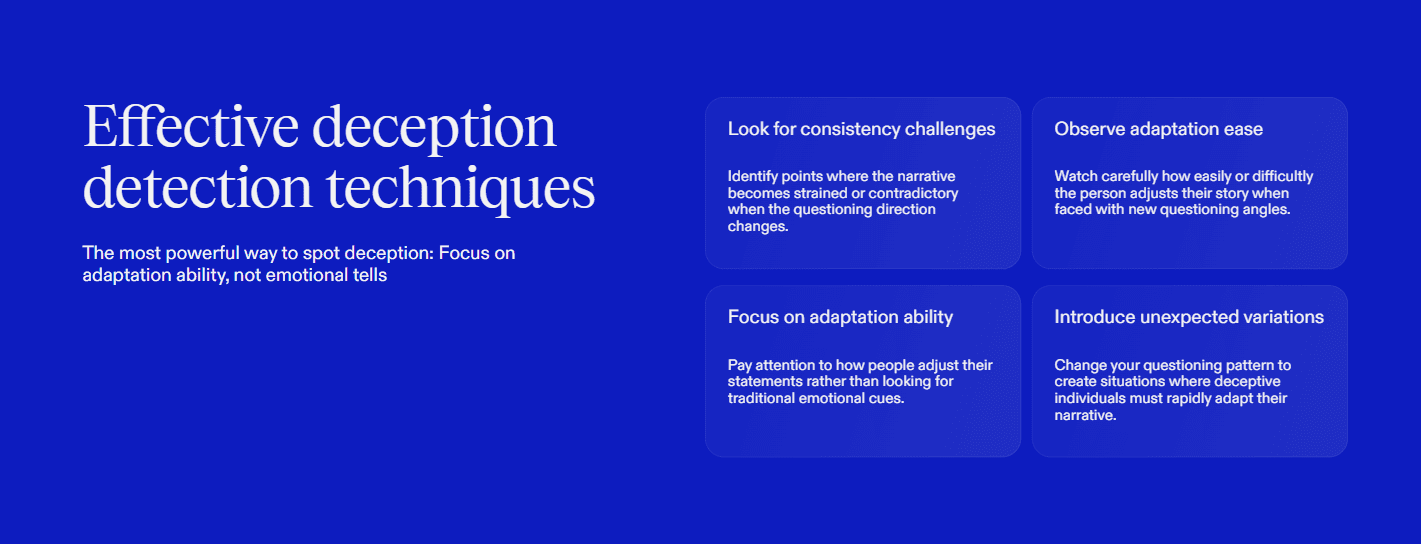
So the strongest detection method is:
Introduce variation and observe adaptation, not emotional expression.
How Sherlock AI Helps
Sherlock AI observes:
Voice and timing coherence
Authorship continuity across sessions
Reasoning stability under follow-up questions
Behavioral mismatches suggestive of external prompting
Sherlock AI does not:
Judge personality
Interpret emotions
Score candidate affect
It focuses on thinking, not performance, which preserves fairness.
Conclusion
Non-verbal cues in virtual interviews are not about posture or eye contact.
They are about:
Ownership clarity
Reasoning adaptability
Narrative stability
Continuity of thinking under change
Dishonesty reveals itself through cognitive inconsistencies, not facial expressions.
Sherlock AI ensures interviewers can focus on:
Listening deeply
Asking meaningful follow-ups
Making fair, evidence-based decisions
Without needing to “play detective.”