Back to all blogs
How to detect AI-Assisted Candidates in Interviews and identify external AI use through reasoning depth, follow-up behavior, and consistency signals.

Abhishek Kaushik
Jun 17, 2026
Remote interviews are now a core part of hiring across roles and industries. At the same time, AI tools have made it easier for candidates to receive real-time assistance during interviews. This shift has created a new challenge for interviewers: distinguishing between a candidate’s true ability and answers influenced by external tools. Surveys show that nearly 4 in 10 job candidates (39%) used AI during the application process, including generating answers to assessment questions, resumes, and cover letters.
Spotting AI-assisted candidates does not require policing or surveillance. It requires understanding how authentic thinking shows up in conversation and recognizing patterns that suggest reliance on AI rather than independent reasoning.
Why AI Assistance Changes Interview Signals
Interviews are designed to evaluate how candidates think, reason, and make decisions. When AI assists in real time, interviewers are no longer evaluating the candidate’s judgment or problem-solving skills. Instead, they are reacting to polished output generated elsewhere.
AI-assisted candidates may appear confident, articulate, and technically sound. The challenge is that these surface signals can mask gaps in understanding that only emerge through deeper interaction.
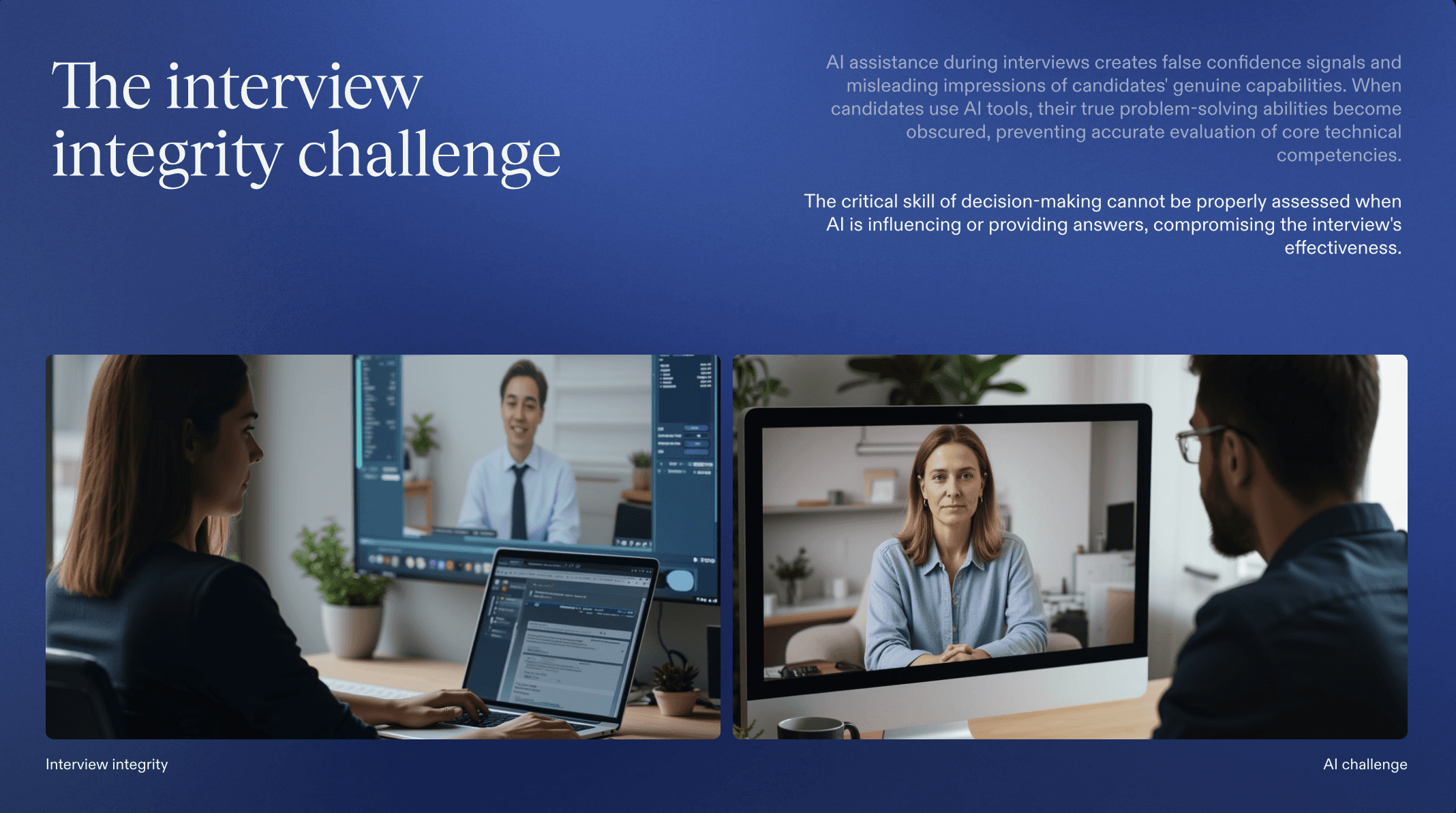
Common Indicators to Detect AI-Assisted Candidates in Interviews
AI-assisted interview behavior is rarely obvious in isolation. Instead, it appears through repeated patterns that emerge as the conversation progresses. These indicators do not prove misconduct on their own, but together they can suggest that a candidate may be relying on external AI support rather than independent reasoning.
1. Polished Answers Without a Clear Thought Process
AI-generated responses are often articulate, well-structured, and confident, but they frequently lack visible reasoning. The candidate delivers a complete answer without showing how they arrived at it.
What this looks like
Answers jump straight to conclusions
Logical steps are skipped or generalized
Explanations feel rehearsed rather than exploratory
Example
When asked how to design a scalable API, the candidate confidently lists best practices like caching, load balancing, and microservices. When asked why they would prioritize one approach over another for a specific use case, the explanation becomes vague or repetitive.
2. Difficulty Handling Follow-Up or Clarifying Questions
AI tools respond best to fully formed prompts. When interviewers ask adaptive or probing follow-up questions, candidates using AI assistance may struggle to adjust naturally.
What this looks like
Strong initial answer followed by weaker clarifications
Repeating earlier points instead of building on them
Losing structure when the question slightly changes
Example
A candidate explains how they would optimize a database query. When asked to apply the same logic to a system with limited memory, the candidate restates the original answer without addressing the new constraint.
3. Inconsistent Communication Style During the Interview
Candidates relying on AI may show noticeable shifts in tone, vocabulary, or confidence throughout the interview. These changes often align with moments when assistance is likely being used.
What this looks like
Alternating between casual speech and formal language
Sudden increases in technical depth
Variations in confidence between similar questions
Example
Early responses sound conversational and informal. Later answers suddenly become highly structured, using advanced terminology and precise phrasing that does not match earlier communication.
4. Overuse of Generic Frameworks and Textbook Language
AI-generated answers often lean heavily on commonly known frameworks, models, and definitions. While these are not incorrect, they can feel disconnected from real experience.
What this looks like
Heavy reliance on buzzwords
Lack of personal examples
Generic explanations that apply to almost any scenario
Example
When asked about leadership challenges, the candidate outlines a popular leadership framework but struggles to describe a specific situation where they applied it or adjusted it based on real constraints.
5. Limited Ability to Explain Trade-Offs and Decisions
Real-world problem-solving involves compromise. AI-assisted candidates often describe ideal solutions but struggle to explain why one option was chosen over others.
What this looks like
Avoiding discussions about drawbacks
Difficulty comparing alternatives
Answers framed as universally correct solutions
Example
A candidate recommends using a microservices architecture. When asked why they would not use a monolith in this case, they give a generic answer about scalability without addressing complexity, cost, or team maturity.
6. Unnatural Response Timing and Pacing
Response timing can reveal subtle cues. AI-assisted answers may introduce patterned pauses or unusually consistent response times.
What this looks like
Long pauses before even simple questions
Similar delays before every answer
Responses delivered in uniform cadence
Example
The candidate pauses for several seconds before answering every question, including basic ones about past experience, then delivers a polished response each time.
7. Shallow Personalization of Examples
AI tools can generate examples, but they often lack depth and specificity. Personal stories may sound plausible but lack concrete details.
What this looks like
Vague timelines and roles
Lack of measurable outcomes
Difficulty answering follow-up questions about the example
Example
A candidate describes leading a project that “improved efficiency significantly,” but cannot explain what metrics were used, what challenges arose, or what their specific contribution was.
8. Inconsistency Across Interview Stages
One of the strongest indicators of AI assistance is variation across interviews. Skills and communication style may fluctuate more than expected.
What this looks like
Strong performance in one round and weaker in another
Different levels of technical depth across sessions
Changes in explanation style or confidence
Example
In the first interview, the candidate demonstrates deep technical knowledge. In a later round, they struggle to explain similar concepts at a basic level.
Read more: Candidate Fraud in Hiring: How to Spot It and How Sherlock Helps?
How Sherlock AI Supports Detection Without Replacing Human Judgment
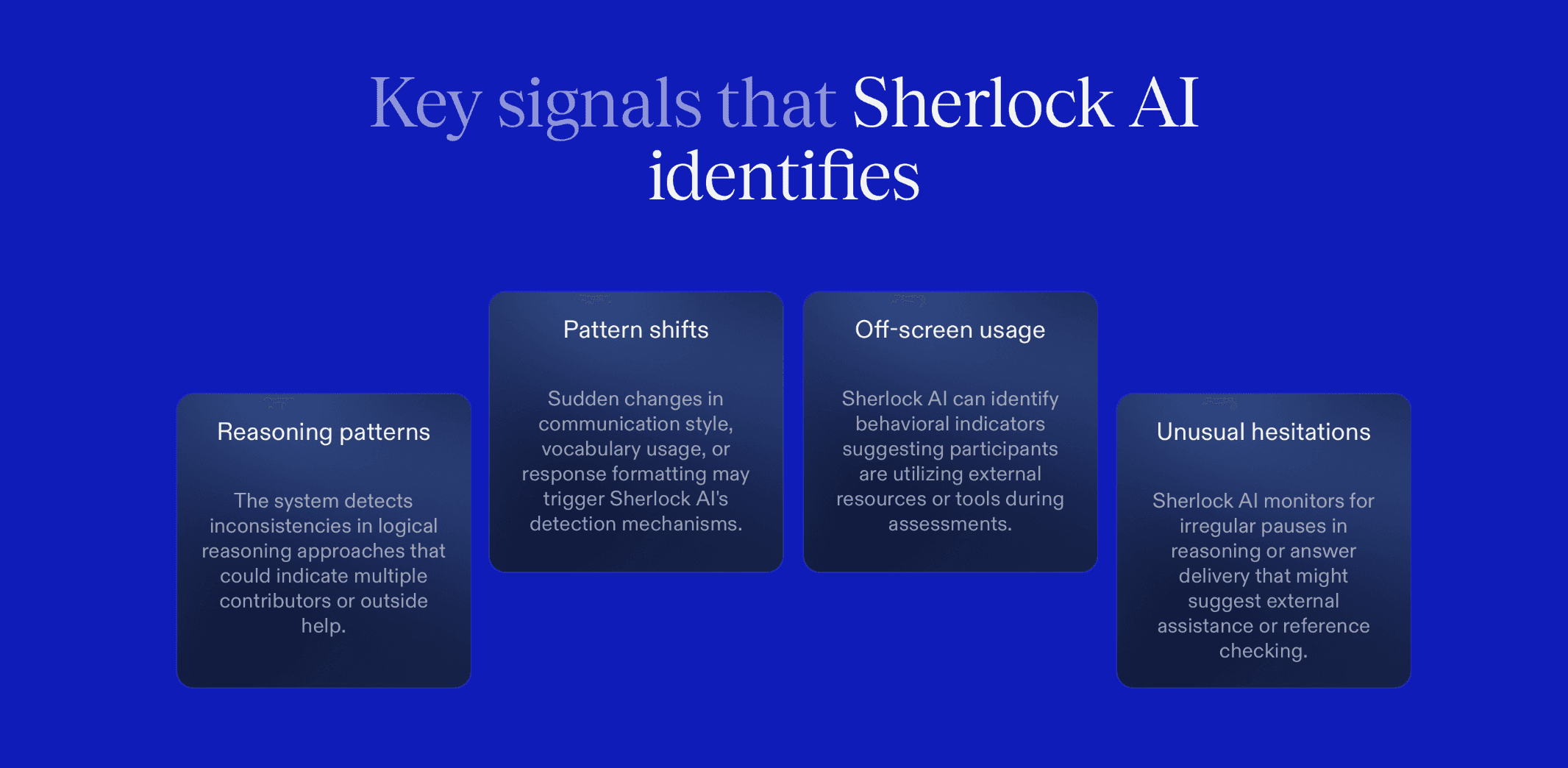
Even experienced interviewers can miss subtle patterns, especially in high-volume remote hiring. Sherlock AI helps teams surface AI-assisted behaviors by analyzing response timing, reasoning flow, and behavioral consistency across interview stages.
Rather than issuing pass or fail judgments, Sherlock AI highlights signals such as:
Unusual pauses before responses
Inconsistencies between reasoning and output
Sudden shifts in communication patterns
Potential off-screen or background tool usage
These insights guide interviewers toward deeper follow-up questions, helping validate real understanding while keeping interviews fair and non-intrusive.
Sherlock AI complements structured interview design by making hidden patterns visible at scale without turning interviews into surveillance exercises.
Final Thoughts
AI-assisted interviewing is no longer rare or experimental. As AI tools become easier to access, hiring teams must adapt how they evaluate candidates.
Spotting AI-assisted candidates is not about catching isolated behaviors. It is about recognizing patterns across reasoning, adaptability, and consistency. Strong interview design combined with intelligent detection restores what interviews are meant to measure: how a candidate truly thinks, decides, and solves problems.
By focusing on reasoning over polish and supporting interviewers with pattern-based insights, organizations can protect hiring integrity while maintaining fairness and trust in remote interviews.