Back to all blogs
See the latest AI-driven cheating methods candidates use and how to protect your hiring process with clear, effective countermeasures.

Abhishek Kaushik
Dec 2, 2025
TL;DR
Candidates now use AI during interviews to:
Generate answers live
Receive real-time coaching
Deepfake their face or voice
Copy solutions into code editors
Have another person answer in the background
The strongest defense is not asking harder questions.
It is designing your interview workflow to detect signal mismatches in reasoning, behavior, and response latency.
Sherlock AI provides automated detection.
We also list manual countermeasures when tools are not in place.
The Five Most Common AI-Enabled Cheating Techniques
1. Live Answer Whispering Through a Second Device
Candidate uses:
Phone just outside camera view
Earbuds to receive instructions
Co-pilot software providing real-time hints
Detection Signals:
Answers sound correct but lack detail
Delay between question and response is constant
Candidate never asks clarifying questions
How Sherlock AI Stops It:
Audio cross-channel analysis
Background conversation fingerprinting
Earbud and silence-pattern detection
Manual Countermeasure (if no tool):
Ask:
Before we continue, explain the problem in your own words.
If the paraphrase is weak, the answers are not their own.
2. Reading From a Script or Prompt Sheet
Often used in:
System design interviews
Project walkthroughs
Behavioral interviews
Scripts are often purchased from coaching institutions.
Detection Signals:
Highly polished narrative
No mention of mistakes or course corrections
Story structure identical to industry templates
How Sherlock AI Stops It:
Narrative pattern matching
Reasoning adaptability checks under constraint shift
Manual Countermeasure:
Ask:
What changed during the project after launch?
Real experience always contains change.
Scripted answers nearly never account for it.
3. AI-Generated Coding Solutions
Candidate:
Pastes solutions from ChatGPT or GitHub Copilot
Cannot debug or modify under constraint change
More than 50% of candidates use AI tools in virtual coding interviews.
Detection Signals:
Code is correct but style shifts mid-answer
Variable naming patterns inconsistent
Candidate struggles when asked to optimize or restructure
How Sherlock AI Stops It:
Typing cadence analysis
Copy-paste detection
Code lineage pattern recognition
Manual Countermeasure:
Ask:
Walk me through how you would improve performance if input size increased by 10 times.
Authentic coders reason forward.
Cheaters freeze.
4. Proxy Interviewer (Another Person Answers)
Most common in:
Remote engineering interviews
Contracting roles
Global sourcing pipelines
Detection Signals:
Candidate avoids turning on camera
Explanation style and voice confidence mismatch resume claims
Real knowledge only appears when improv-level detail requests are avoided
How Sherlock AI Stops It:
Face match verification
Voice identity comparison
Interaction pattern detection over time
Manual Countermeasure:
Ask:
Could you open your settings and switch cameras?
Proxy setups usually collapse at this request.
5. Deepfake or Masking Software During Video Interviews
Still emerging, but increasing rapidly.
Detection Signals:
Blurry skin texture only around face
Mouth movement does not align perfectly with speech
Eye gaze does not react to screen content
How Sherlock AI Stops It:
Liveness checks
Gaze tracking alignment
Head movement realism signals
Manual Countermeasure:
Ask candidate to:
Turn head slightly to the left and say the phrase: "Testing for clarity."
Deepfakes struggle with side profile rendering.
Why Trying to “Outsmart” Candidates Doesn’t Work
Raising difficulty leads to:
Anxiety for honest candidates
Advantage for coached candidates
Interviewer inconsistency
The correct approach is:
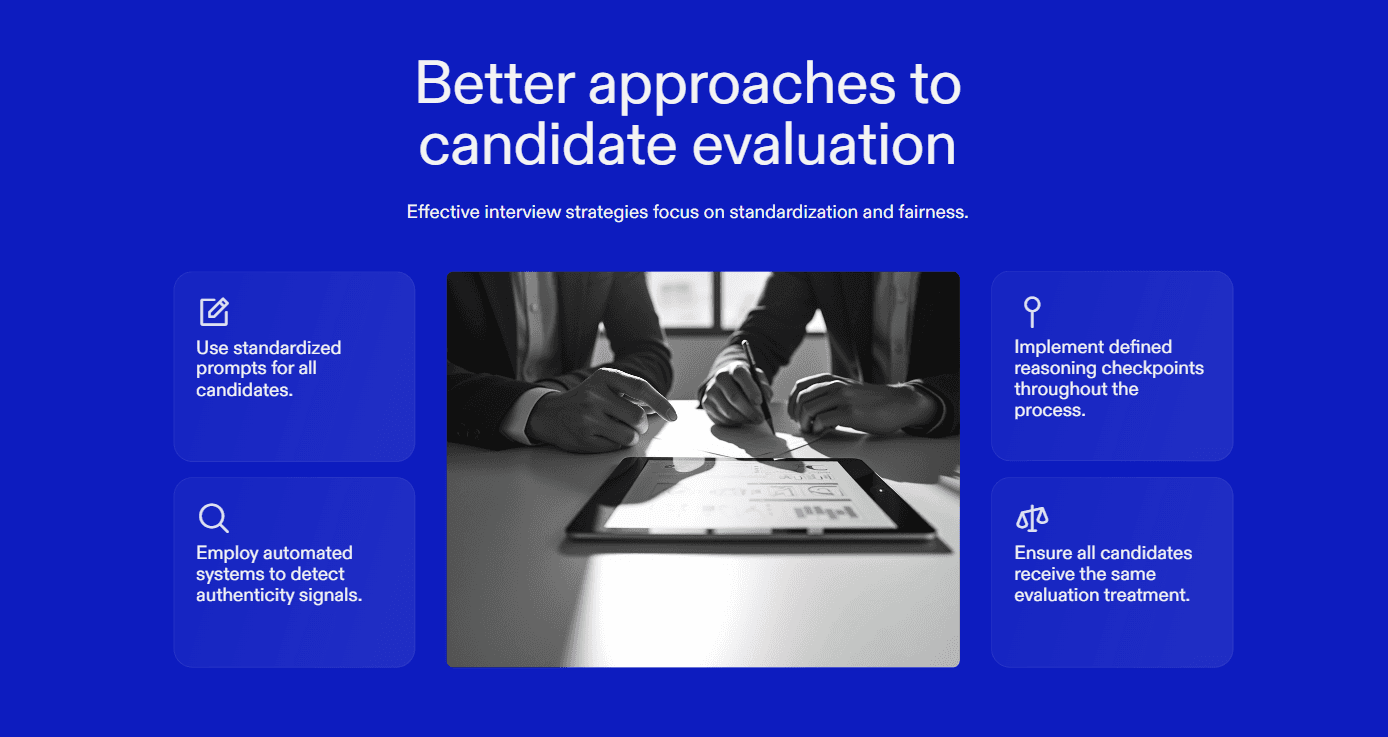
Standardized prompts
Consistent reasoning checkpoints
Automated authenticity signals
The Preventive Interview Workflow (Copy This)
Verify identity before the interview starts
Use one micro problem to test reasoning
Apply one constraint shift to verify adaptability
Record findings directly in the scorecard
Escalate only when reasoning and behavior do not match resume claims
This workflow is:
Light
Fair
Hard to cheat
Easy to train globally
Conclusion
AI cheating is not a fringe phenomenon.
It is a predictable pattern with detectable signatures.
The goal is not to catch criminals.
The goal is to ensure the person hired is the same person who performs the job.
With:
Real-time AI-based fraud detection (Sherlock)
Reasoning-focused interview prompts
Consistent documentation standards
Companies maintain:
Talent quality
Fair candidate treatment
Audit safety
Brand integrity