Back to all blogs
Remote hiring demands more than speed and quality. Learn how to protect interview integrity, prevent AI-assisted cheating, and hire confidently with Sherlock AI.

Abhishek Kaushik
May 8, 2026
Remote hiring has transformed how organizations recruit talent. It has made hiring faster, more flexible, and more scalable than ever before. Teams can now interview candidates across geographies, reduce time-to-fill, and streamline decision-making without the constraints of physical offices.
However, this shift has introduced a critical challenge that traditional hiring advice often overlooks: interview integrity. 59% of hiring managers say they’ve suspected candidates of using AI tools or deceptive tactics to misrepresent themselves during the hiring process.
Most conversations around recruitment focus on balancing speed and quality. Companies want to move quickly without compromising standards. But in remote environments, another layer of risk has emerged. AI-assisted cheating, proxy candidates, deepfake impersonation, and real-time answer generation tools are making it harder to verify whether interview performance truly reflects a candidate’s abilities. 31% of managers reported interviewing a candidate who was later revealed to be using a fake identity.
As a result, hiring leaders are no longer asking only how to hire faster or how to hire better. They are also asking a more fundamental question: how can we ensure the person we hire is actually the person we interviewed?
Balancing speed, quality, and integrity is no longer optional. It is the new standard for successful remote hiring.
The Growing Importance of Hiring Quality and Speed Balance
Speed matters because top candidates are off the market quickly. Quality matters because a bad hire is expensive.
But in remote interviews, integrity matters just as much.
If interview performance can be manipulated using AI tools, external assistance, or impersonation, then even a fast and structured hiring process can lead to costly hiring mistakes.
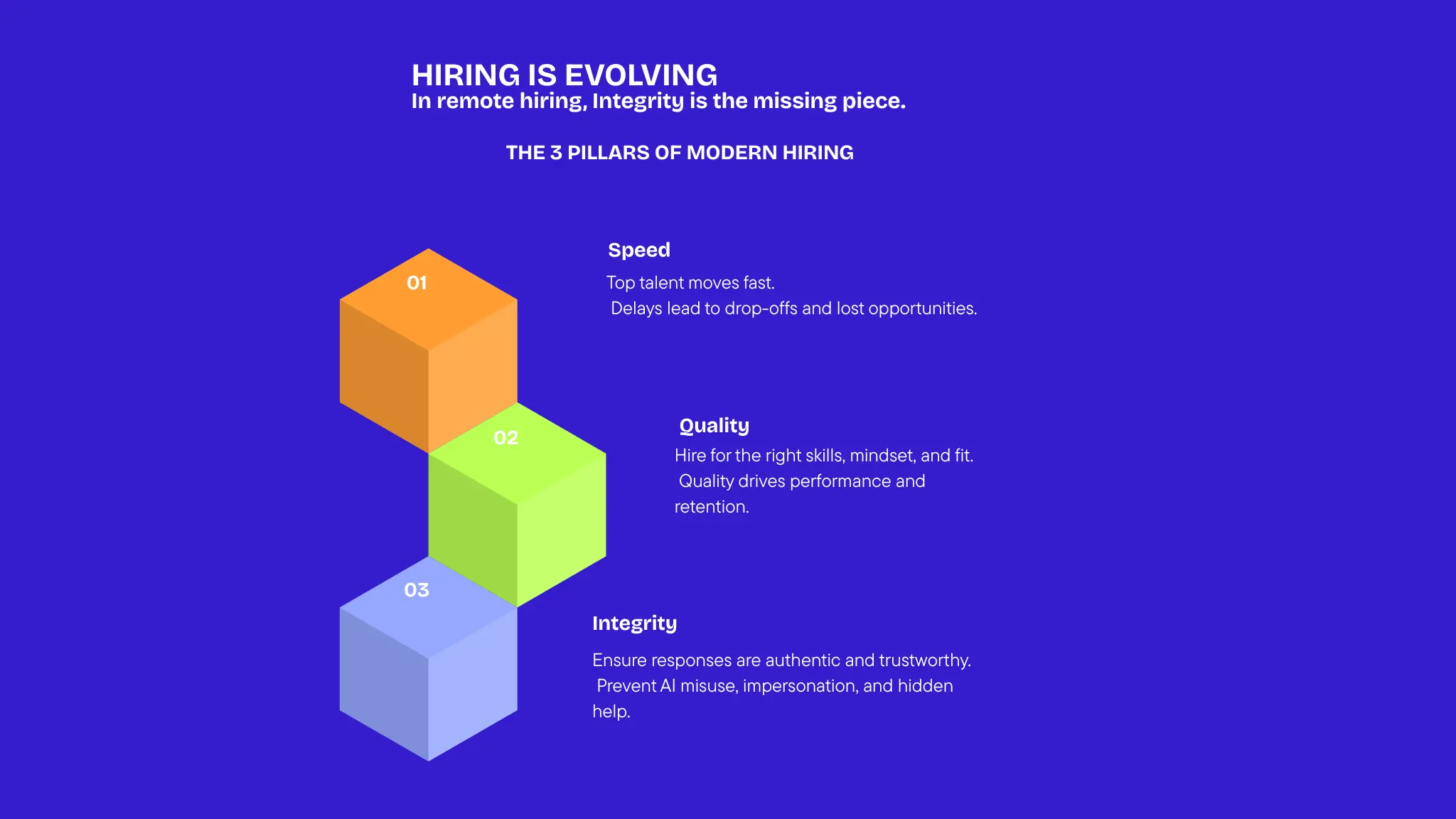
Modern hiring must protect three pillars:
Speed
Quality
Integrity
Without integrity, speed and quality metrics become unreliable.
Why Speed Matters in Hiring
Hiring delays increase drop off rates and reduce offer acceptance.
Fast hiring helps organizations:
Reduce candidate drop off
Improve offer acceptance rates
Lower time to fill
Maintain team productivity
However, rushing interviews without safeguards increases the risk of hiring someone who relied on AI-generated responses or external coaching.
Speed without safeguards creates hidden risk.
Why Quality Matters Even More
Quality hiring ensures:
Strong job performance
Cultural alignment
Long-term retention
Reduced re-hiring costs
Structured interviews, skills-based assessments, and competency mapping improve hiring accuracy. But even high-quality interview frameworks fail if the responses being evaluated are not authentic.
Quality depends on authenticity.
The Missing Pillar: Integrity in Remote Interviews
Remote interviews have created new fraud vectors:
AI-generated answers in real time
Proxy participation
Deepfake video impersonation
Hidden collaboration tools
Real-time external coaching
Traditional proctoring solutions focus on screen recording or browser locking. That is no longer enough. Organizations now need behavior-driven detection that identifies suspicious patterns during interviews. This is where modern interview integrity platforms such as Sherlock AI play a crucial role.
👉 Sherlock AI (Anti-Interview-Fraud) Security Overview
The Tension Between Speed, Quality and Integrity
Hiring teams often believe adding integrity controls will slow down the process.
The truth is the opposite.
When integrity checks are automated and AI-driven:
Recruiters do not need to manually review hours of recordings
Suspicious sessions are flagged automatically
Interviews can proceed without intrusive restrictions
Hiring managers receive structured insights faster
The goal is not to add friction. The goal is to reduce invisible risk while preserving candidate experience.
How to Balance Speed, Quality and Integrity in Remote Interviews
Balancing speed, quality, and integrity in remote interviews means designing a hiring process that moves efficiently, evaluates candidates accurately, and protects against fraud or misrepresentation at the same time.
In traditional hiring, the primary tension was between speed and quality. Move too fast and you risk a poor hire. Move too slowly and you lose strong candidates. In remote hiring, there is now a third dimension: integrity. If external assistance, AI-assisted interview responses or impersonation, then even a well-structured and fast process can lead to the wrong hiring decision. If organizations are not focused on detecting hidden AI tools in interviews, a structured and efficient process can still lead to poor hiring decisions.
Here is how organizations can balance all three effectively.
1. Define What You Really Need
Before interviews begin:
Define critical competencies
Identify must-have skills versus nice-to-have skills
Determine what behaviors signal real expertise
Clear evaluation criteria reduce unnecessary interview rounds and accelerate decisions.
2. Standardize Interviews to Protect Quality
Unstructured interviews slow down decisions and introduce bias. Structured interviews help you:
Ask consistent, role-relevant questions
Score candidates using predefined rubrics
Compare candidates objectively
Reduce decision delays
Structured formats increase hiring accuracy while keeping the process efficient.
3. Use Technology Wisely
Recruitment technology should improve speed and decision-making clarity, not complicate workflows.
Smart hiring tech should:
Automate scheduling
Track structured evaluation metrics
Flag suspicious behavioral patterns
Detect AI-generated response patterns
Identify potential proxy participation
Sherlock AI enables organizations to monitor interview authenticity in real time without disrupting the candidate experience. Instead of blocking tools or restricting browsers, it analyzes behavioral signals and response patterns to identify anomalies.
This approach preserves speed while protecting integrity.
4. Build a Proactive Talent Pipeline
Relying only on urgent hiring increases pressure to rush interviews.
Building talent pipelines allows:
Pre-vetted candidate pools
Faster shortlisting
Reduced hiring stress
Better evaluation depth
When hiring pressure decreases, decision quality improves.
5. Streamlining Interview Processes While Maintaining Depth
Many companies assume fewer rounds means lower quality. That is not true.
Efficiency improves when interviews are:
Structured
Skills-based
Focused on role-relevant challenges
Supported by interview intelligence tools
Depth does not require more time. It requires better signal detection.
6. Enhancing Candidate Experience to Protect Hiring Speed
Candidate experience directly impacts hiring speed.
Ways to improve it include:
Clear communication
Transparent timelines
Fair and structured interviews
Non-intrusive integrity monitoring
Heavy-handed proctoring can damage employer branding. Intelligent, background integrity monitoring preserves trust while protecting organizations.
7. Bias Reduction for Efficient Hiring
Structured interviews reduce bias and improve fairness.
When combined with behavioral analytics:
Decisions rely on evidence, not intuition
Suspicious anomalies are objectively flagged
Recruiters gain decision support instead of guesswork
This improves both fairness and speed.
New KPIs for the Remote Hiring Era
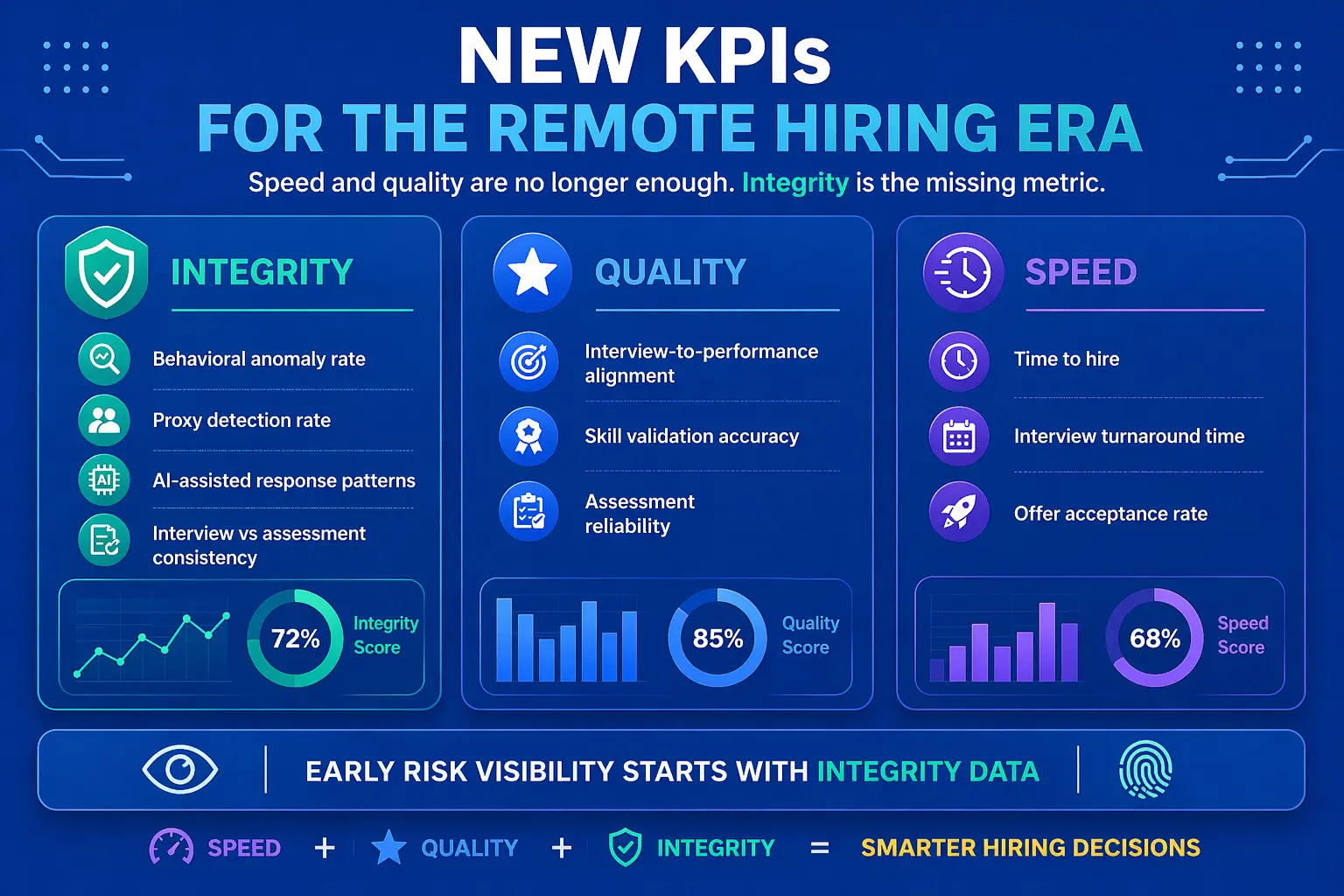
To truly balance speed, quality, and integrity, organizations should track additional data points.
Beyond traditional recruiting KPIs, consider measuring:
Integrity-Specific Metrics
Percentage of interviews flagged for behavioral anomalies
Consistency between interview responses and assessment results
Interview-to-performance alignment after onboarding
Proxy participation detection rate
AI-assisted response pattern frequency
These metrics provide early visibility into risk.
When integrity data is layered alongside quality and speed metrics, hiring leaders gain a full 360-degree view of decision health.
Building an Integrity-Driven Interview Architecture with Sherlock AI
Remote interviews require more than scheduling tools and structured questions. They require a system that protects authenticity at every stage without turning the process into a surveillance exercise.
Sherlock AI operates as an integrity infrastructure layer within the interview lifecycle. It does not replace interviewer judgment. Instead, it strengthens it by validating authorship, monitoring behavioral consistency, and structuring evidence in a way that supports defensible hiring decisions.
Rather than adding friction, Sherlock AI works quietly in the background, ensuring that what is being evaluated truly reflects the candidate’s own capability.
Establishing Trust Before the Interview Begins
Integrity should not begin once the first question is asked. It should be embedded from the moment a candidate enters the evaluation environment.
Sherlock AI prepares the interview session by:
Confirming candidate identity alignment with submitted credentials
Detecting environmental irregularities such as additional faces or device substitutions
Identifying suspicious infrastructure setups like virtual machines or remote desktop overlays
Validating baseline audio and video continuity
By resolving identity and environment risks upfront, interviewers are free to focus on evaluating skill and reasoning instead of policing logistics.
The conversation begins on verified ground.
Protecting Authenticity During the Interview
While interviewers assess communication, problem solving, and domain expertise, Sherlock AI analyzes behavioral continuity in parallel.
It observes patterns that humans cannot reliably track in real time, such as:
Sudden shifts in response timing
Inconsistencies in speech or interaction style
Signals suggesting off-camera assistance
Behavioral deviations from earlier assessment stages
Importantly, Sherlock AI does not interrupt or disrupt the interview flow. It does not impose restrictive lockdowns or create visible barriers. It captures structured signals silently and contextualizes them for later review.
This allows interviewers to remain evaluators, not investigators.
Structured Evidence After the Conversation
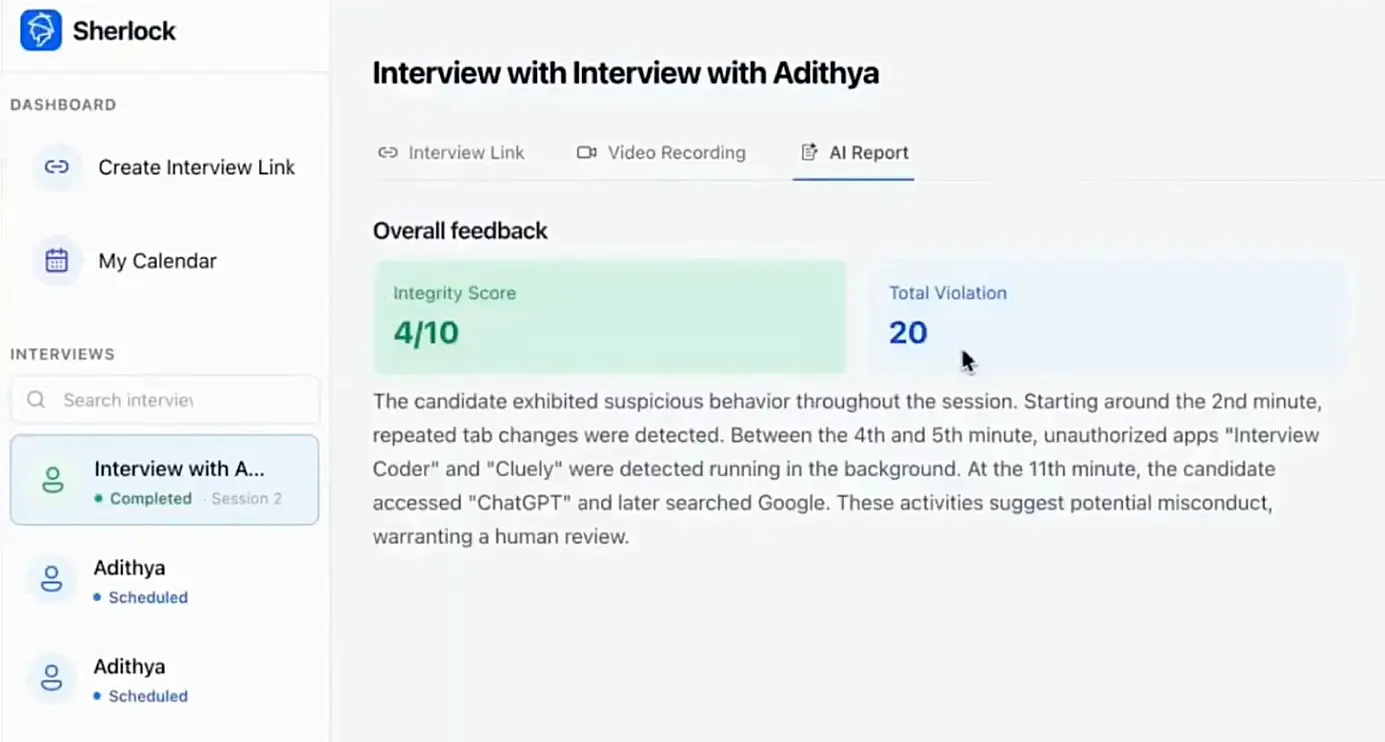
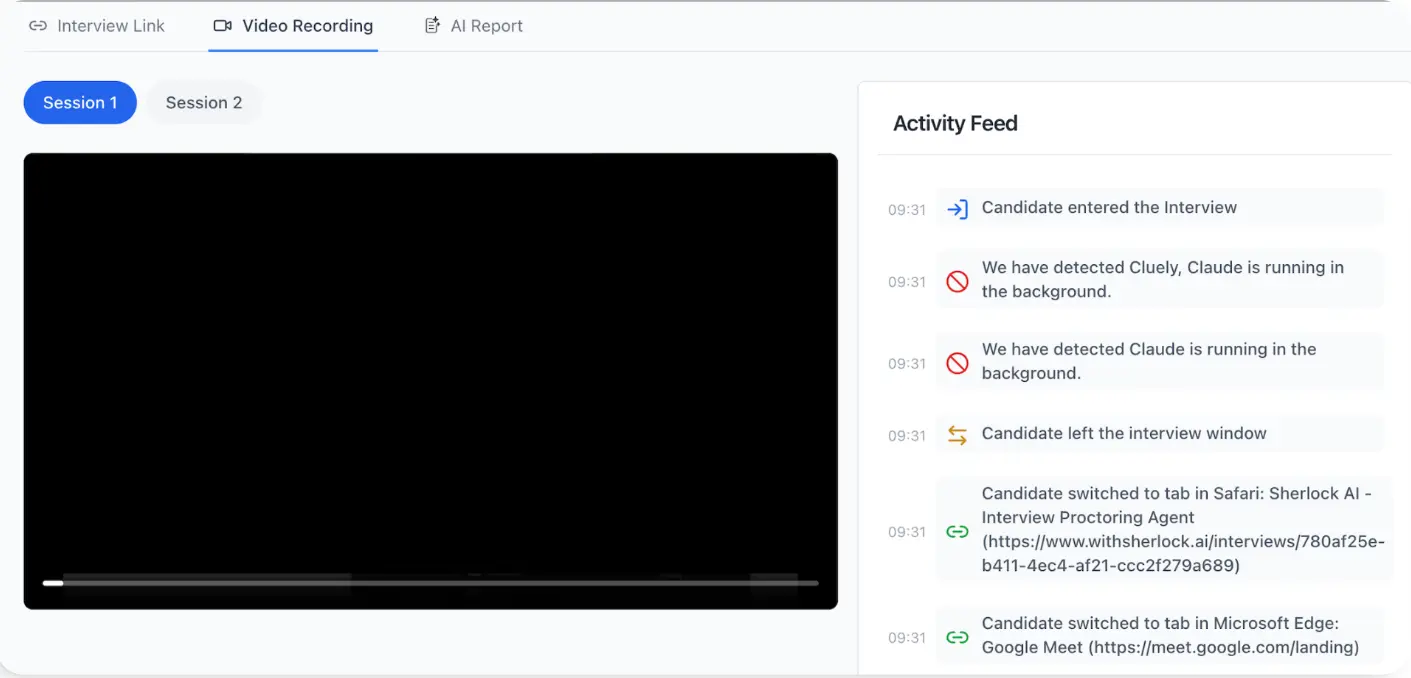
Once the interview concludes, Sherlock AI transforms captured signals into structured intelligence.
Instead of automated verdicts, it provides:
A documented sequence of integrity-related events
Contextual summaries aligned with evaluation rubrics
Behavioral pattern comparisons across hiring stages
Consolidated insights for hiring panels
This approach ensures that integrity signals are interpreted within context. A flagged anomaly may reflect a technical disruption, a candidate adjustment period, or a genuine risk. The final decision always remains with humans.
Technology provides evidence. Humans provide judgment.
Standardization Without Rigidity
One of the hidden challenges in remote hiring is inconsistency across interviewers and sessions.
Sherlock AI introduces standardization by applying the same monitoring logic and documentation framework to every candidate. This results in:
Reduced interviewer subjectivity
Clear audit trails for compliance and governance
Lower cognitive load during evaluation
More consistent panel discussions
At the same time, it avoids heavy-handed surveillance tactics that undermine candidate experience. Instead of restricting access, it verifies authorship and reasoning continuity, which are far more relevant indicators of real-world performance.
Preserving Human-Centered Hiring at Scale
The goal of integrity-first hiring is not automation. It is confidence.
Sherlock AI separates responsibilities clearly:
The system captures signals and structures evidence
Interviewers assess context, and capability
Hiring panels make informed, defensible decisions
This balance allows remote interviews to scale without sacrificing fairness or reliability. When integrity is built into the system architecture rather than evaluated subjectively, hiring becomes more consistent, more transparent, and more resilient against modern fraud risks.
Sherlock AI enables organizations to maintain human judgment at the center of hiring, while technology ensures that the signals supporting those decisions are trustworthy.
Why Integrity-First Hiring Is Becoming a Strategic Advantage
Remote hiring is no longer an operational convenience. It is a strategic function that directly impacts organizational performance.
When integrity is embedded into hiring systems from the beginning, companies gain measurable advantages that go beyond filling roles quickly.
1. Talent Stability Improves
Authentic interviews lead to authentic hires. When candidates are evaluated based on genuine skill and capability:
Retention improves
Early attrition decreases
Performance ramp-up is smoother
Teams operate with greater confidence
Integrity protects long-term workforce stability.
2. Operational Risk Decreases
Fraudulent or misrepresented hires create hidden risks that surface later:
Underperformance
Security vulnerabilities
Compliance exposure
Costly rehiring cycles
By validating authenticity at the interview stage, organizations reduce downstream operational disruptions.
3. Organizational Trust Strengthens
Hiring decisions influence internal morale and external perception.
Integrity-first processes reinforce:
Stakeholder confidence
Hiring manager trust in recruitment
Candidate perception of fairness
Employer brand credibility
Trust compounds over time. Integrity builds it.
Conclusion
Remote hiring has redefined how organizations compete for talent. It has unlocked speed, flexibility, and access to global candidate pools. But as hiring becomes more digital, the risks tied to authenticity and verification have grown just as quickly. Today, successful recruitment is not just about filling roles faster or improving assessment frameworks. It is about ensuring that every hiring decision is built on genuine, verifiable performance.
Speed keeps you competitive. Quality ensures performance. Integrity protects both. Without confidence in interview authenticity, even the most structured process can produce unreliable outcomes. As AI tools, proxy participation, and remote manipulation tactics become more sophisticated, organizations must move beyond traditional hiring safeguards and adopt smarter, behavior-driven solutions.
This is where Sherlock AI becomes critical. By monitoring behavioral patterns and identifying anomalies during remote interviews, Sherlock AI helps organizations protect authenticity without adding friction to the candidate experience. It strengthens decision-making confidence while preserving efficiency, allowing hiring teams to focus on what truly matters: selecting the right talent based on real capability.
The future of remote hiring belongs to companies that embed integrity into their systems from the start. With platforms like Sherlock AI, organizations can move quickly, evaluate accurately, and hire with confidence. In a digital-first hiring landscape, trust is no longer assumed. It is intelligently secured.