Back to all blogs
Learn how AI philosophy in hiring shifts focus to reasoning, adaptability, and authenticity over storytelling. Improve hiring with decision-making evaluations.

Abhishek Kaushik
Dec 15, 2025

“AI in hiring” is not just about using new tools.
It changes how we evaluate skill, how we define potential, and how we measure trust.
The key shift:
Recruiters must evaluate how a candidate thinks, not just what they know or say.
This is an AI philosophy.
It is a mindset for designing fair, high-signal, integrity-safe hiring systems.
The Core Idea
AI can now:
Draft code
Write interview answers
Generate leadership stories
Explain architecture patterns
So knowledge and fluency are no longer meaningful hiring signals on their own.
The new hiring differentiator is:
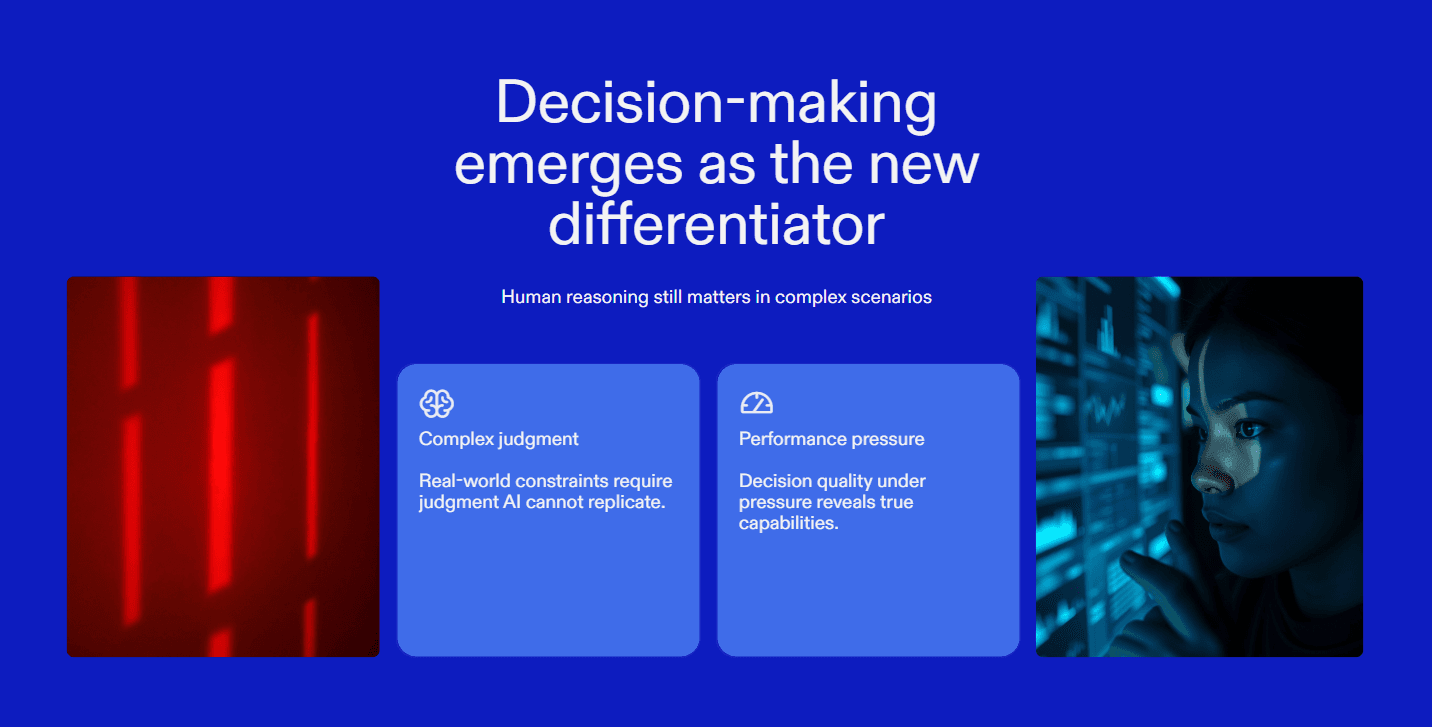
Decision-making under real constraints.
A Forbes article on AI decision-making limitations highlights that while AI excels at pattern recognition and structured reasoning, it lacks deep contextual understanding, flexibility, and adaptive judgment required in novel, real-world situations.
This is where human reasoning matters.
The Three Pillars of AI Philosophy in Hiring
1. Evaluate Reasoning, Not Recall
Traditional interviews rewarded:
Memorized frameworks
Familiarity with buzzwords
Confidence in storytelling
AI makes these signals unreliable.
Recruiters now need to evaluate:
How a candidate arrives at an answer
How do they choose among alternatives
How they adapt when conditions change
Practical Example
Old question:
Explain microservices vs monolith.
New question:
Describe a real change that forced you to adjust the architecture. What broke and how did you decide what to do next?
This surfaces ownership and real thinking.
2. Authenticity Must Be Verified, Not Assumed
Remote interviews mean:
Proxy participation is possible
AI whispering support is easy
Deepfake identity is emerging
Recruiters can no longer assume the candidate is:
The person interviewing
The person writing code
The person telling the story
Solution
Sherlock verifies:
Identity continuity
Reasoning authenticity
Code authorship behavior
This is not about distrust.
This is about ensuring fairness for honest candidates.
3. Potential Matters More Than Pedigree
AI raises the performance floor for many roles.
The difference between junior and senior is no longer:
Knowledge volume
Title history
Company brand
The real difference is:
Ability to diagnose new situations
Ability to reason about tradeoffs
Ability to learn and adapt self-directionally
Recruiters must shift from resume-anchored selection to learning velocity selection.
Signal to Look For:
Ask:
Tell me about a time you updated your mental model after discovering you were wrong.
Candidates who can do this:
Grow
Collaborate
Lead
Candidates who cannot:
Stagnate even with AI tools available
What This Means for Recruiters Day-to-Day
Recruiter Task | Old World | AI Philosophy Approach |
|---|---|---|
Resume review | Past titles | Evidence of decision-making and adaptability |
Screening call | Memorized insight prompts | Real reasoning prompts and paraphrasing tests |
Interview loop design | Skill checklists | Signal-based question clusters |
Debrief | Opinion-based discussion | Evidence-based reasoning notes |
This is a shift in how professionalism is defined in talent work.
What Breaks If Recruiters Ignore This
Hiring looks equal on paper, but performance diverges quickly
Managers lose trust in recruiting judgment
Interview loops become inconsistent and vulnerable to fraud
Quality of hire declines while interview volume rises
Real Example
A fast-scaling marketplace startup hired engineers solely on technical correctness.
Within 3 months:
New hires struggled with tradeoff decisions
Senior engineers became bottlenecks
Product roadmaps slowed
After shifting to a reasoning-first evaluation, velocity improved noticeably.
What Gets Better When Recruiters Adopt This Philosophy
Candidates feel interviews are more meaningful
Interviewers feel more confident in the evaluation
Managers see a higher signal in debriefs
Quality of hire strengthens in the first 90 days
This creates a trustworthy and aligned hiring culture.
Read More: Best Practices to Prevent AI Fraud in Your Hiring Process
Conclusion
AI does not replace recruiters.
It changes what great recruiters optimize for.
The new recruiter advantage is:
Understanding human reasoning
Identifying ownership signals
Detecting authenticity without intimidation
The recruiter becomes:
Interpreter of thought, not scorekeeper of trivia
This is the strategic leap.
This is what “AI philosophy in hiring” means.