Back to all blogs
Ensure AI hiring compliance with transparency, consent, and bias audits. Get region-specific steps for the US, EU, and UK to avoid lawsuits.

Abhishek Kaushik
Dec 22, 2025
TL;DR
AI can support fairness and efficiency in hiring, but only if transparency, consent, and auditability are in place.
The US, EU, and UK each regulate AI hiring differently, with the EU taking the strictest stance.
Recruiters must disclose AI usage, document evaluation reasoning, and preserve audit-ready evidence.
This guide provides region-specific rules, practical compliance steps, and a copy-paste legal disclosure template.
AI is now deeply embedded in hiring. It screens resumes, summarizes interviews, and evaluates competencies. But as AI becomes more influential in hiring decisions, it also becomes more legally regulated.
Hiring leaders must be prepared to answer questions like:
Did AI influence the hiring outcome?
Could a rejected candidate challenge the fairness of the decision?
Can the organization prove the evaluation was non-discriminatory and consistent?
Using AI in hiring is not a legal risk. Using AI without documentation and transparency is.
According to 2025 Greenberg Traurig’s report, many U.S. states and countries, including the EU and UK, introduced AI-hiring regulations in 2024–2025, requiring transparency, human oversight, and bias controls.
Legal Landscape Overview: US vs EU vs UK
Region | Regulation Style | Key Requirement | Risk Exposure |
|---|---|---|---|
US | Patchwork (state by state) | Notice to candidate | Liability varies by jurisdiction |
EU | Centralized under the AI Act | High-risk system controls | Highest compliance enforcement |
UK | Audit and accountability-oriented | Fairness and explainability | Focus on transparency and bias review |
United States: Focus on Disclosure and Bias Testing
The US does not have one federal law regulating AI in hiring. Instead, compliance is driven by:
EEOC anti-discrimination rules
State and city-specific regulations (like New York City Local Law 144)
ADA accessibility requirements
What US Employers Must Do
Notify candidates when AI tools are used.
Explain the purpose of the AI system.
Perform and document annual bias audits for automated screening tools.
Allow human appeal or re-evaluation.
New York City’s Local Law 144 requires employers using AI hiring tools to run yearly independent bias audits, notify candidates that AI is being used, explain what qualifications the system evaluates, and allow candidates to request an alternative process.
European Union: The Strictest Region for AI in Hiring
The EU has classified hiring algorithms as High-Risk AI systems under the EU Artificial Intelligence Act.
This means:
You must maintain complete logs and audit trails
You must document how models were trained and evaluated
Human oversight must be present in every final decision
Candidates have the right to ask for an explanation
What EU Employers Must Do
Provide clear and explicit consent language
Store interview and evaluation data securely
Maintain audit logs for multi-year periods
Provide candidate access to stored personal data
The EU AI Act entered into force on August 1, 2024, and will be implemented gradually: general-purpose AI rules kick in August 2025, while high-risk AI systems (including those used for hiring) must comply by August 2026–2027.
United Kingdom: Explainability and Accountability First
The UK does not prohibit AI in hiring, but requires that hiring decisions be:
Explainable
Consistent
Non-discriminatory
What UK Employers Must Do
Document how interview decisions are made and validated
Provide candidates the ability to request reasoning
Maintain internal data protection impact assessments (DPIAs)
Industry guidance from the UK ICO notes that employers using AI in recruitment must complete DPIAs, be transparent about how automated tools influence decisions, and ensure candidates can exercise their data-protection rights. The guidance emphasises preventing discrimination and maintaining clear accountability when AI is part of the hiring process.
The Core Compliance Principles (Applies Everywhere)
Regardless of region, four pillars must be in place:
Compliance Pillar | Meaning |
|---|---|
Transparency | The candidate must know AI is in use |
Consent | Candidate must agree to the recording or analysis of data |
Human Oversight | AI scores cannot be the final hiring decision |
Auditability | Records must show how decisions were made |
If you cannot explain and prove your hiring decision, it is not legally defensible.
The Most Common Compliance Risk in 2026: Interview Records
If the interview was not documented:
There is no defensible basis for acceptance or rejection
There is no way to prove fairness or consistency
There is increased exposure to discrimination claims
This is why recruiters are shifting to:
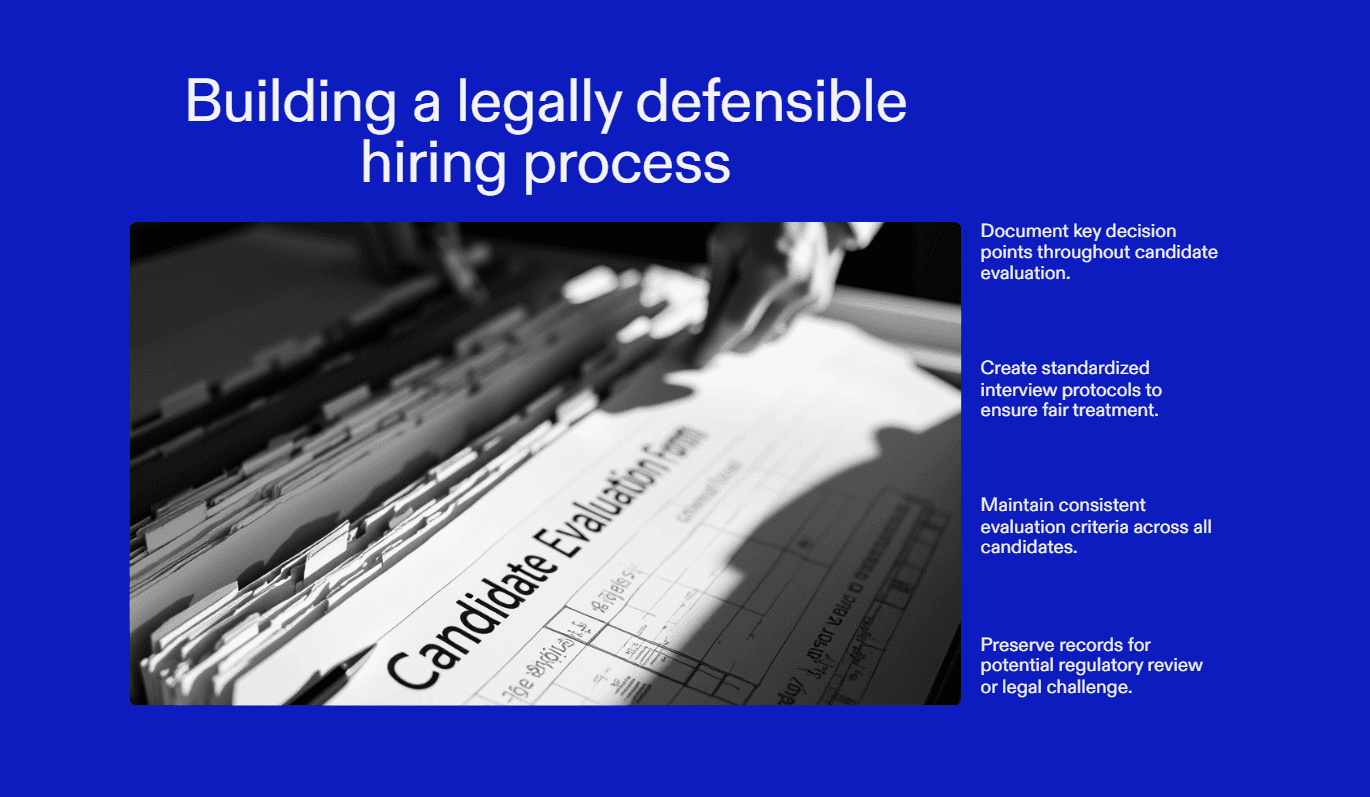
Structured scorecards
AI-generated summaries
Audit-ready interview logs
Copy-Paste Candidate Disclosure Script
Use this across Zoom, Teams, Meet, and in-person interviews:
During this interview, we will be using an AI note-taking and evaluation support tool. The purpose is to ensure consistent documentation and fair evaluation. Your interview will still be reviewed and scored by human interviewers. If you have questions about how the tool works or how your data will be used, we are happy to explain. Do we have your consent to proceed?
This script satisfies disclosure requirements in the US, UK, and EU.
Conclusion
You do not need to avoid AI to stay compliant. You need to use AI responsibly, transparently, and consistently.
Compliance risk does not come from the technology. It comes from the absence of documentation and oversight.