Back to all blogs
Learn how to redesign interviews to prevent candidate cheating, improve hiring accuracy, and create a fair, skills-based recruitment process with proven strategies.

Abhishek Kaushik
Jul 13, 2026
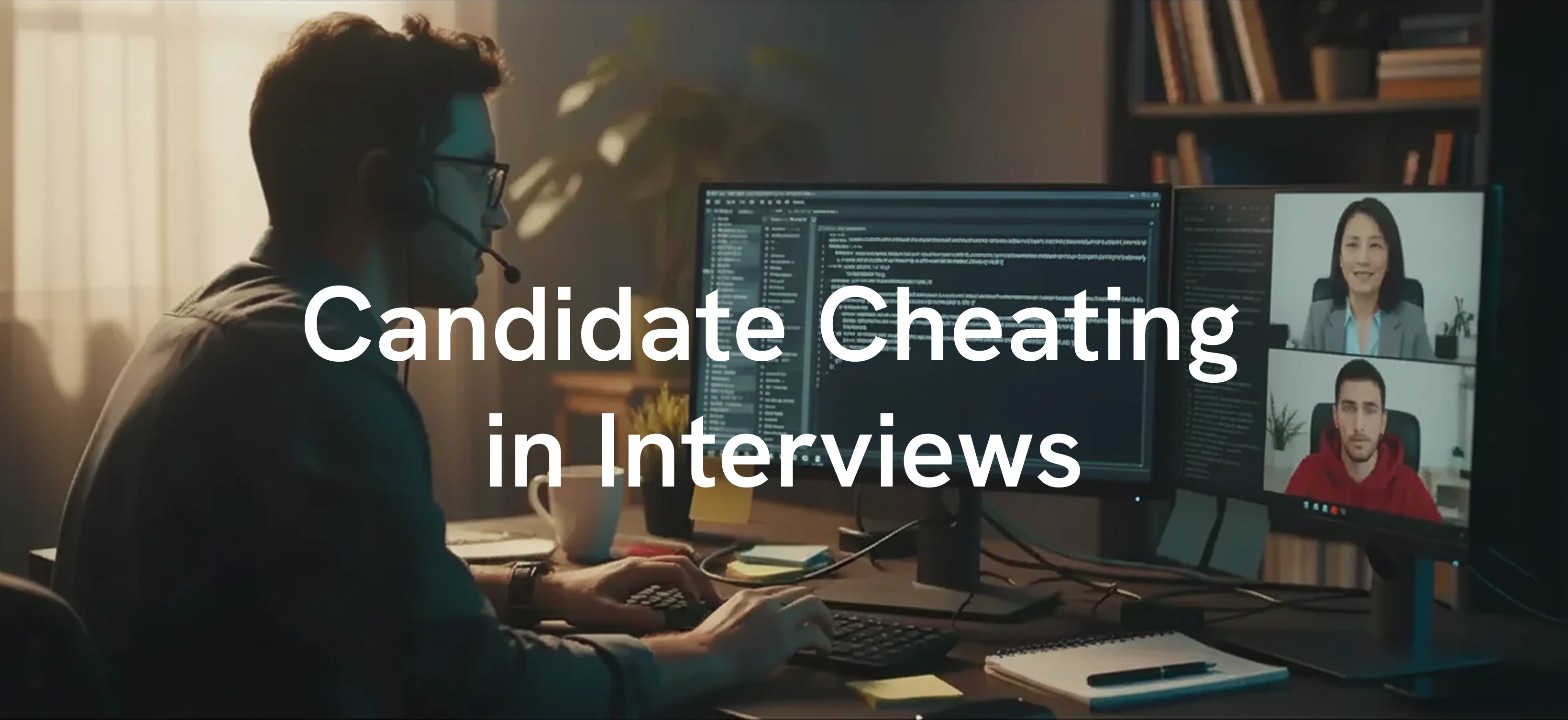
Candidate cheating in interviews is no longer rare or surprising. According to a recent survey, about 7 in 10 job seekers admit to lying or cheating during the hiring process, including interviews, assessments, resumes, and references.
It happens quietly across roles, industries, and seniority levels. Some candidates use outside help during live interviews. Others exaggerate skills, reuse answers they did not write, or rely on real-time assistance they cannot replicate on the job.
This is not only a problem of dishonesty. It is a hiring problem. When interviews reward memorized answers or perfect output instead of real thinking, they make cheating easier and honest candidates harder to spot. The result is missed signals, wrong hiring decisions, and teams that pay the price months later. Research shows that applicants often fake information to improve their chances, and those who fake more frequently can even rank higher than truthful applicants in traditional interview settings.
How Traditional Interview Formats Enable Cheating
Many interview formats unintentionally reward predictability. When every candidate goes through the same structure, interviews become easier to prepare for than to perform in. This creates gaps where cheating can quietly succeed.

1. Scripted questions reward recognition, not reasoning
Most interviews rely on a fixed set of questions that rarely change. Over time, these questions become easy to find through prep sites, forums, and peer networks. Candidates learn to recognize the question rather than think through the problem.
What this leads to:
Answers that are memorized or externally assisted
Polished responses that sound right but lack depth
Little need for real-time thinking once the pattern is known
Instead of evaluating how a candidate reasons, the interview tests recall and delivery.
2. Trivia-heavy rounds push candidates toward shortcuts
Many interviews still focus on definitions, syntax, or edge cases that rarely come up in real work. These rounds create pressure without adding meaningful signal.
Common outcomes:
Success depends on memory rather than understanding
Speed is rewarded more than clarity or judgment
Normal work behavior, like looking things up, is treated as failure
When the bar is recall under stress, candidates naturally turn to real-time help.
3. Static take-home tasks are easy to game
Take-home assignments are often reused and predictable. Without strong follow-up, it is hard to know how the work was actually done.
This creates room for misuse:
Solutions can be reused, outsourced, or heavily assisted
Final output looks strong even when ownership is weak
Decision-making gaps stay hidden
If the interview never explores why choices were made, the task reveals very little about true ability.
4. Fixed interview flows hide adaptability issues
Traditional interviews often move linearly from question to question. The discussion rarely changes based on how the candidate responds.
As a result:
There is little pressure to adjust thinking in real time
Answers are rarely challenged if they sound correct
Prepared responses work unusually well
This structure favors candidates who can deliver pre-built answers over those who can adapt.
5. Clean output is rewarded more than honest process
Candidates who pause, think aloud, or revise their approach can appear less confident. Meanwhile, polished answers are often treated as a sign of competence, even when assisted.
Over time:
Process gets overlooked
Perfect answers are overvalued
Genuine problem-solving is penalized
Traditional interview formats do not encourage cheating on purpose. But by rewarding predictability, speed, and polish, they make cheating effective. Until interviews reflect how real work happens, this gap will continue to exist.
Subtle Cheating Signals Interviewers Often Miss
Cheating in interviews is often quiet and indirect. It does not usually look like obvious rule-breaking. Instead, it shows up in small inconsistencies in how a candidate thinks, responds, and adapts during the conversation. These signals are easy to miss when interviewers focus only on correct answers.
1. Unnatural Pacing
One of the most common patterns is unnatural pacing. Real problem-solving usually involves hesitation, clarification, and occasional course correction. When responses feel optimized rather than worked through, it can indicate outside help or heavily rehearsed material.
Long pause before answering, followed by a very polished response
Complex questions answered faster than simple follow-ups
Little visible effort when working through unfamiliar problems
2. Inconsistent depth across related topics
Candidates who truly understand a subject tend to maintain similar depth even when questions shift slightly. Cheating often reveals itself when that consistency breaks.
Strong high-level explanations but weak practical examples
Ability to state conclusions without explaining intermediate steps
Difficulty adapting answers when the problem is reframed
3. Follow-up questions
Follow-up questions are especially revealing because they are harder to prepare for. When a candidate relies on external input, the initial answer may sound strong, but the cracks appear once the discussion moves off-script.
Delayed responses to clarifying questions
Repetition of earlier points instead of direct answers
Loss of structure when asked to explain reasoning in a different way
4. Sudden shift in communication style
This can happen within minutes and often feels unnatural in conversation.
Vocabulary or tone changes sharply mid-interview
Written responses differ noticeably from spoken explanations
Confidence spikes or drops without a clear reason
These signals should not be treated as proof of cheating on their own. However, when multiple patterns appear together, they often point to external help or memorized responses. Interviewers who pay attention to how candidates think, adjust, and recover will spot issues far earlier than those who focus only on final answers.
Redesigning Interviews to Make Cheating Unattractive
Stopping cheating does not require stricter rules or heavier monitoring. It requires interviews that reward real thinking and make shortcuts ineffective. When the structure changes, the incentive to cheat drops naturally, without harming the experience for honest candidates.
1. Use adaptive questioning instead of fixed scripts
Interviews work better when questions change based on how the candidate responds. Adaptive questioning makes it difficult to rely on memorized or assisted answers.
What this looks like in practice:
Follow up based on the candidate’s own explanation, not a checklist
Ask “why” and “what would you change” after initial answers
Adjust difficulty or direction in real time
Candidates who understand the problem can adapt. Those relying on external help struggle to keep up.
2. Frame problems in real time
Pre-defined problems are easy to prepare for. Real-time framing forces candidates to think on the spot, just like they would on the job.
Effective approaches include:
Presenting incomplete or evolving scenarios
Introducing new constraints halfway through
Asking candidates to make trade-offs with limited information
This shifts the focus from arriving at the correct answer to making reasonable decisions.
3. Introduce collaborative, not adversarial, tasks
Cheating thrives in one-way evaluations. Collaboration reduces its value. When candidates are asked to work with the interviewer, shortcuts become obvious.
This can include:
Thinking aloud while solving a problem together
Responding to feedback or pushback mid-task
Explaining how they would work with teammates
Collaboration mirrors real work and rewards clarity over polish.
4. Build decision-explanation loops into every round
The strongest signal comes from understanding how a candidate makes decisions. Asking for explanations makes external help far less useful.
Simple ways to do this:
Ask why a specific approach was chosen
Explore alternatives the candidate considered but rejected
Discuss what they would do differently with more time
These loops expose depth, ownership, and judgment, not just output.
5. Leverage tools to support fair evaluation
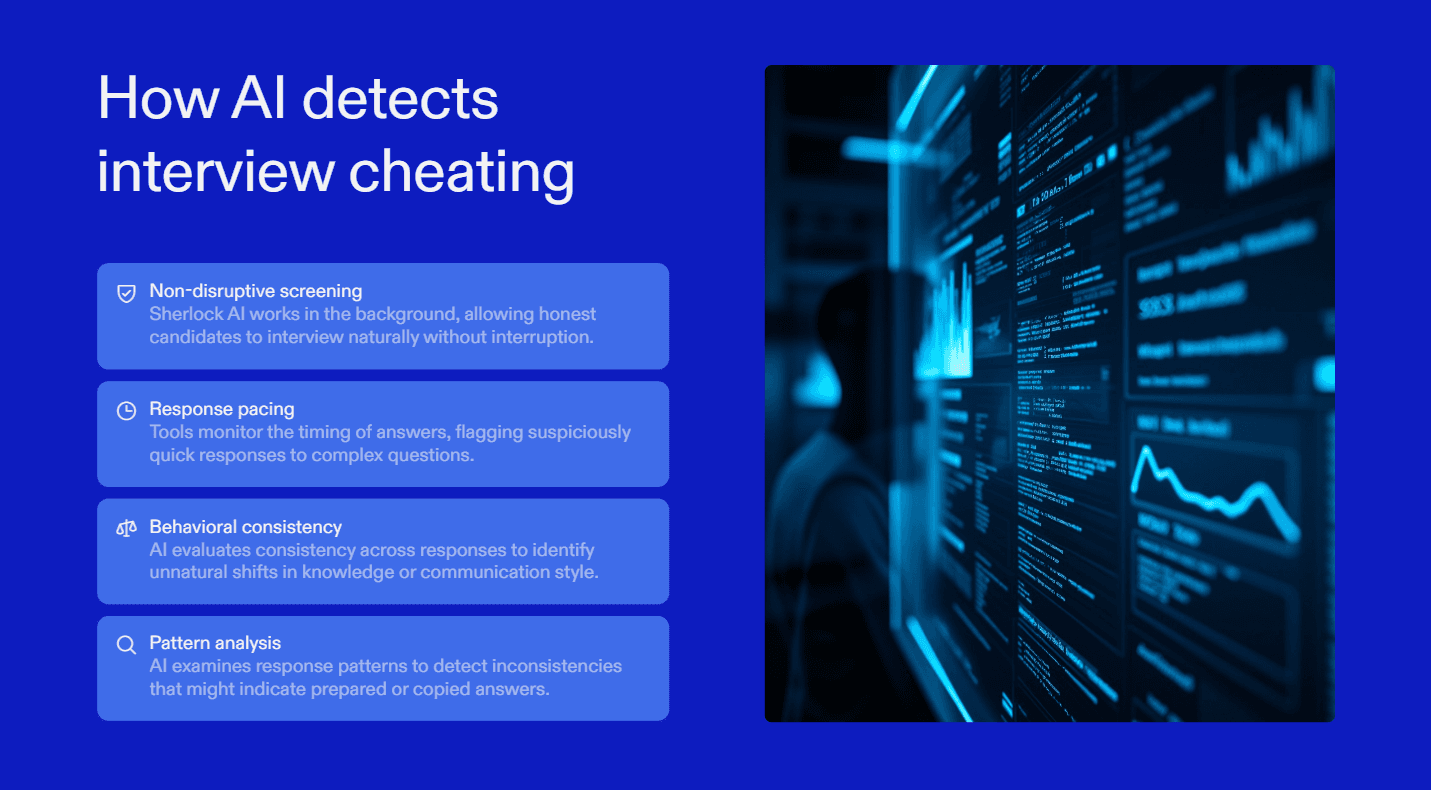
Modern tools can help interviewers detect subtle signals of cheating without disrupting honest candidates. Sherlock AI, for example, analyzes response patterns, pacing, and consistency to highlight unusual behavior.
How tools can help:
Track answer timing to spot unusually fast or rehearsed responses
Monitor consistency across related questions
Flag sudden shifts in communication style or reasoning patterns
Provide objective data to complement human judgment
When integrated thoughtfully, tools like Sherlock AI make it easier to focus on genuine skill and thinking, rather than relying on guesswork or rigid rules.
6. Keep friction low for honest candidates
Well-designed interviews do not feel restrictive. In fact, they often feel more natural.
Honest candidates feel heard and engaged
Thinking aloud becomes an advantage, not a risk
Performance reflects real work, not interview tactics
When interviews reward reasoning, adaptability, and ownership, cheating loses its payoff. The goal is not to catch candidates doing the wrong thing, but to make the right behavior the easiest path forward.
Conclusion
Candidate cheating in interviews is not just a behavior problem. It is often a signal that the interview process is testing the wrong things. When interviews reward polished answers, speed, and predictability, they make shortcuts effective and honest effort harder to recognize.
Better interviews do not rely on heavier controls or stricter rules. They rely on structure. Adaptive questioning, real-time problem framing, and clear decision explanations shift the focus from answers to thinking. This makes external help less useful and genuine skill easier to spot.
When interviews reflect real work, cheating becomes unattractive. Honest candidates shine, hiring decisions improve, and teams gain people who can think, adapt, and own their decisions. With the right design, and tools like Sherlock AI, the easiest path for candidates is to do the right thing.