Back to all blogs
Learn 15 effective ways to prevent proxy interviews remotely using AI-powered verification, secure hiring workflows, and fraud detection strategies for remote recruitment.

Abhishek Kaushik
Jun 25, 2026

Remote hiring has made recruitment faster, more flexible, and more global. But it has also introduced a serious challenge for recruiters and hiring managers: proxy interviews.
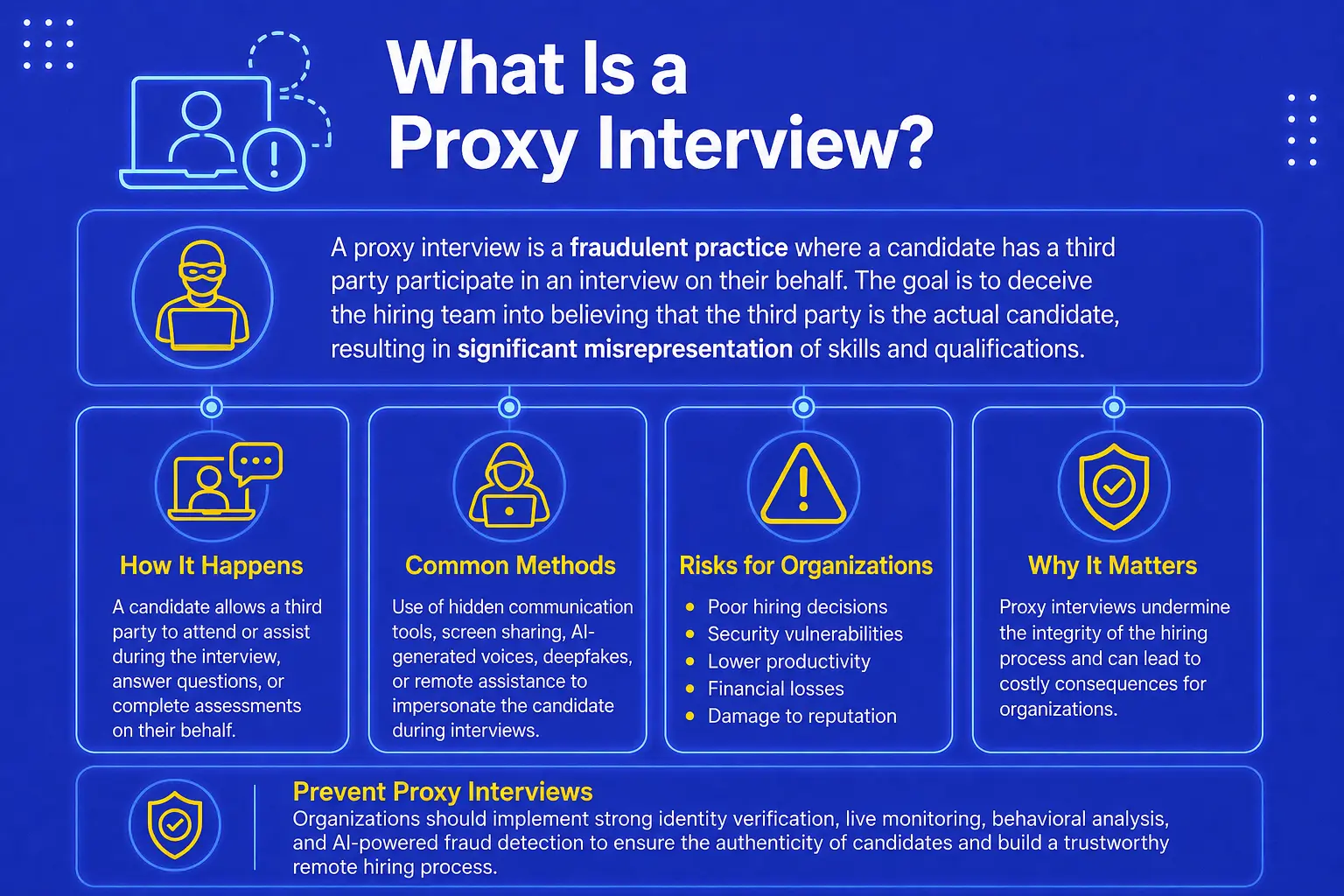
A proxy interview happens when someone other than the actual candidate attends the interview process. In some cases, candidates use another person to answer technical questions during live interviews. In more advanced scenarios, fraudsters rely on AI-generated voices, deepfake videos, remote desktop tools, and real-time assistance to cheat during hiring assessments.
The rise of remote work has significantly increased the risk of interview impersonation. According to Gartner research cited by multiple industry reports, 1 in 4 job candidates globally could be fake by 2028.
As remote hiring continues to evolve, recruiters are facing increasingly sophisticated forms of candidate fraud. What once involved simple impersonation has now expanded into organized proxy interview networks that use advanced technology to manipulate hiring processes. Some candidates receive live assistance through hidden communication devices, while others rely on remote desktop access, AI-generated responses, or coordinated support teams during interviews. These tactics make it difficult for recruiters to accurately evaluate a candidate’s true skills, communication abilities, and professional experience.
Preventing proxy interviews remotely requires more than just conducting video interviews or asking technical questions. Organizations need a layered approach that combines identity verification, behavioral analysis, secure assessments, and real-time monitoring throughout the hiring journey. Companies that strengthen their remote hiring processes can reduce hiring risks, improve recruitment quality, and protect sensitive business operations from fraudulent candidates. With AI-powered hiring security solutions becoming more accessible, businesses now have better tools to identify suspicious behavior before a candidate reaches the onboarding stage.
15 Ways to Prevent Proxy Interviews Remotely
Preventing proxy interviews remotely requires a combination of identity verification, secure interview practices, behavioral monitoring, and AI-driven fraud detection. Companies can no longer rely only on resumes and video calls to evaluate candidates. A structured and secure hiring process helps organizations identify suspicious behavior early and reduce the risk of hiring fraudulent candidates.
Below, we will explore 15 effective ways organizations can detect, prevent, and stop proxy interview fraud during remote hiring.
1. Verify Candidate Identity Before Interviews
Identity verification is one of the most effective ways to prevent proxy interviews remotely. Before moving candidates to technical rounds or final interviews, organizations should confirm that the person attending the interview is the same individual who applied for the role. This step helps reduce impersonation risks and prevents fake candidates from entering the hiring pipeline.
Recruiters can ask candidates to submit government-issued identification documents and conduct live verification during video interviews. Comparing the candidate’s appearance, application details, and official records helps organizations identify suspicious inconsistencies early in the hiring process.
Organizations should also maintain identity verification across multiple interview stages rather than performing it only once. Reconfirming candidate identity during technical rounds and onboarding minimizes the risk of candidate switching later in the process.
How to Implement It
Request government-issued identification before interviews
Match candidate information with application records
Conduct live face verification during video interviews
Use secure identity verification software for remote hiring
Reconfirm identity during onboarding and final selection stages
Example
A software company hiring remote developers asks candidates to upload an official ID before the interview. During the live video interview, the recruiter requests the candidate to briefly display the same ID on camera. The recruiter notices that the facial features do not fully match the submitted document and escalates the profile for further verification, preventing a potential proxy interview attempt.
2. Conduct Mandatory Video Interviews
Mandatory video interviews help organizations reduce the risk of proxy interviews by allowing recruiters to visually verify candidates throughout the hiring process. Unlike audio-only calls or text-based assessments, video interviews make it more difficult for candidates to hide impersonation attempts, receive external assistance, or use fake identities during remote hiring.
Keeping cameras enabled during interviews allows recruiters to observe facial expressions, communication patterns, eye movement, and behavioral consistency. These visual cues often help identify suspicious activity that may indicate proxy interview fraud.
Recruiters should encourage candidates to attend interviews from a professional and distraction-free environment with proper lighting and stable internet connectivity. Clear visibility helps interviewers monitor whether the candidate is genuinely responding independently.
Video interviews also create opportunities for recruiters to ask spontaneous follow-up questions and evaluate whether responses align naturally with the candidate’s experience and resume details.
How to Implement It
Make video interviews mandatory for all remote hiring stages
Require candidates to keep cameras on throughout the session
Use secure video interview platforms with recording capabilities
Ask spontaneous and role-specific follow-up questions
Observe body language, facial expressions, and response timing
Conduct interviews in real time instead of relying only on pre-recorded answers
Example
A company conducting remote interviews for a cloud engineering role notices that a candidate repeatedly looks away from the screen before answering technical questions. The recruiter also observes delayed responses and inconsistent communication patterns during the interview. After further investigation, the company discovers that the candidate was receiving live assistance from another person off-camera.
3. Use AI-Powered Identity Verification Tools Like Sherlock AI
AI-powered identity verification tools help organizations detect suspicious interview behavior that may not be visible during manual screening. As proxy interview fraud becomes more advanced, recruiters can no longer rely only on visual observation to verify candidate authenticity. Fraudulent candidates now use deepfake videos, AI-generated voices, remote desktop tools, and real-time assistance to manipulate remote interviews.
AI-driven verification systems analyze multiple factors during the hiring process, including facial consistency, voice patterns, behavioral activity, device usage, and environmental anomalies. These technologies help organizations identify impersonation attempts and unusual candidate behavior in real time.
Using AI verification tools also improves consistency across remote hiring workflows. Instead of depending entirely on manual checks, recruiters can automate identity verification and fraud detection throughout different interview stages.
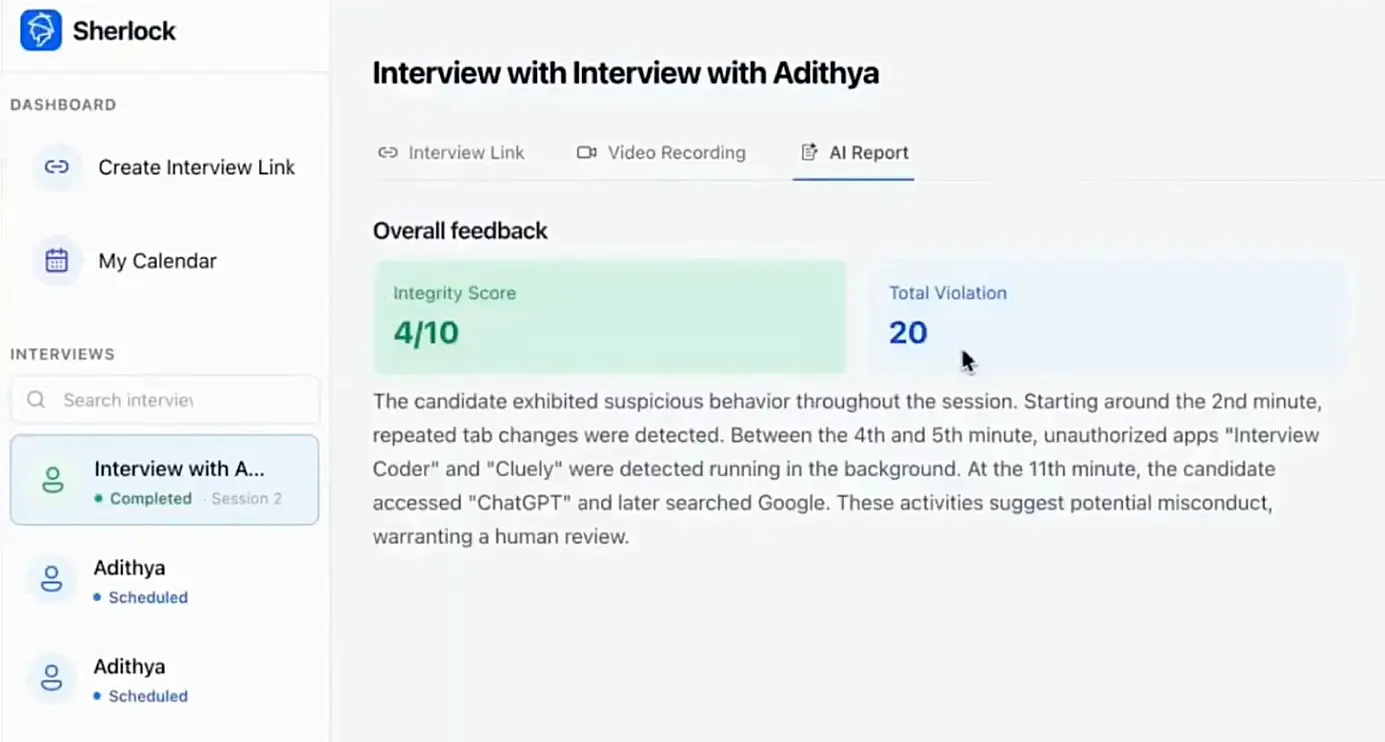
Sherlock AI help organizations strengthen remote hiring security through AI-powered interview monitoring and candidate verification. It can detect suspicious behavioral patterns, identify possible deepfake manipulation, monitor interview integrity, and flag potential proxy interview attempts before fraudulent candidates move further in the hiring process.
How to Implement It
Use AI-based facial recognition during interviews
Detect deepfake videos and voice manipulation
Monitor suspicious behavioral patterns during assessments
Analyze candidate consistency across multiple interview rounds
Integrate AI verification into remote hiring platforms
Enable automated fraud alerts for suspicious interview activity
Example
A recruiter interviewing a remote cybersecurity candidate receives an alert from the verification platform indicating unusual facial inconsistencies and voice synchronization issues during the interview. The candidate’s lip movements do not fully align with the audio responses, and the system detects possible AI-generated voice activity. After reviewing the interview session, the organization identifies the use of deepfake software and prevents the candidate from progressing further in the hiring process.
4. Conduct Real-Time Skill Assessments
Real-time skill assessments help recruiters verify whether candidates genuinely possess the technical and professional skills listed on their resumes. Unlike take-home assignments or unsupervised online tests, live assessments reduce opportunities for proxy participation, external coaching, and hidden assistance during remote hiring.
Candidates involved in proxy interview fraud often depend on another person to complete coding tests, technical challenges, or role-specific assignments. Conducting assessments during live interview sessions allows recruiters to evaluate how candidates think, solve problems, communicate ideas, and respond under pressure without external support.
Real-time evaluations also help interviewers identify inconsistencies between a candidate’s claimed experience and actual technical understanding.
How to Implement It
Conduct live coding or technical exercises
Ask candidates to explain their thought process while solving problems
Use scenario-based assessments relevant to the role
Introduce unexpected follow-up questions during evaluations
Monitor screen activity during assessments
Use collaborative coding platforms with live monitoring features
Example
During a live coding interview for a software engineering role, a candidate quickly completes a programming task but struggles to explain the logic behind the solution. The recruiter asks additional follow-up questions about the code structure and optimization approach, but the candidate fails to provide clear answers. This inconsistency raises concerns that the candidate may have been receiving external assistance during the assessment.
5. Randomize Interview Questions
Candidates involved in proxy interview schemes often prepare scripted responses or rely on external experts to predict common interview questions. Using the same interview structure repeatedly makes it easier for fraudulent candidates to rehearse answers or receive live support during remote interviews.
Randomizing interview questions helps organizations create less predictable interview environments. It allows recruiters to evaluate genuine subject knowledge, problem-solving ability, and communication skills instead of memorized responses.
Dynamic questioning also makes it difficult for candidates using proxy support to coordinate answers in real time. Follow-up questions based on previous responses can further expose inconsistencies in technical understanding and professional experience.
How to Implement It
Use dynamic question banks for interviews
Ask scenario-based and problem-solving questions
Include follow-up questions related to previous answers
Avoid repeating identical interview formats for every candidate
Change technical assessment patterns regularly
Customize interview questions based on the candidate’s resume and experience
Example
A recruiter interviewing a backend developer changes the interview flow midway and asks practical troubleshooting questions related to a project mentioned on the candidate’s resume. Although the candidate initially answers confidently, they struggle to explain basic implementation details and fail to respond clearly to follow-up questions. The recruiter suspects that the earlier responses may have been externally assisted or rehearsed beforehand.
6. Monitor for Unusual Interview Behavior
Behavioral inconsistencies during remote interviews can often indicate proxy interview fraud or external assistance. Recruiters should carefully observe communication patterns, facial expressions, eye movement, response timing, and candidate engagement throughout the interview process.
Candidates involved in proxy interviews may display unnatural pauses, delayed responses, repeated eye movement away from the screen, or inconsistent communication patterns while receiving help from another person. In some cases, candidates may use hidden audio devices, second screens, or messaging platforms during interviews.
Behavioral monitoring helps recruiters identify suspicious activity that may not be detected through resumes or technical assessments alone.
How to Implement It
Observe eye movement and response timing during interviews
Watch for delayed or unnatural answers
Monitor unusual audio disturbances or background interruptions
Identify lip-sync mismatches during conversations
Record interviews for later review if necessary
Train recruiters to recognize signs of interview manipulation
Example
During a technical interview, a candidate repeatedly pauses before answering questions and frequently looks away from the screen. The recruiter notices that responses often begin several seconds after the question is asked, as if the candidate is listening to external instructions. After further investigation, the company discovers that the candidate was receiving live assistance through a hidden audio device.
7. Reverify Candidate Identity During Onboarding
Some fraudulent candidates use proxy support only during interviews and later send a different individual to join the organization after selection. Revalidating identity during onboarding helps companies confirm that the selected candidate is the same person who completed the interview process.
Many organizations focus heavily on interview verification but fail to continue identity checks during onboarding. This creates opportunities for candidate substitution after job offers are released.
Reverification helps maintain consistency across recruitment and onboarding while reducing the risk of unauthorized individuals gaining access to company systems.
How to Implement It
Conduct live onboarding verification sessions
Match onboarding records with interview documentation
Recheck government-issued identification
Use biometric or AI-based verification tools
Compare interview recordings with onboarding appearances
Verify employee details before granting system access
Example
A remote hiring team notices that the employee attending onboarding sessions looks noticeably different from the person interviewed during technical rounds. After conducting additional verification, the company identifies a candidate substitution attempt before granting access to internal systems and confidential company resources.
8. Use Secure Remote Interview Platforms
Using secure interview platforms is essential for preventing unauthorized access, hidden collaboration, and interview manipulation during remote hiring. Basic video conferencing tools without security controls may allow candidates to exploit vulnerabilities during interviews.
Secure remote hiring platforms provide features such as identity verification, screen monitoring, browser restrictions, interview recording, and AI-powered fraud detection to improve interview integrity.
Organizations should choose platforms designed specifically for secure hiring workflows instead of relying only on general communication tools.
How to Implement It
Use interview platforms with built-in identity verification
Enable secure interview recording and monitoring
Restrict unauthorized screen sharing during assessments
Use browser lockdown or proctoring features for technical tests
Enable suspicious activity alerts during interviews
Protect interview sessions with secure login authentication
Example
A company conducting remote technical assessments switches to a secure interview platform with live proctoring and screen monitoring capabilities. During an assessment, the platform detects multiple unauthorized window switches and external screen-sharing attempts, helping recruiters identify suspicious candidate behavior immediately.
9. Perform Thorough Background Verification
Background verification helps organizations confirm whether a candidate’s education, employment history, certifications, and professional experience are genuine. Many candidates involved in proxy interviews also exaggerate or falsify credentials to improve their chances of getting hired.
Conducting proper background checks helps organizations identify inconsistencies before onboarding fraudulent candidates.
Verification should not be limited to resumes alone. Recruiters should validate employment records, references, and skill claims through reliable sources.
How to Implement It
Verify educational qualifications and certifications
Cross-check previous employment history
Contact professional references directly
Validate technical experience mentioned on resumes
Use third-party background verification services
Review candidate online professional profiles for consistency
Example
A company hiring a remote DevOps engineer conducts background verification after the final interview round. During the process, recruiters discover that the candidate falsely claimed experience at a well-known technology company and provided fake employment documentation, preventing a fraudulent hire.
10. Train Recruiters to Detect Proxy Interviews
Technology alone cannot completely eliminate proxy interview fraud. Recruiters and hiring managers must also understand how proxy interviews work and learn how to identify suspicious candidate behavior during remote hiring.
Training recruitment teams improves awareness of common fraud tactics, behavioral warning signs, and emerging AI-based interview manipulation techniques.
Organizations with well-trained hiring teams are more likely to detect inconsistencies early and prevent fraudulent candidates from progressing through recruitment stages.
How to Implement It
Train recruiters to identify impersonation signs
Educate hiring teams about deepfakes and AI-generated voices
Conduct workshops on remote hiring fraud detection
Share examples of common proxy interview tactics
Standardize interview verification procedures
Create escalation processes for suspicious candidates
Example
A recruitment team participates in internal training on detecting proxy interviews and learns how to identify unusual communication patterns and deepfake inconsistencies. During a later interview, a recruiter notices suspicious lip-sync delays and inconsistent facial movement, helping the company detect a fraudulent candidate before the final selection stage.
11. Conduct Multi-Round Interviews With Different Interviewers
Conducting multiple interview rounds with different interviewers helps organizations identify inconsistencies in candidate behavior, communication, and technical knowledge. Proxy interview candidates often struggle to maintain consistency across several rounds, especially when different interviewers ask unexpected or role-specific questions.
Using varied interview panels also reduces the chances of candidates relying on rehearsed answers or external support throughout the hiring process.
Different interviewers can evaluate separate aspects of the candidate, including technical expertise, communication skills, problem-solving ability, and cultural fit.
How to Implement It
Schedule multiple interview rounds for critical roles
Involve technical, managerial, and HR interviewers
Use different question formats in each round
Compare candidate responses across interviews
Document inconsistencies in communication or experience
Conduct surprise follow-up discussions when necessary
Example
A candidate applying for a remote data engineering role performs exceptionally well during the first technical interview. However, during the second round with a different interviewer, the candidate struggles to explain the same concepts discussed earlier. The hiring team notices major inconsistencies and identifies possible proxy interview involvement.
12. Use Live Problem-Solving Sessions
Live problem-solving sessions help recruiters evaluate how candidates think and respond in real time without relying on external assistance. Unlike memorized answers or prepared assignments, spontaneous problem-solving exercises reveal a candidate’s genuine technical and analytical abilities.
These sessions are especially effective for technical, analytical, and operational roles where practical thinking is essential.
Recruiters can also evaluate communication style, decision-making, and adaptability during the exercise.
How to Implement It
Use real-world scenarios related to the job role
Ask candidates to explain their reasoning step by step
Introduce follow-up challenges during the session
Conduct collaborative exercises in real time
Monitor how candidates respond under pressure
Avoid sharing complete assessment details in advance
Example
During a live troubleshooting exercise for a network engineering role, a candidate initially gives strong responses but becomes confused when the interviewer changes the scenario slightly. The recruiter notices that the candidate struggles to adapt without scripted guidance, indicating possible external coaching during earlier rounds.
13. Monitor Device and Network Activity During Assessments
Monitoring device and network activity during remote assessments helps organizations identify suspicious behavior linked to proxy interviews and external assistance. Candidates involved in fraudulent activities may use multiple devices, remote desktop tools, hidden browser tabs, or unauthorized communication platforms during interviews.
Advanced monitoring systems can detect unusual technical behavior and alert recruiters in real time.
This approach is especially important for high-risk technical and security-sensitive roles.
How to Implement It
Use secure proctoring software during assessments
Detect unauthorized browser switching or tab activity
Monitor multiple device connections during interviews
Restrict remote desktop access during evaluations
Enable suspicious activity alerts for recruiters
Record assessment sessions for audit purposes
Example
A company conducting a remote coding assessment notices repeated browser switching and unauthorized application usage during the test. The monitoring platform flags the activity, and recruiters later discover that the candidate was receiving live coding support through an external communication tool.
14. Maintain Consistency Checks Throughout Hiring
Consistency checks help recruiters compare candidate behavior, communication style, technical understanding, and identity throughout the entire hiring process. Proxy interview candidates often struggle to maintain consistent performance across multiple stages because different individuals may participate in interviews or assessments.
Reviewing consistency across resumes, interviews, technical tests, and onboarding helps organizations detect unusual discrepancies early.
Consistency analysis also improves overall hiring accuracy and reduces the chances of fraudulent candidates progressing unnoticed.
How to Implement It
Compare interview performance across multiple rounds
Review consistency in communication style and technical knowledge
Validate resume claims during interviews
Match onboarding behavior with interview recordings
Document suspicious inconsistencies for review
Conduct additional verification for high-risk candidates
Example
A recruiter notices that a candidate who demonstrated advanced cloud architecture knowledge during technical interviews struggles to answer basic onboarding questions related to the same subject. The company conducts additional verification and discovers that another individual participated in earlier interview rounds.
15. Establish a Structured Remote Hiring Workflow
A structured remote hiring workflow helps organizations reduce confusion, improve consistency, and minimize opportunities for proxy interview fraud. When hiring processes are unorganized or inconsistent, fraudulent candidates can exploit gaps between screening, assessments, interviews, and onboarding stages.
Creating a standardized workflow ensures that every candidate goes through the same verification, evaluation, and monitoring process throughout recruitment. This makes it easier for recruiters to identify suspicious behavior, inconsistencies, and impersonation attempts during remote hiring.
A well-defined hiring workflow also improves collaboration between recruiters, hiring managers, and technical interviewers while strengthening overall recruitment security.
How to Implement It
Standardize identity verification for all candidates
Use consistent interview and assessment procedures
Conduct verification at multiple hiring stages
Document interview observations and candidate behavior
Maintain secure records of interviews and assessments
Create escalation processes for suspicious candidates
Align recruiters and interviewers on fraud detection practices
Example
A company hiring remote software developers creates a structured hiring workflow that includes identity verification, live technical assessments, behavioral monitoring, and onboarding revalidation. During the final stage, recruiters notice inconsistencies between the candidate’s earlier interview responses and onboarding interactions. Because the organization followed a standardized verification process, the suspicious activity is identified before system access is granted.
How Sherlock AI Helps Prevent Proxy Interviews Remotely
As proxy interview fraud becomes more sophisticated, organizations need stronger hiring security measures beyond traditional verification methods. Manual checks alone are often not enough to detect deepfake videos, AI-generated voices, hidden assistance, or impersonation attempts during remote interviews.
Sherlock AI helps organizations strengthen remote hiring security through AI-powered candidate verification and interview fraud detection. The platform is designed to help recruiters identify suspicious interview behavior, maintain hiring integrity, and reduce the risk of fraudulent candidates entering the organization.
Sherlock AI continuously analyzes interview activity in real time to detect inconsistencies that may indicate proxy interview fraud. By combining behavioral monitoring, facial analysis, and identity verification, organizations can improve hiring accuracy while reducing manual effort for recruitment teams.

Key Features of Sherlock AI
Real-Time Candidate Authenticity Checks
Sherlock AI helps recruiters confirm that the same individual participates throughout the entire hiring process. The platform continuously analyzes candidate behavior, facial consistency, and interview interactions to identify potential impersonation attempts or candidate switching during remote interviews.
Deepfake and Voice Manipulation Detection
The platform can identify suspicious facial movements, lip-sync inconsistencies, and AI-generated voice patterns that may indicate deepfake usage during interviews. Sherlock AI continuously analyzes video and audio behavior in real time to detect unnatural communication patterns that are difficult to identify through manual observation alone.
Real-Time Behavioral Monitoring
Sherlock AI analyzes candidate behavior, response timing, eye movement, and interview interactions to detect unusual activity or hidden assistance. The platform continuously monitors interview engagement patterns to identify signs of proxy interview fraud, external coaching, or suspicious communication behavior during remote hiring.
Interview Integrity Analysis
The platform monitors interview consistency across multiple hiring stages to help organizations identify discrepancies in communication, technical understanding, and candidate behavior. Sherlock AI compares interview patterns across screening rounds, and in managerial discussions, stages to identify potential candidate substitution or impersonation attempts.
Automated Fraud Alerts
Recruiters receive real-time alerts when suspicious interview activity is detected, allowing hiring teams to investigate potential risks before moving candidates forward. Sherlock AI automatically flags unusual behavior patterns such as voice inconsistencies, facial mismatches, prolonged response delays, suspicious device activity, and abnormal interview interactions.
Secure Remote Hiring Workflow
Sherlock AI supports secure and structured remote hiring processes by integrating identity verification, interview monitoring, and fraud detection into a single workflow. Organizations can standardize candidate verification procedures across every hiring stage, helping recruiters maintain consistency and reduce security gaps during remote recruitment.
Conclusion
Proxy interviews have become a growing challenge in remote hiring as candidates increasingly use impersonation techniques, external assistance, deepfake technology, and AI-generated tools to manipulate recruitment processes. Traditional interview methods alone are no longer enough to protect organizations from fraudulent hiring attempts.
To prevent proxy interviews remotely, companies need a structured hiring strategy that combines identity verification, real-time assessments, behavioral monitoring, secure interview platforms, and recruiter awareness. Organizations that implement strong verification practices across every stage of hiring can significantly reduce the risk of fraudulent candidates entering the workforce.
AI-powered hiring security solutions are also playing a major role in helping businesses strengthen remote recruitment. Platforms like Sherlock AI help organizations detect suspicious interview behavior, identify impersonation attempts, and maintain interview integrity throughout the hiring process.
As remote hiring continues to evolve, businesses that prioritize secure and transparent recruitment practices will be better positioned to hire genuine talent, protect sensitive systems, and build stronger, more trustworthy teams.