Back to all blogs
Learn how to prevent interview fraud in mass hiring. Discover common fraud patterns, detection strategies, and how Sherlock AI ensures real-time interview integrity at scale.

Abhishek Kaushik
May 13, 2026
Interview fraud in high-volume recruitment is no longer a niche concern. Employers are facing an unprecedented rise in deceptive candidate behavior, driven in part by easy access to AI tools and remote interviewing platforms. Gartner predicts that by 2028, 1 in 4 candidate profiles worldwide could be fake, a staggering shift in candidate authenticity that demands new controls.
59% of managers report suspecting candidates of using AI or other deceptive tactics to misrepresent themselves, and about 31% have actually interviewed someone later revealed to be using a false identity or proxy. Increasingly, organizations are also experiencing the financial impact of fraud in hiring with nearly one in four reporting losses of more than $50,000 due to fraudulent hires or identity deception.
The combination of high applicant volumes, remote interviews, and sophisticated deception tools has created the perfect conditions for fraud to flourish at scale. In this blog, we’ll explore the root causes of interview fraud in mass hiring, common fraud patterns hiring teams encounter, and practical prevention strategies you can implement today.
Why Interview Fraud Scales So Easily in Mass Hiring
Interview fraud is a problem n high-volume recruitment because the conditions that make mass hiring efficient also make it easier for fraud to slip through unnoticed. Traditional hiring workflows were never designed for today’s remote, AI-assisted environment, and that gap is being exploited at scale.
Here’s why fraud scales so easily:
1. Overwhelming applicant volumes: When recruiters receive hundreds or thousands of applications per role, it becomes impractical to manually verify every resume, interview, or portfolio. High volumes reduce the time spent on individual checks, creating blind spots fraudsters can exploit.
2. Standardized interviews with limited verification: Mass hiring often relies on repeatable, structured questions designed for speed and fairness. These formats are easy for candidates or AI tools to anticipate and game. Generic Q&A doesn’t force real thinking or identity consistency, which makes cheating easier.
3. Interviewer fatigue and cognitive overload: In mass hiring, interviewers often run back-to-back sessions with minimal breaks. This fatigue reduces their ability to spot subtle deception cues, especially when fraud tactics mimic legitimate responses.
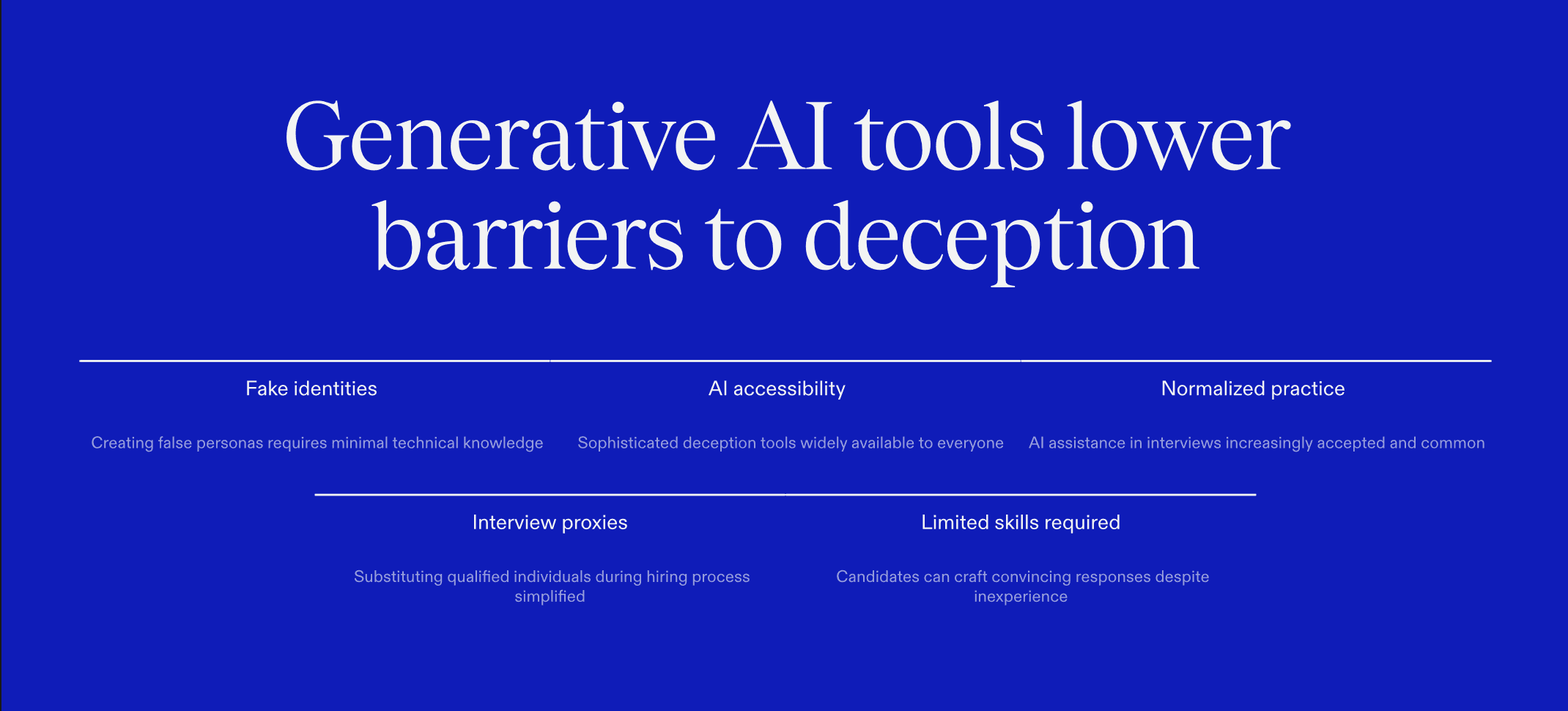
4. AI tools democratizing fraud: Generative AI and low-cost fraud tools have lowered the technical barrier even candidates with limited skills can craft convincing interview responses or fake identities. What used to require technical know-how is now accessible to anyone.
5. Competitive pressures and reduced moral barriers: As cheating becomes normalized, many candidates feel compelled to use AI or proxies just to stay competitive especially in roles with large applicant pools and tight deadlines. This drives a self-reinforcing cycle where fraud spreads because others are perceived to be doing it.
Mass hiring creates ideal conditions for proxy candidates, AI assistance, and identity fraud to slip through unnoticed, overwhelming traditional verification and trust-based interviewing methods, with the real cost often showing up later as bad hires, repeated hiring cycles, and avoidable operational risk.
The Most Common Interview Fraud Patterns in High-Volume Hiring
High-volume hiring exposes recruiters to a variety of fraud patterns that are harder to spot when dozens or hundreds of candidates are interviewed daily. Understanding what actually occurs at scale is critical for prevention.
Here are the most common patterns:
1. Proxy Interviews and Stand-ins
Someone other than the applicant attends the interview often a more qualified person or AI-assisted proxy. These can be hard to detect in mass hiring without continuous identity verification.
2. AI Copilots and Scripted Answers
Candidates use real-time AI tools to generate polished responses, relying on hidden prompts or browser overlays. Even structured interview questions can be gamed with near-perfect answers.
3. Reused Identities Across Multiple Applications
Fraudsters submit multiple applications using the same or slightly altered identities to increase chances of placement. High-volume hiring makes it difficult to track duplicates without automated checks.
4. Deepfake or Altered Audio/Video
Face or voice manipulation is increasingly being used to impersonate candidates. Deepfakes allow someone to appear as a different person, while AI can generate consistent voice or lip-sync patterns.
5. Coordinated Cheating Rings
Some groups organize at scale, sharing scripts, AI prompts, or proxies across multiple candidates. These rings exploit standardized interviews and bulk application pipelines in large organizations.
By identifying these fraud patterns, recruiters and hiring teams can tailor both detection and prevention strategies, making mass hiring safer and more reliable.
Read more: 15 Interview Fraud Examples Hiring Teams Must Know in 2026
How to Prevent Interview Fraud Without Slowing Down Hiring
Preventing fraud in high-volume hiring requires strategies that scale, you can’t rely on manual verification or random spot checks. The key is to combine prevention, real-time detection, and purpose-built systems without adding friction to the process.
Here’s how organizations can address it:
1. Pre-Interview Identity and Continuity Checks
Verify candidate identity before interviews begin using biometric or multi-factor methods.
Ensure the same person attends all stages of the process to prevent proxy interviews or identity swaps.
Track continuity across applications to flag reused or suspicious identities.
2. Real-Time Behavioral and Technical Signals
Monitor eye-line movement, response latency, and speech patterns during interviews to detect AI assistance or scripted responses.
Analyze audio-visual consistency to catch deepfake or altered video/audio attempts.
Track behavioral inconsistencies across follow-up questions.
3. Automation vs Human Review Balance
Use automated systems to flag high-risk patterns in real time.
Human reviewers focus on flagged sessions or anomalies rather than reviewing all interviews manually.
This approach ensures scale without slowing down hiring velocity.
4. Purpose-Built Interview Integrity Systems
High-volume hiring requires tools specifically designed to detect AI assistance, impersonation, and coordinated fraud.
These systems integrate seamlessly with existing interview workflows, protecting integrity without adding delays or friction.
By combining pre-interview verification, real-time monitoring, and purpose-built integrity systems, organizations can prevent fraud at scale while keeping mass hiring efficient and reliable.
Sherlock AI: The Purpose-Built Solution for Mass Hiring Integrity
When hiring at scale, traditional checks break down but Sherlock AI is engineered specifically to address the unique fraud vectors in high‑volume remote interviewing.
Rather than partial indicators or one‑off rule flags, Sherlock AI uses advanced multimodal intelligence to provide real‑time integrity signals without slowing down the hiring pipeline.
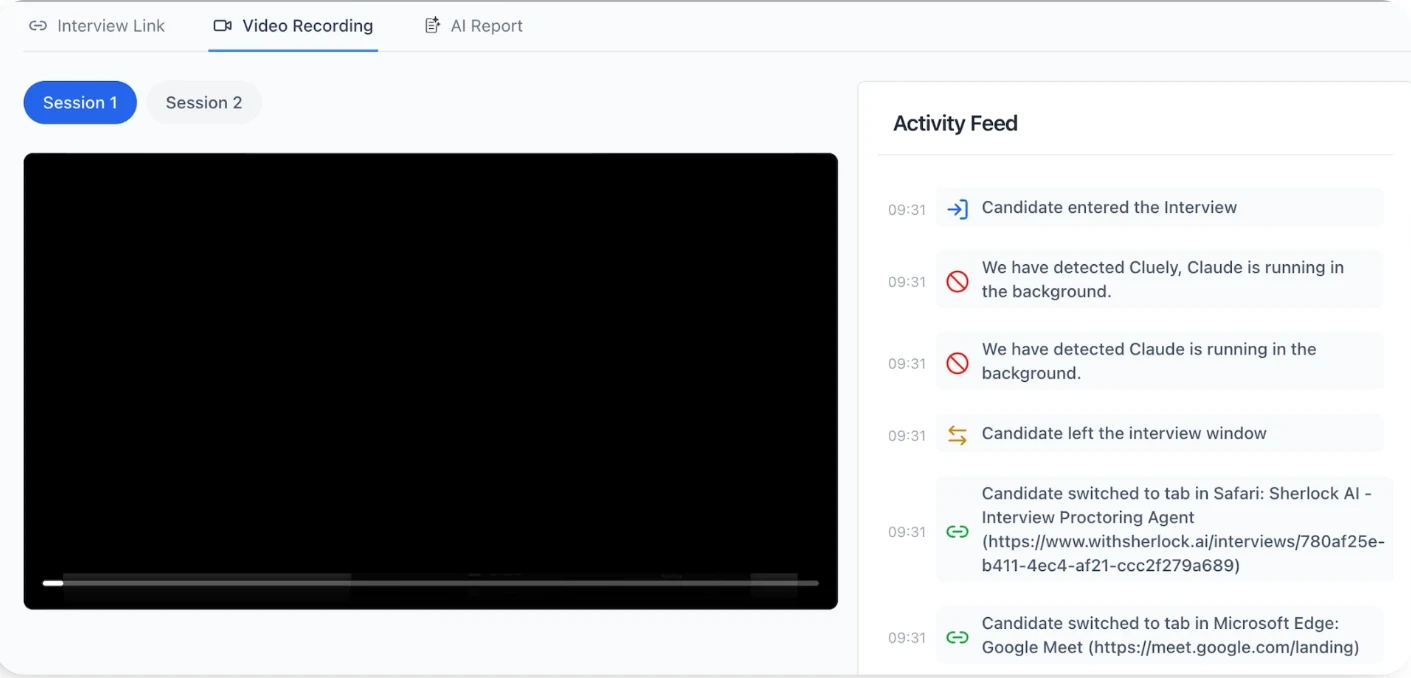
Sherlock AI Capabilities Designed for Scale:
Multimodal Fraud Detection Engine: Sherlock AI combines device activity, audio environment, and candidate behavioral patterns into a unified classifier, modeling natural vs adversarial interaction signatures with enterprise‑grade accuracy (improved to >97%).
Real‑Time Identity & Continuity Verification: Instead of intrusive ID scans, Sherlock AI verifies that the same individual remains present throughout the session using face and voice pattern continuity, preventing proxy interviews or identity swaps with minimal candidate friction.
Behavioral & Contextual Signal Analysis: By analyzing gaze, attention shifts, response latency anomalies, and reasoning consistency over time, Sherlock AI detects hidden AI assistance, scripted answers, and interaction patterns that indicate external help.
Environmental & Audio Context Monitoring: Sherlock AI evaluates audio cues and environment inconsistencies such as overlapping voices or unusual background patterns, as part of its combined signal model, strengthening detection while avoiding over‑reliance on any single indicator.
AI Fluency Observation (Optional Mode): In use cases where AI assistance is allowed (e.g., problem solving with tools), Sherlock AI can assess how effectively candidates integrate those tools, not just flag them, enabling nuanced evaluation rather than blunt disqualification.
Automated Notes & Insight Capture: Beyond fraud detection, Sherlock AI generates structured interview notes and insights automatically, reducing manual workload and creating audit‑ready records aligned with integrity signals.
Seamless Workflow Integration: Interviewers connect Sherlock AI to their Google, Apple, or Outlook calendar and enable it for scheduled meetings. The system then auto‑joins interviews and provides real‑time feedback without altering interviewer flow.
Real‑Time Alerts, Not Verdicts: Sherlock AI surfaces actionable alerts when patterns suggest potential assistance or fraud, empowering hiring teams to review flagged behavior. It augments human decision‑making rather than replacing it.
Unlike generic proctoring or rule‑based tools, Sherlock AI pattern‑based, multimodal approach scales across hundreds or thousands of interviews with consistent fidelity. It reduces false positives by contextualizing signals over time rather than reacting to isolated cues, enabling teams to maintain throughput and integrity even in large hiring cycles.
Conclusion
Interview fraud is no longer a rare problem in mass hiring. It is a systemic risk that can slip through traditional checks, from proxy candidates to AI-assisted responses and deepfake impersonation. Relying on manual review or standardized questions alone is no longer enough to protect hiring integrity.
Sherlock AI provides a purpose-built solution for these challenges, offering real-time monitoring, multimodal behavioral analysis, identity verification, and actionable alerts, all without slowing down high-volume recruitment. By implementing tools like Sherlock AI, organizations can detect and prevent fraud at the source, ensuring that candidate performance reflects real skill, not artificial assistance.
In mass hiring, maintaining trust in interviews is essential. With the right systems in place, you can scale hiring efficiently while safeguarding your team, your data, and your talent pipeline.