Back to all blogs
Explore how intelligent proctoring platforms detect cheating in remote interviews and why trust-first solutions like Sherlock AI are shaping the future.

Abhishek Kaushik
Jan 9, 2026
Remote assessments and interviews are now a core part of modern hiring and education. While they offer speed, scale, and global reach, they also introduce new risks. From AI-generated answers to off-screen assistance and impersonation, cheating methods have become more sophisticated and harder to detect manually.
This is where intelligent proctoring systems come in. Understanding how proctoring platforms detect and prevent cheating helps organizations maintain fairness, protect assessment integrity, and ensure decisions are based on real ability not external help. In a recent survey of U.S. job seekers, found that 7 in 10 recent job applicants engaged in some form of cheating or dishonest behavior somewhere in the hiring process including interviews.
This article explores how modern proctoring platforms work, what signals they analyze, where their limits lie, and how trust-first solutions like Sherlock AI approach proctoring differently.
What Are Proctoring Platforms and What Is Their Purpose?
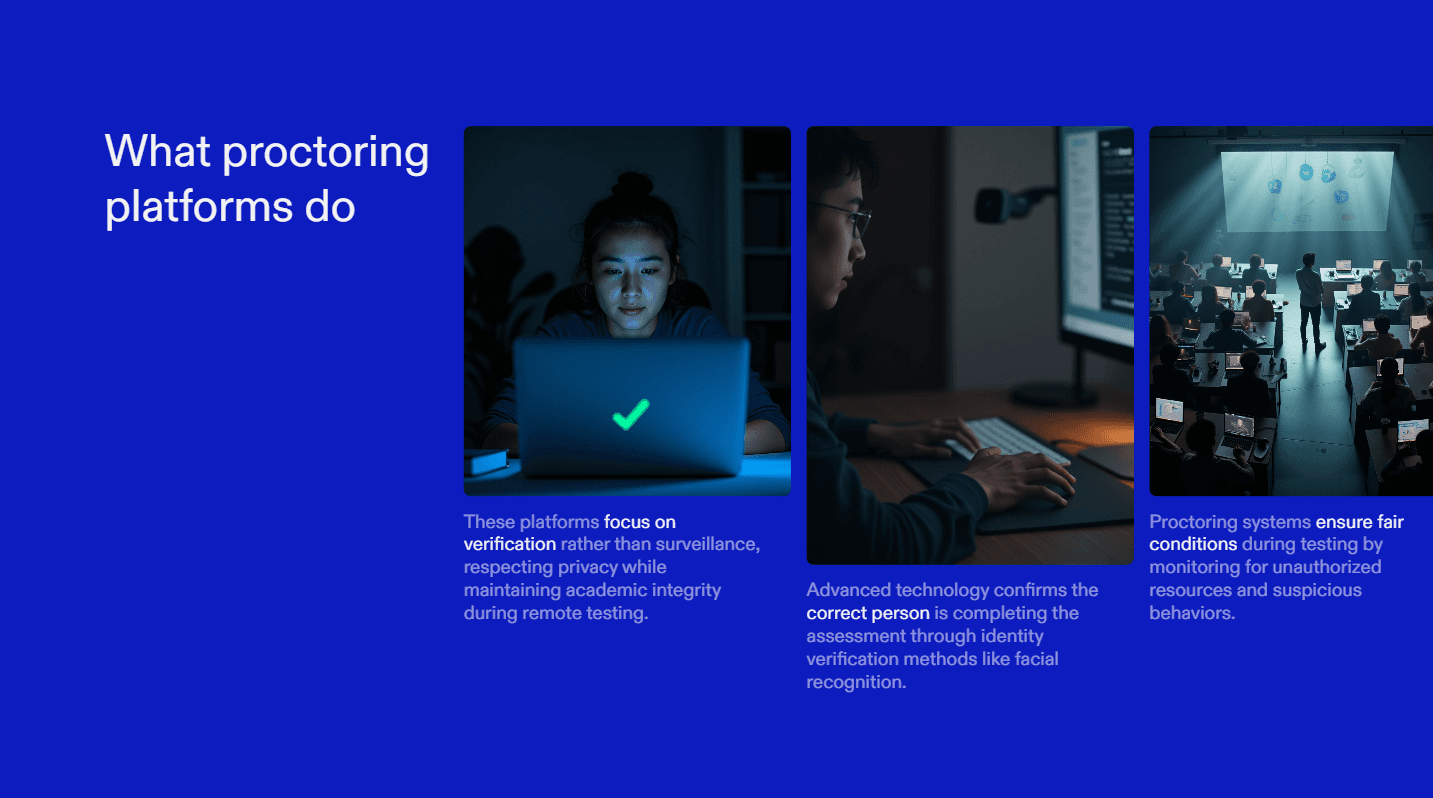
Proctoring platforms are digital systems designed to supervise remote exams, interviews, and assessments. Their goal is not surveillance for its own sake, but verification confirming that the right person is completing the assessment under fair conditions.
Modern platforms go beyond simple webcam monitoring. They combine artificial intelligence, behavioral analysis, and human review to understand context, consistency, and intent. This layered approach is central to how proctoring platforms detect and prevent cheating without disrupting genuine candidates.
How Proctoring Platforms Detect and Prevent Cheating
1. Using Identity Verification
A foundational layer in how proctoring platforms detect and prevent cheating is identity and continuity verification.
Rather than relying solely on one-time ID checks, AI-based systems monitor whether the same individual remains present throughout the session. Facial consistency, voice patterns, and session continuity help detect proxy participation or candidate switching without requiring intrusive manual checks.
This ensures that assessments measure the intended individual’s skills from start to finish.
2. Through Behavioral Monitoring
Behavioral monitoring focuses on how a candidate interacts during an assessment, not just what they submit. In practice, these are the small timing and interaction shifts that most interviewers notice but can’t reliably track on their own.
AI analyzes response timing, interaction flow, hesitation patterns, and consistency across questions. For example, repeated delays followed by unusually polished answers may suggest external assistance. Importantly, single behaviors are never treated as proof patterns over time are what matter.
This approach reduces false positives caused by stress, cultural differences, or natural pauses.
3. Screen and System Analysis
Another critical layer in how proctoring platforms detect and prevent cheating is system-level monitoring. For remote interviews especially, this layer is a core part of overall interview security, not just “extra” monitoring.
This can include detecting restricted tab switching, unusual application behavior, or repeated focus loss during key moments. Unlike rigid browser lockdowns alone, modern platforms interpret these signals in context, distinguishing between technical issues and suspicious behavior.
Used responsibly, system analysis strengthens integrity without penalizing legitimate users.
4. Using Audio and Environmental Signals
Audio and environmental context adds another dimension to proctoring intelligence.
Rather than constant recording or surveillance, AI looks for anomalies such as overlapping voices, sudden background changes, or repeated whispering patterns. These signals do not automatically indicate cheating, but they contribute to a broader behavioral picture when combined with other indicators.
This contextual approach is more accurate than relying on a single detection method.
What Proctoring Platforms Do Not Do
Understanding how proctoring platforms detect and prevent cheating also means knowing what they are intentionally designed not to do. Responsible platforms operate with clear boundaries to protect fairness and trust.
They do not automatically disqualify candidates
Proctoring platforms do not make final pass-or-fail decisions on their own. AI-generated signals are used to highlight potential concerns, not to instantly reject a candidate. This ensures that honest candidates are not unfairly penalized due to technical issues, nervousness, or natural variations in behavior.They do not rely on isolated behaviors
Single actions such as looking away from the screen, pausing before answering, or adjusting posture are not treated as evidence of cheating. Proctoring platforms evaluate patterns and consistency over time, recognizing that individual behaviors can have many legitimate explanations.They do not replace human decision-making
Final judgment always remains with human reviewers, recruiters, or evaluators. Proctoring platforms provide structured insights and contextual data to support better decisions, not to remove human oversight from the process.They do not assume intent without context
Responsible systems avoid labeling behavior as cheating without considering the broader interview or assessment context. This helps reduce bias and prevents misinterpretation of culturally or individually influenced behaviors.They do not prioritize surveillance over fairness
Modern proctoring platforms are designed to assist, not intimidate. Their purpose is to support integrity while maintaining a respectful and transparent experience for candidates.
Together, these boundaries ensure that proctoring technology strengthens assessment integrity while keeping the process fair, explainable, and human-led.
How Sherlock AI Takes a Different Approach to Proctoring Integrity
Sherlock AI is designed specifically for interviews and real-world skill evaluation, not standardized exams.
Instead of enforcing rules, Sherlock AI focuses on understanding behavior, reasoning, and response authenticity. It analyzes how candidates explain ideas, adapt to follow-ups, and maintain consistency across the interview.
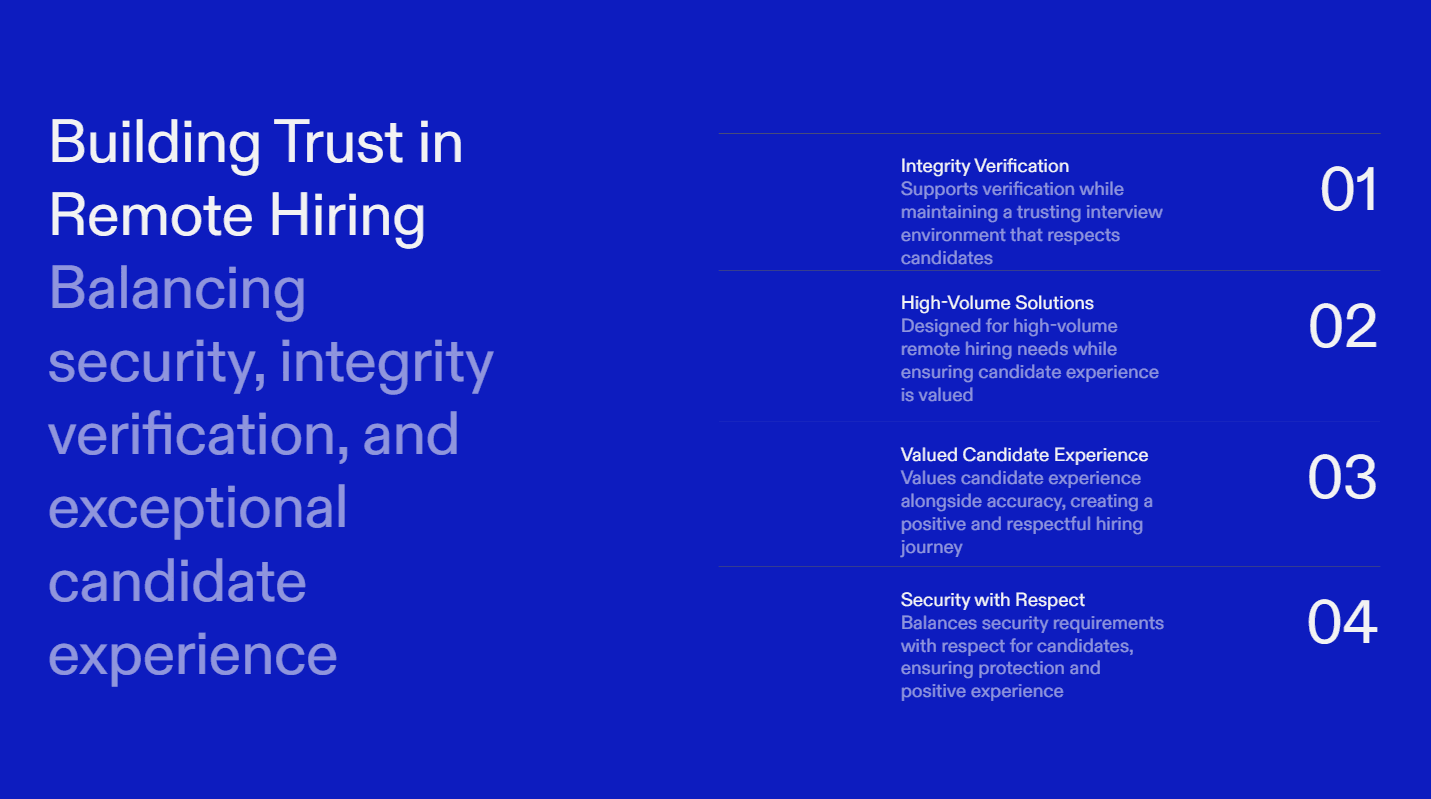
Sherlock AI’s approach supports integrity while preserving trust making it suitable for modern, high-volume, remote hiring environments where experience matters as much as accuracy.
The Future of Proctoring Platforms in Detecting and Preventing Cheating
The future of proctoring platforms will move away from heavy surveillance and toward smarter, more contextual detection methods. Instead of focusing on strict controls, these platforms will prioritize reasoning, behavioral consistency, and skill validation to identify genuine performance. This shift will allow organizations to maintain assessment integrity while preserving privacy, fairness, and candidate trust.
1. Shift From Surveillance to Smarter Cheating Detection
Future proctoring platforms will rely less on constant monitoring and more on meaningful behavioral signals that indicate genuine understanding.
2. Greater Focus on Reasoning-Based Evaluation
AI will prioritize how candidates think and explain their answers, making real-time assistance tools less effective.
3. Rise of Adaptive and Context-Aware Interviews
Interview flows will adjust dynamically based on responses, reducing the impact of scripted or AI-generated answers.
4. Adoption of Privacy-Preserving AI Models
Proctoring systems will collect less data while extracting higher-quality insights, improving compliance and candidate trust.
5. Proctoring as Decision Support, Not Enforcement
AI will increasingly assist human reviewers by surfacing patterns and insights instead of acting as an automated gatekeeper.
Final Thoughts
As AI tools continue to advance, the challenge is no longer whether cheating can happen, but how organizations respond to it responsibly. Traditional, rule-heavy approaches are proving insufficient in a world where assistance can be invisible, instant, and scalable.
The future of fair assessment lies in smarter design, better signal interpretation, and clear expectations. By focusing on how candidates reason, adapt, and communicate under real conditions, organizations can evaluate true capability rather than surface-level performance.
Platforms like Sherlock AI reflect this shift by prioritizing behavioral understanding, contextual insights, and human judgment over invasive controls. By balancing accuracy with transparency and trust, Sherlock AI demonstrates how proctoring can strengthen integrity while preserving a fair and respectful candidate experience in an increasingly digital world.