Back to all blogs
Discover the warning signs of lip sync mismatch in interviews, why it happens, and how recruiters can detect deepfakes, proxy interviews, and interview fraud.
Abhishek Kaushik
Jul 13, 2026

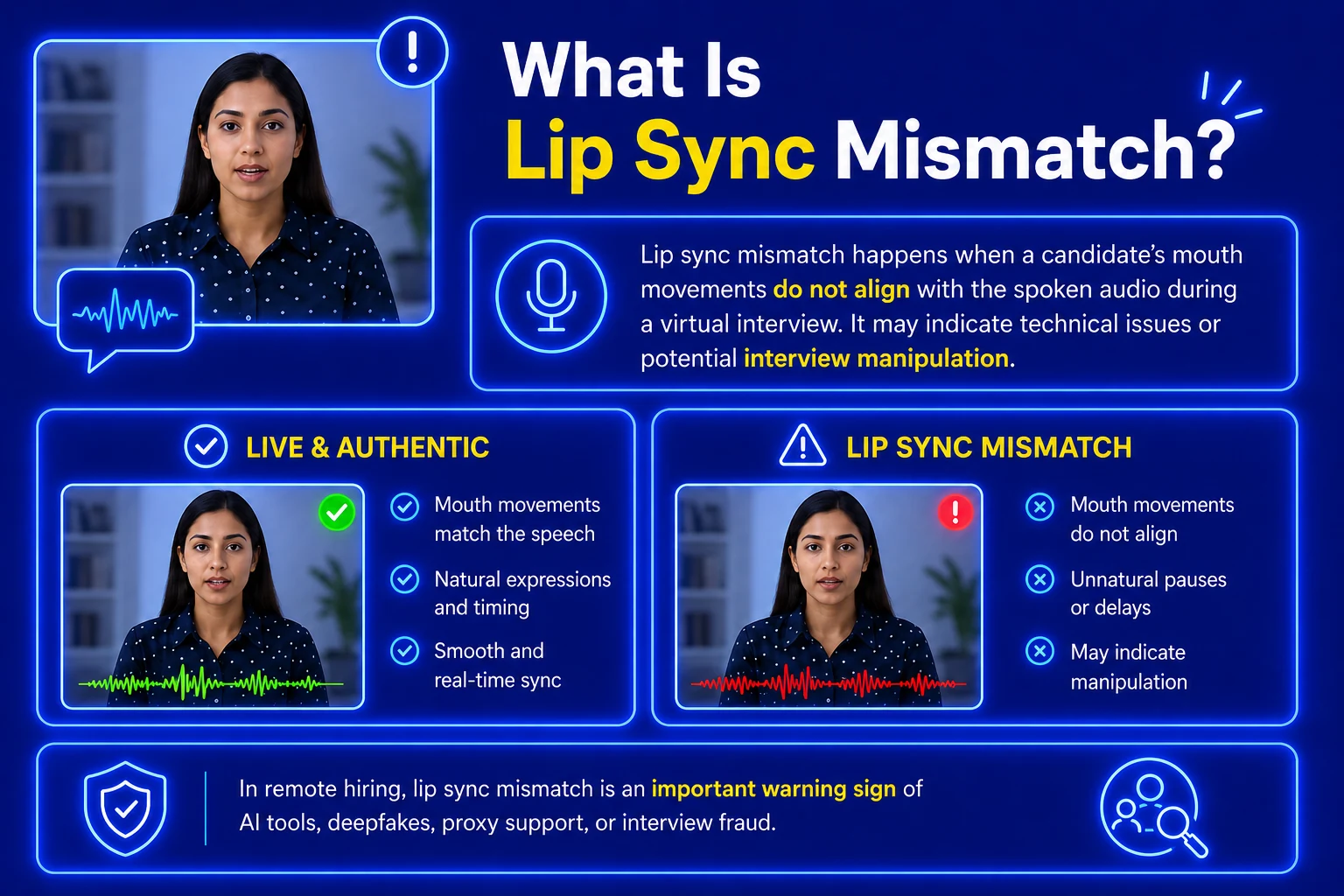
Virtual interviews have become the standard hiring method for companies worldwide. While remote hiring improves speed and accessibility, it has also created new opportunities for interview fraud, deepfake impersonation, and AI assisted cheating. One of the most overlooked warning signs during virtual interviews is lip sync mismatch, where a candidate’s mouth movements do not properly align with their speech.
Lip sync mismatch in interviews can indicate several types of suspicious activity. In some cases, candidates may use AI generated avatars, deepfake overlays, delayed audio feeds, or external assistance tools to manipulate interview outcomes. Recruiters are increasingly reporting situations where facial movements appear unnatural, speech timing feels delayed, or the candidate’s expressions do not match their responses.
The rise of AI powered fraud has made this problem more serious than ever. According to Statista, 46% of businesses surveyed experienced cases of synthetic identity fraud and other advanced identity manipulation techniques linked to AI generated content. Another report found that more than 10% of organizations worldwide experienced deepfake powered cyberattacks between 2024 and 2025.
These statistics highlight why recruiters can no longer rely solely on traditional interview evaluation methods. Hiring teams must now assess both candidate skills and digital authenticity during remote interviews.
Detecting lip sync mismatch is becoming a critical part of interview fraud prevention because these inconsistencies often reveal deeper manipulation attempts. Small signs such as delayed lip movement, frozen facial expressions during speech, unnatural pauses, or mismatched phonemes can expose the use of deepfake tools or proxy interview assistance.
In this guide, we will explain how to detect lip sync mismatch in interviews, the common warning signs recruiters should monitor, why these mismatches occur.
Why Lip Sync Mismatch Happens in Virtual Interviews
Lip sync mismatch in virtual interviews can happen because of both technical problems and intentional interview manipulation. While minor synchronization delays may occur due to unstable internet connections, repeated or unnatural mismatches can signal deepfake usage, proxy interviews, or AI assisted cheating.
Understanding the root causes helps recruiters differentiate between harmless technical glitches and serious interview fraud risks.
AI Generated Deepfake Technology
Deepfake technology is becoming a major concern in remote hiring. Fraudulent candidates can now use AI powered tools to manipulate video feeds, replace faces, or create synthetic interview appearances.
Although deepfake tools have improved rapidly, many still struggle to maintain perfect real time synchronization between facial movement and speech. Around 17% of hiring managers have already encountered candidates using deepfake technology during video interviews” based on a March survey by Resume Genius
Common deepfake related lip sync issues include:
Mouth movements lagging behind speech
Unnatural blinking patterns
Frozen facial regions while talking
Distorted jawline movement
Facial expressions that do not match tone or emotion
These inconsistencies become more noticeable when candidates answer unexpected questions or engage in longer conversations.
Proxy Interviews and External Assistance
Some candidates participate in proxy interviews where another individual secretly provides answers during the interview. In other cases, candidates use hidden audio support, live coaching, or AI generated prompts.
Because candidates rely on external assistance, delays often occur between hearing the answer and responding on camera.
Recruiters may observe:
Unnatural pauses before answers
Delayed emotional reactions
Inconsistent speaking confidence
Limited conversational flow
Slow responses during follow up questions
These patterns often create visible lip sync inconsistencies and awkward communication timing.
AI Voice Generation and Voice Cloning Tools
AI voice generation software can now create realistic sounding speech in real time. Some candidates misuse these tools during remote interviews to generate polished responses instantly.
However, synchronizing AI generated speech with natural facial movement remains difficult.
This can result in:
Robotic mouth movement
Incorrect lip positioning for spoken words
Delayed consonant pronunciation
Speech patterns that sound unnaturally smooth
These signs are especially noticeable during technical interviews that require spontaneous problem solving.
Prerecorded or Manipulated Video Feeds
In some fraudulent interviews, candidates use prerecorded videos or manipulated camera feeds while delivering live audio separately. This creates unnatural synchronization problems because the visual reactions are no longer fully live.
Warning signs may include:
Repetitive facial expressions
Minimal head movement
Static posture throughout the interview
Delayed reactions to interruptions
Inconsistent body language during conversation
Recruiters often identify these behaviors when asking spontaneous or unexpected questions.
How to Detect Lip Sync Mismatch in Interviews
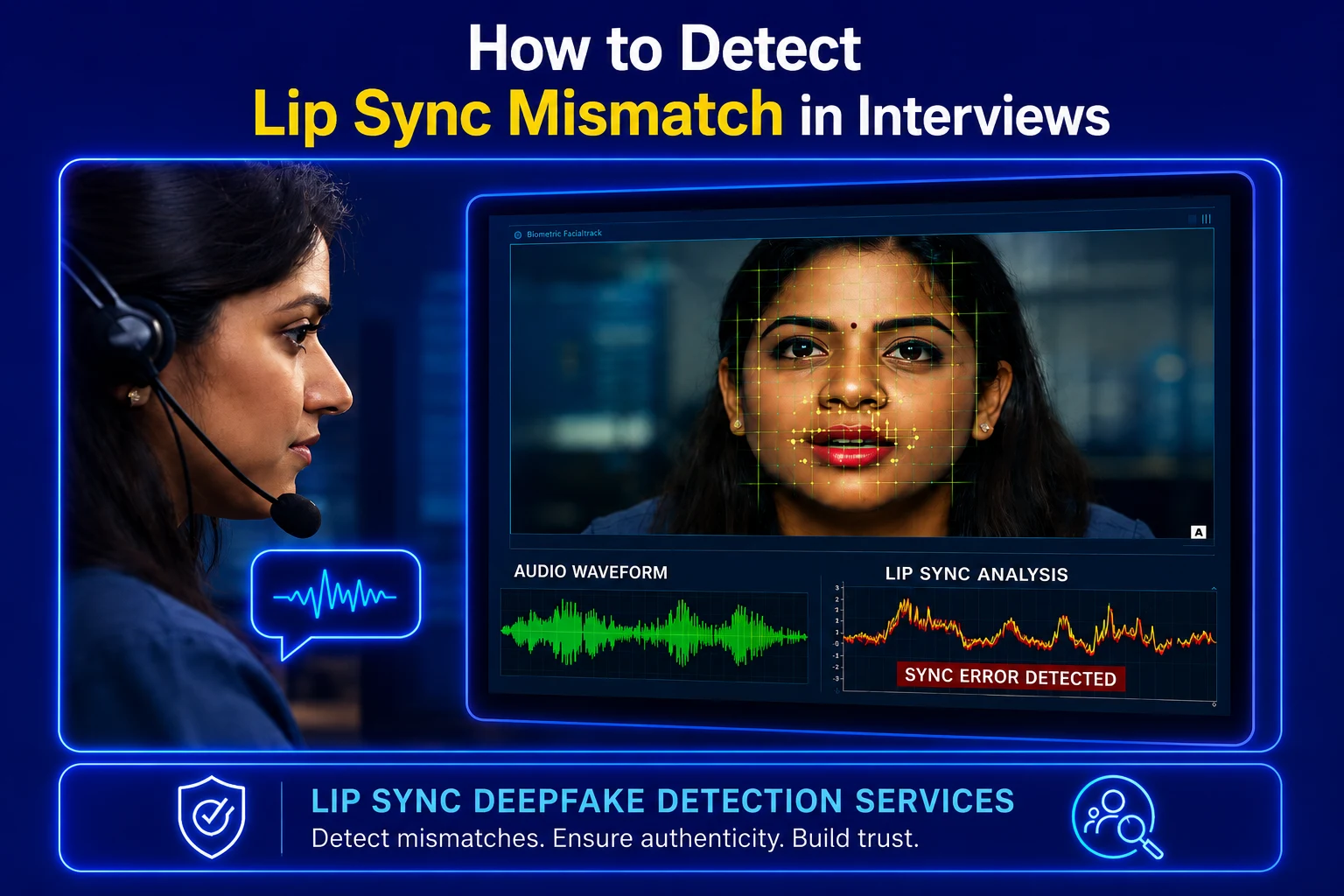
Detecting lip sync mismatch in interviews requires recruiters to carefully observe candidate behavior, facial movement, audio timing, and real time communication patterns. While occasional lag can happen because of internet issues, repeated synchronization inconsistencies may indicate deepfake technology, proxy interviews, AI generated assistance, or manipulated video feeds.
As remote hiring fraud becomes more advanced, recruiters need a structured approach to identify suspicious interview behavior before making hiring decisions. Out of the total job frauds, 80% were guilty of lip syncing, where the interviewee pretended to answer questions in a third person’s voice.
Here are the most effective ways to detect lip sync mismatch during virtual interviews.
Use AI Powered Interview Proctoring Tool Like Sherlock AI
As interview fraud becomes more sophisticated, manual observation alone is often not enough to detect lip sync mismatch and deepfake manipulation accurately.
Modern interview intelligence platforms can help recruiters identify:
Lip sync inconsistencies
Deepfake behavior
Tab switching activity
Background voice interference
Eye movement anomalies
Multiple face detection
Suspicious response timing
Behavioral irregularities
Platforms like Sherlock AI help organizations strengthen remote hiring integrity by monitoring interview authenticity in real time and identifying suspicious candidate behavior during virtual interviews.
By combining AI powered behavioral analysis with human evaluation, recruiters can detect interview manipulation more effectively and reduce the risk of fraudulent hiring decisions.
Watch for Delayed Mouth Movement
One of the most obvious indicators of lip sync mismatch is when the candidate’s lip movement does not properly align with their speech.
Recruiters should observe:
Lips moving slightly after audio is heard
Incorrect mouth shapes for spoken words
Delayed facial reactions during fast responses
Audio continuing after mouth movement stops
These inconsistencies are often easier to identify during detailed explanations or technical discussions.
Observe Facial Expressions Carefully
Natural conversations involve continuous facial movement, blinking, emotional reactions, and subtle muscle changes. Deepfake systems and manipulated video feeds often struggle to recreate these expressions consistently.
Warning signs include:
Frozen facial expressions while speaking
Limited blinking during long answers
Stiff jaw movement
Delayed emotional reactions
Expressions that do not match tone of speech
Unnatural facial behavior can be an important indicator of interview manipulation.
Check Audio and Video Synchronization
In genuine internet lag, both audio and video are usually affected together. Suspicious manipulation often causes one stream to behave independently.
Recruiters should monitor:
Clear audio while video freezes
Mouth movement stopping during speech
Sudden synchronization shifts
Delayed lip movement during certain answers
Smooth audio with irregular facial movement
Consistent synchronization issues throughout the interview deserve closer investigation.
Ask Spontaneous Follow Up Questions
Candidates relying on AI generated responses or external assistance may struggle with unscripted questions.
Recruiters can ask:
“Can you explain that differently?”
“What challenge did you personally face?”
“How would you solve this situation today?”
“Can you elaborate further on your approach?”
Unexpected questions force candidates to respond naturally in real time, making suspicious delays and lip sync mismatches more visible.
Interrupt the Candidate Naturally
Real conversations involve interruptions and dynamic interaction. Candidates using delayed audio systems or hidden support may react unnaturally when interrupted. Around 8 percent of candidates chose to take help from a third person who prompted from behind the screen.
Read More:
https://www.moneycontrol.com/news/business/lip-syncing-accounts-for-maximum-interview-frauds-finds-flocareer-10445791.html?utm_source=chatgpt.com
Watch for:
Continuing to speak without reacting
Delayed awareness of interruption
Confused facial expressions
Slow conversational adjustment
These behaviors may indicate externally generated responses or proxy interview assistance.
Monitor Eye Movement and Attention Shifts
Candidates using external screens, hidden prompts, or AI support tools often display unusual eye movement patterns.
Recruiters may notice:
Repeated glances away from the camera
Reading behavior during responses
Delayed eye contact
Attention shifts before answering questions
These patterns can help identify suspicious interview activity.
Request Real Time Camera Adjustments
Manipulated video feeds and deepfake overlays often perform best from fixed camera angles. Asking candidates to move naturally can expose visual inconsistencies.
Recruiters can request candidates to:
Move closer to the camera
Turn slightly sideways
Adjust lighting position
Reposition the webcam
Fraudulent systems may produce distortion, lag, or tracking problems during movement.
Verify Candidate Identity During the Interview
Identity verification is one of the most effective ways to reduce interview fraud.
Organizations can request:
Government issued ID verification
Live face matching
Real time movement verification
Additional verification rounds if needed
These steps make it more difficult for proxy candidates or deepfake systems to remain undetected.
Look for Repeated Behavioral Patterns
A single synchronization issue may simply be caused by technical problems. However, repeated behavioral inconsistencies throughout the interview are stronger indicators of suspicious activity.
Recruiters should evaluate:
Ongoing lip sync delays
Repeated frozen expressions
Consistent response lag
Unnatural conversational rhythm
Multiple suspicious behaviors occurring together
Pattern recognition is critical for accurate detection
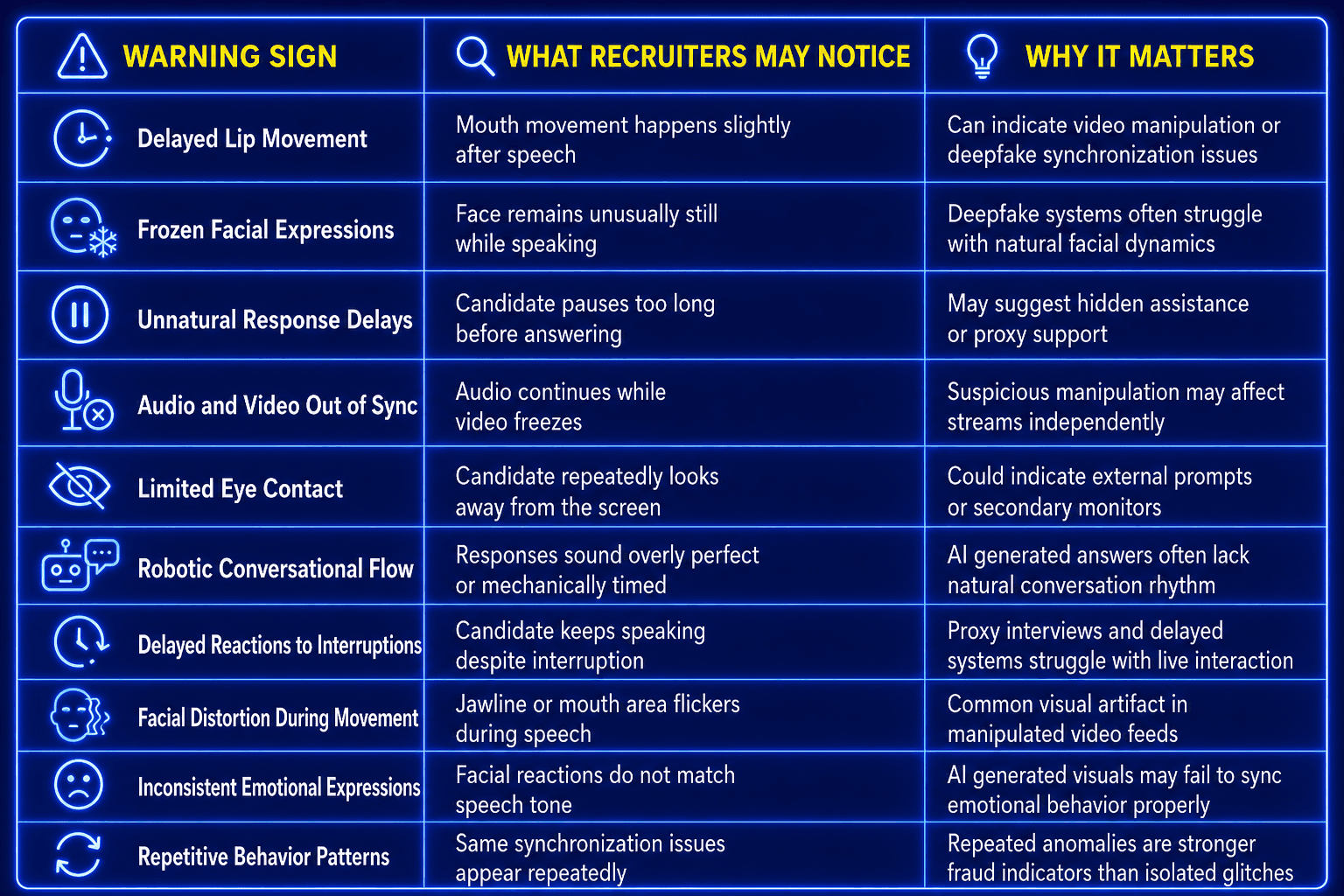
Lip Sync Mismatch Red Flags Recruiters Should Never Ignore
Detecting lip sync mismatch becomes easier when recruiters know exactly what behaviors to look for during a virtual interview. Instead of focusing only on technical glitches, hiring teams should evaluate whether the candidate’s speech, facial movement, and reactions feel naturally connected throughout the conversation.
Below are some of the biggest warning signs that may indicate suspicious interview activity.
Best Practices to Prevent Lip Sync Fraud in Remote Hiring
As interview fraud techniques become more advanced, organizations must move beyond traditional hiring methods and adopt stronger verification strategies during virtual interviews. Preventing lip sync mismatch fraud requires a combination of technology, structured interview processes, and recruiter awareness.
Here are some of the most effective best practices companies should follow to reduce remote hiring fraud risks.
Use Multi Layer Identity Verification
Identity verification should not be limited to a single checkpoint. Organizations should verify candidate authenticity throughout different hiring stages to reduce the risk of deepfake impersonation and proxy interviews.
Companies can implement:
Government ID verification
Live face matching
Real time selfie verification
Verification during assessment rounds
Final stage identity confirmation
Multiple verification layers make it harder for fraudulent candidates to manipulate the hiring process.
Conduct Structured Live Interviews
Structured interviews help recruiters identify inconsistencies more effectively because every candidate is evaluated using similar questions and interaction patterns.
Recruiters should:
Ask role specific follow up questions
Include spontaneous conversational interactions
Encourage detailed explanations
Request real world problem solving examples
Use scenario based questioning
Natural conversation flow often exposes delayed responses, lip sync mismatch, and AI assisted answering behavior.
Train Recruiters to Detect Behavioral Red Flags
Recruiters should be trained to recognize suspicious communication patterns that may indicate interview manipulation.
Important warning signs include:
Delayed mouth movement
Frozen facial expressions
Robotic conversational flow
Delayed reactions to interruptions
Repeated eye movement away from the screen
Unnatural pauses before answers
Fraud detection becomes more accurate when recruiters understand both technical and behavioral indicators.
Encourage Real Time Candidate Interaction
Live interaction reduces the effectiveness of prerecorded videos, delayed audio systems, and AI generated response tools.
Recruiters can improve authenticity checks by:
Interrupting naturally during conversations
Asking candidates to elaborate instantly
Requesting screen or camera adjustments
Changing interview flow dynamically
Introducing unexpected follow up questions
Real time interaction makes manipulated interview systems harder to maintain consistently.
Combine Human Judgment With AI Detection
AI tools can identify suspicious technical patterns, but human recruiters are still essential for evaluating conversational authenticity, emotional consistency, and contextual behavior.
The most effective fraud prevention strategy combines:
AI powered monitoring
Human behavioral observation
Structured evaluation frameworks
Identity verification systems
Technical interview validation
This layered approach significantly improves remote hiring integrity and reduces the chances of fraudulent candidates progressing through the hiring pipeline.
How Sherlock AI Helps Detect Lip Sync Mismatch in Interviews
As interview fraud becomes more advanced, recruiters need stronger systems to identify suspicious behavior during virtual interviews. Manual observation alone is often not enough to detect deepfake manipulation, proxy interviews, AI assisted cheating, or lip sync mismatch consistently.
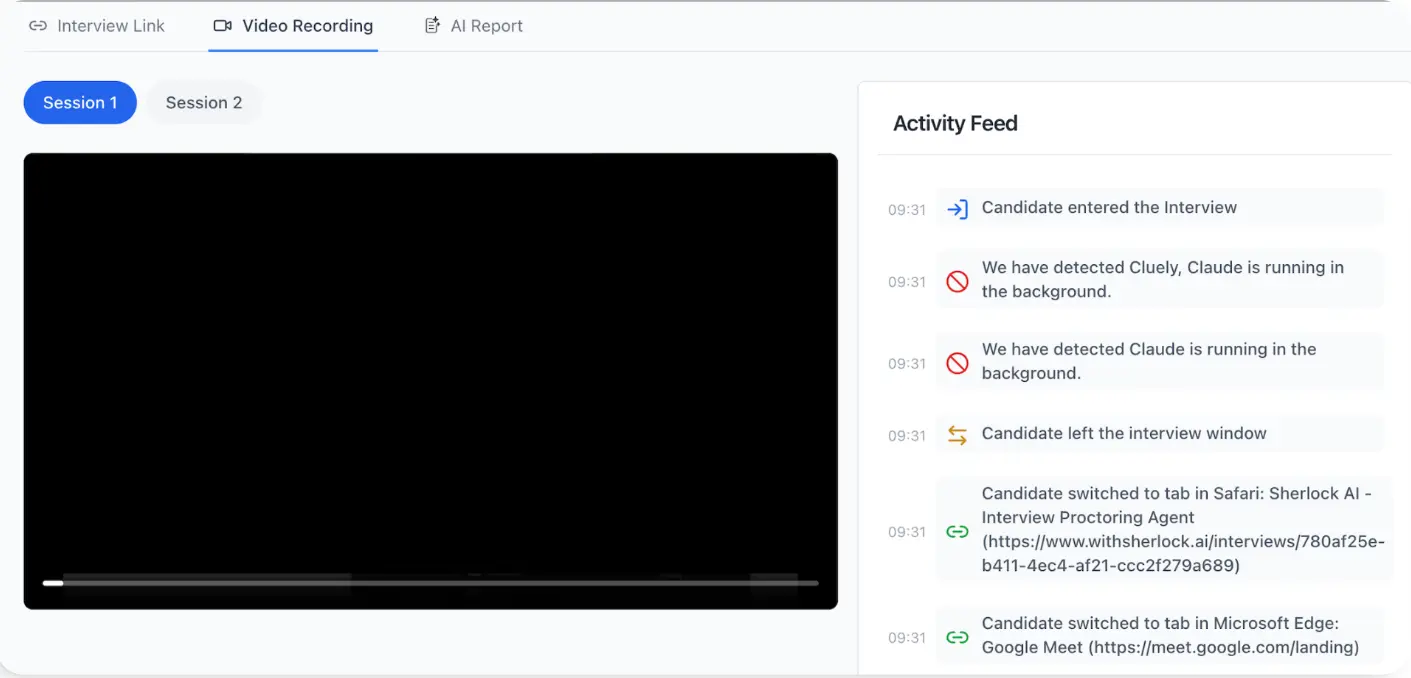
Sherlock AI helps organizations strengthen remote hiring security through AI powered interview monitoring and behavioral analysis. The platform assists recruiters in identifying suspicious candidate activity in real time while improving interview authenticity verification.
Lip Sync Mismatch Detection
Sherlock AI helps identify synchronization inconsistencies between facial movement and speech during live interviews. The platform analyzes whether a candidate’s mouth movement naturally aligns with spoken audio in real time. It can detect delayed lip movement, incorrect mouth positioning for spoken words, unnatural facial synchronization patterns, and repeated timing inconsistencies throughout conversations. These issues may indicate deepfake overlays, manipulated video feeds, delayed audio systems, or AI generated interview assistance.
Deepfake Detection
Deepfake technology can create highly realistic synthetic video appearances that are difficult for recruiters to identify manually. Sherlock AI helps detect visual inconsistencies commonly associated with AI generated faces and manipulated interview feeds. The platform monitors frozen facial regions during speech, unnatural blinking behavior, distorted jawline movement, facial texture inconsistencies, and irregular emotional expressions. By identifying these subtle anomalies, Sherlock AI helps recruiters detect potential deepfake impersonation attempts before fraudulent candidates progress through the hiring process.
Eye Movement Monitoring
Candidates using hidden prompts, secondary devices, or AI generated assistance tools often display unusual eye movement behavior during interviews. Sherlock AI analyzes eye tracking patterns to identify suspicious attention shifts and non natural viewing behavior. The system can detect repeated glances away from the camera, reading behavior during responses, delayed eye contact, sudden focus shifts before answering questions, and attention patterns inconsistent with normal conversation. These insights help recruiters identify candidates who may be relying on unauthorized external support during interviews.
Multiple Face Detection
Proxy interviews remain a growing concern in remote hiring, where another individual may secretly assist or replace the actual candidate during the interview process. Sherlock AI helps identify suspicious multi person activity within the interview environment. The platform can monitor additional individuals entering the frame, face switching attempts, hidden participant movement, unusual face tracking inconsistencies, and sudden visual changes during interviews. This feature strengthens candidate identity verification and reduces the risk of impersonation based interview fraud.
Background Voice Interference Detection
Some candidates use hidden audio assistance, live coaching, or external support systems during virtual interviews. Sherlock AI analyzes audio patterns to identify suspicious background interference that may not be immediately noticeable to recruiters. The platform can detect overlapping voices, whispering or hidden prompts, delayed response timing after external audio, secondary voice interference, and irregular conversational pacing. These indicators can reveal situations where candidates are receiving unauthorized assistance during live interviews.
Behavioral Anomaly Analysis
Beyond technical detection, Sherlock AI also evaluates broader behavioral patterns that may indicate interview manipulation or AI assisted cheating. The platform analyzes how naturally candidates interact throughout the conversation and helps recruiters identify robotic conversational flow, unnatural response timing, delayed reactions to interruptions, inconsistent emotional behavior, suspicious communication rhythm, and repeated behavioral irregularities during the interview. Behavioral analysis adds an additional layer of fraud detection by helping recruiters distinguish between genuine candidate interaction and manipulated interview behavior.
Conclusion
Lip sync mismatch has become an increasingly important warning sign in modern virtual hiring. While occasional audio and video delays can happen because of technical issues, repeated synchronization inconsistencies may indicate deeper problems such as deepfake impersonation, proxy interviews, AI assisted cheating, or manipulated video feeds.
Detecting lip sync mismatch requires a combination of recruiter awareness, structured interview processes, identity verification measures, and AI powered interview monitoring tools. Sherlock AI help organizations strengthen remote hiring security by identifying suspicious behavioral patterns and improving interview authenticity verification in real time.
As remote hiring continues to grow, recruiters can no longer rely solely on traditional interview evaluation methods. Hiring teams must now assess both candidate skills and digital authenticity during online interviews. Small indicators such as delayed mouth movement, frozen facial expressions, unnatural response timing, mismatched emotional reactions, and suspicious eye movement patterns can often reveal interview manipulation attempts.
Organizations that proactively invest in interview fraud prevention strategies will be better prepared to protect hiring integrity, reduce fraudulent hiring risks, and build more trustworthy remote recruitment processes in the age of AI driven interview fraud.