Back to all blogs
Discover key red flags in live interviews that every recruiter must spot. Use our observation framework to improve your hiring process.

Abhishek Kaushik
Jan 8, 2026

TL;DR
Most interview red flags are not dramatic.
There are minor inconsistencies in ownership, reasoning, confidence, and narrative detail.
This guide explains the signals that matter, how to probe them, and how to document them in a neutral, bias-safe way.
First: What a Red Flag Is (and Isn’t)
A red flag is not proof of dishonesty or incompetence.
It is a prompt to probe further.
A red flag means:
There is a possible mismatch between the story and the understanding.
It is an interview signal, not a conclusion.
The Red Flag Framework: Look for Patterns, Not Moments
1. Ownership Avoidance
The candidate cannot clearly explain what they personally own.
Research shows that clarity in personal contributions and self-awareness are common red flags in interviews when missing.
Common Phrases:
“We did”
“The team handled that.”
“The architect decided”
Probe With:
Which part did you personally lead?
What was your decision specifically?
If the candidate cannot answer, ownership is unclear.
2. Overly Polished Answers
If every answer sounds like a textbook explanation, it may be:
Memorized
Rehearsed
AI-generated
Real experience includes:
Uncertainty
Mistakes
Tradeoffs
Probe With:
What was the hardest part, and what made it hard?
3. No Timeline or Sequence
Candidates with real experience describe work in time order.
Those without real experience describe isolated snapshots.
Techniques that prompt candidates to describe events along a timeline help elicit richer detail and separate deeper knowledge from surface narratives.
Probe With:
Walk me through what happened first, second and third.
If the story cannot unfold in sequence, the experience may not be authentic.
4. Conflict-Free Collaboration Stories
If every team interaction story is:
Smooth
Aligned
Perfectly supportive
This is not realistic
Real collaboration includes:
Disagreement
Negotiation
Compromise
Probe With:
Tell me about a disagreement and how you resolved it.
5. Defensive Response to Clarification
If a candidate reacts emotionally to probing questions, it may signal:
Lack of depth
Lack of confidence
Fragile knowledge
Real expertise handles pressure calmly.
Probe With:
I am asking to understand your reasoning, not to challenge it. Can you help me see your thought process?
6. Inability to Explain Tradeoffs
Real decision-making requires choosing one thing over another.
Ask:
Why did you choose this approach instead of a different one?
If they cannot describe:
Alternatives
Risks
Criteria
Then the answer may not be rooted in practice.
7. Sudden Answer Pauses on Follow-Up
This is the most reliable pattern in AI-assisted or coached answers.
Smooth initial answer → pause → rephrasing = red flag.
This indicates:
The first response was rehearsed
The follow-up requires original reasoning
Behavioral Signals (Video Interview Specific)
Signal | What It Suggests | Next Step |
|---|---|---|
Frequent side glances | Off-screen prompting | Ask reasoning follow-ups |
Perfectly consistent tone | Scripted or AI-formatted answer | Request real examples |
The camera refuses to reposition | Identity or environment masking | Trigger identity check workflow |
Quick answers followed by a long pause after the probe | Pattern recall vs real knowledge | Ask step-by-step reasoning |
These are signals, not accusations.
How to Document Red Flags Safely
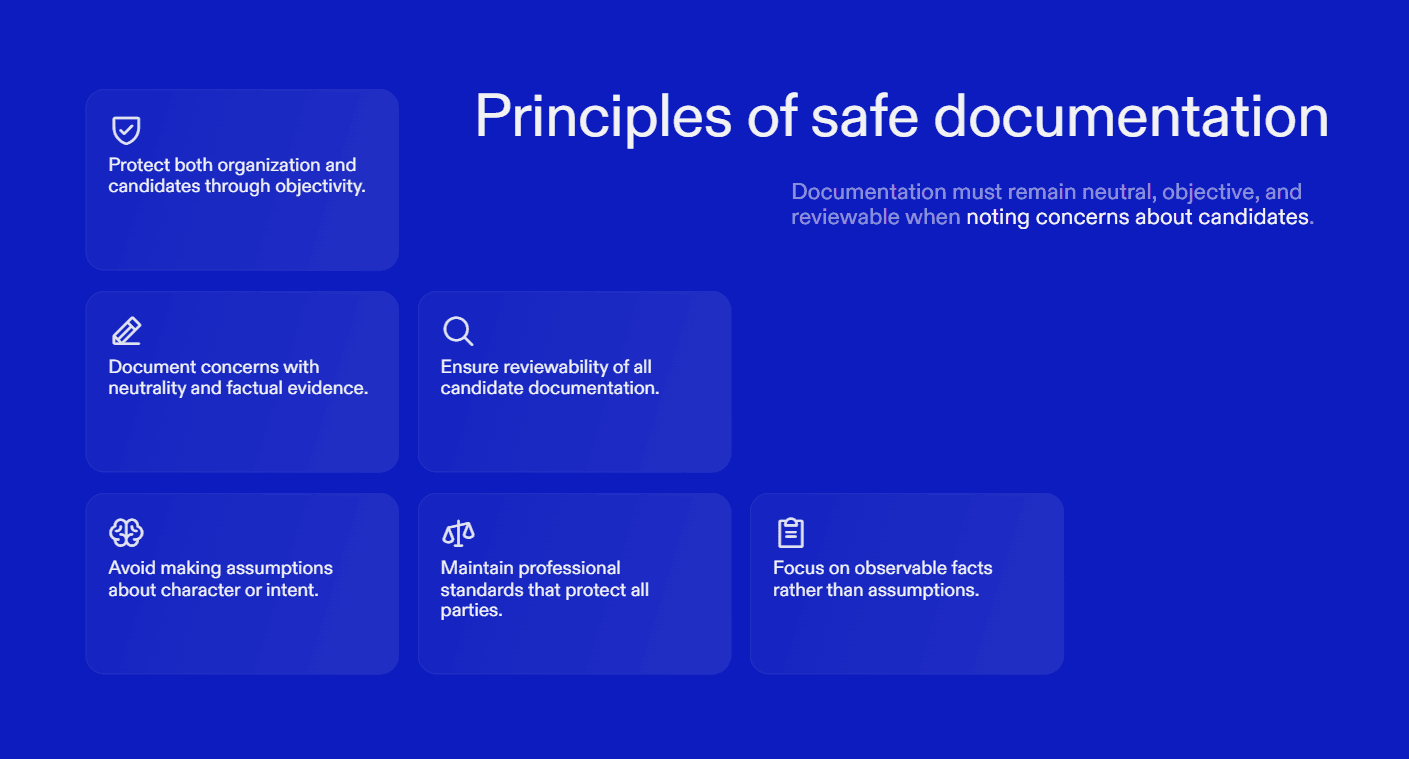
Avoid language that implies intent.
Describe behaviors only.
Write:
The candidate could not explain personal ownership.
The story could not be placed in the timeline.
Answer repeated after follow-up questioning.
Avoid:
The candidate lied.
The candidate was dishonest.
The candidate lacked integrity.
Documentation must remain neutral and reviewable.
Conclusion
Red flags are not about suspicion.
They are about understanding whether the experience is real and owned.
The best recruiters:
Probe with curiosity
Look for reasoning, not polish
Use structured follow-up questions
This leads to:
Better hires
Lower mis-hire cost
Stronger evaluation confidence