Back to all blogs
Learn how to present fraud findings to hiring managers professionally. Use our neutral, evidence-based framework to avoid conflict and ensure hiring success.

Abhishek Kaushik
Jan 8, 2026

When you identify possible interview fraud, the most significant risk is not the fraud itself.
The most considerable risk is presenting it the wrong way and triggering:
Defensive reactions
Relationship friction
Blame of the recruiter
Emotional escalation
Hiring manager distrust
This framework ensures the conversation stays:
Neutral
Evidence-based
Non-accusatory
And focused on decision integrity, not blame
First: The Mindset Shift
Your goal is not to prove someone cheated.
Your goal is to show:
The signals we observed require verification before a hiring decision can be made.
Everything must be framed around:
Consistency
Fairness
Accuracy
Protecting team performance
Not:
Suspicion
Accusation
Policing candidates
When feedback uses emotional language, recipients become self-focused and less task-oriented.
Removing emotional framing keeps the focus on the work and what needs to improve.
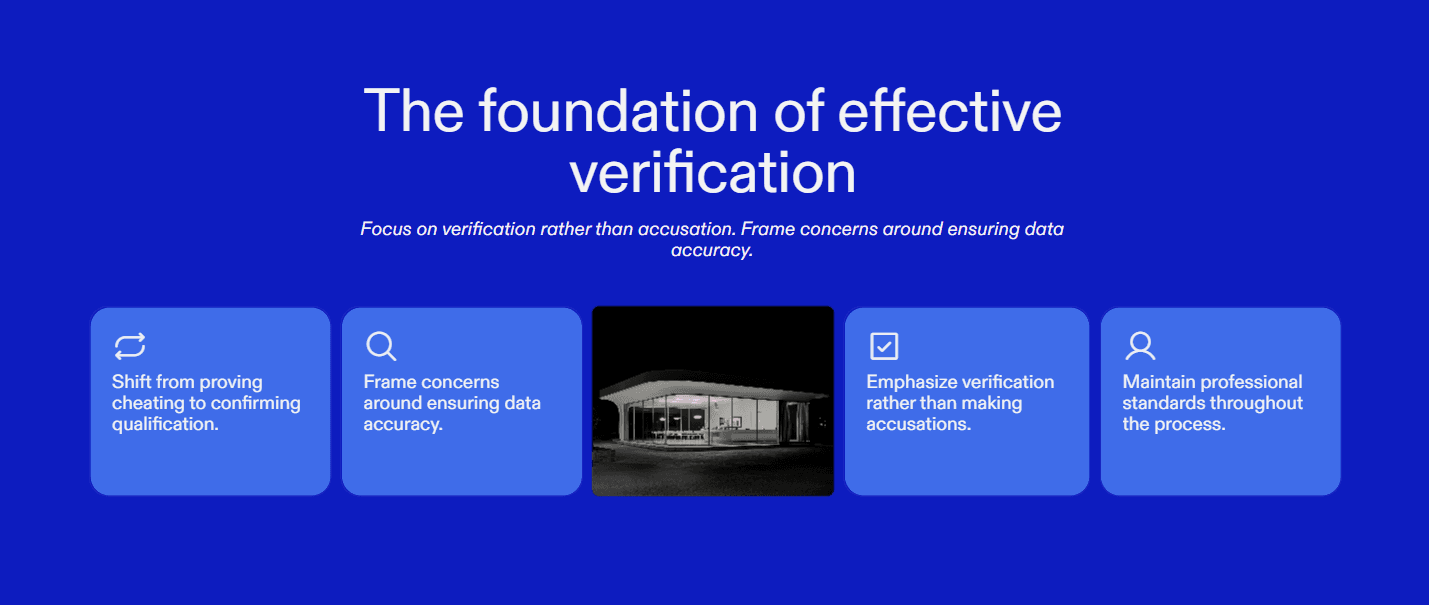
The Three Principles of Present Fraud Findings to Hiring Managers
To avoid conflict:
Principle | Meaning |
|---|---|
Neutral Language | Describe behaviors, not intentions |
Shared Accountability | “We are ensuring accuracy together.” |
Process Framing | Fraud detection as standard quality control, not judgment |
The Conversation Script
Use this exact structure.
Step 1: Start With the Goal
Our goal is to ensure we make a reliable hiring decision based on the candidate’s own skills and reasoning.
This grounds the discussion in shared purpose.
Step 2: Describe Observations (Not Conclusions)
Avoid:
“I think the candidate cheated.”
“I don’t believe this candidate.”
Use neutral behavior statements:
During the interview, the candidate was able to provide polished answers, but when asked follow-up reasoning questions, they struggled to explain personal decisions or adapt the solution when constraints changed.
These signals indicate there may be a gap between the delivered interview performance and the candidate’s own skill depth.
This is evidence, not an accusation.
Step 3: Tie the Signal to Hiring Risk
In our experience, when we see this pattern, it often results in performance issues post-hire. We want to prevent rework, frustration and offboarding scenarios.
Now the hiring manager sees:
You are solving their problem
Not blocking their hire
Step 4: Present the Next Step as Standard Procedure
Make this sound like policy, not choice.
The next step in our standard workflow is to conduct a short identity and reasoning verification session.
This ensures the interview reflects the candidate’s own capabilities.
This is the same process we apply in similar cases.
Repeat:
Same process. Not special treatment.
This prevents emotional reaction.
Step 5: Ask for Agreement
Keep the question low-friction.
Does that sound reasonable?
Or
Happy to walk through what that verification looks like.
Never ask:
“Do you believe me?”
“Do you want to move forward or reject?”
You are not asking for judgment.
You are requesting alignment on the process.
Common Hiring Manager Reactions and How to Respond
Manager Response | Underlying Concern | Your Response |
|---|---|---|
“They seemed great. Are you sure?” | Fear of losing a candidate | “We are not rejecting. We are verifying to confirm fit.” |
“Is this really necessary?” | Time pressure | “Verification prevents weeks of rework later.” |
“Are we accusing them?” | Concern for fairness | “No accusations. Just clarity and consistency for all candidates.” |
“This feels like we are slowing down.” | Urgency to fill the role | “This step takes less than 10 minutes and protects your team once they join.” |
This prevents friction.
Documentation Template (Internal Notes)
This is audit-safe, bias-safe, and manager-safe.
Conclusion
Presenting fraud findings is about tone, not confrontation.
The winning formula:
Describe observations
Tie them to performance risk
Frame verification as standard, neutral workflow
Seek alignment, not agreement, on suspicion
Your job is not to accuse.
Your job is to protect hiring quality and team performance.