
Back to all blogs
Discover how to conduct fair job interviews using structured formats, standardized questions, and unbiased evaluation methods to improve hiring quality and consistency.

Abhishek Kaushik
May 18, 2026
In today’s evolving hiring landscape, conducting fair job interviews is no longer optional. It is a critical requirement for building high-performing and compliant organizations. As companies compete for top talent while managing remote hiring, global candidate pools, and AI-assisted recruitment, the margin for error in hiring decisions has become extremely small.
A fair job interview ensures that every candidate is evaluated based on relevant skills, experience, and potential rather than subjective opinions or unconscious bias. Yet, achieving this fairness is more challenging than it seems. Research shows that 48% of HR managers admit bias influences their hiring decisions, highlighting how widespread the issue is in real-world recruitment processes.
Unstructured interviews are one of the biggest contributors to unfair hiring. When interviewers rely on instinct or “gut feeling,” they often make decisions influenced by first impressions, similarity bias, or likeability rather than job-related competencies.
The consequences of unfair interviews go beyond missed hiring opportunities. Poor hiring decisions can lead to increased employee turnover, higher recruitment costs, and reduced team productivity. In fact, the average cost-per-hire is around $4,700, and total hiring costs can reach up to three to four times an employee’s salary when mistakes are made.
For modern organizations, fairness is not just about compliance. It directly impacts business performance, employer branding, and candidate trust. This is where structured processes and AI-driven platforms like Sherlock AI play a crucial role by standardizing interviews, reducing bias, and ensuring consistent evaluations.
In this guide, we will explore how to conduct fair job interviews step by step, including proven strategies, best practices, and the role of technology in building a transparent and bias-free hiring process.
What Is a Fair Job Interviews
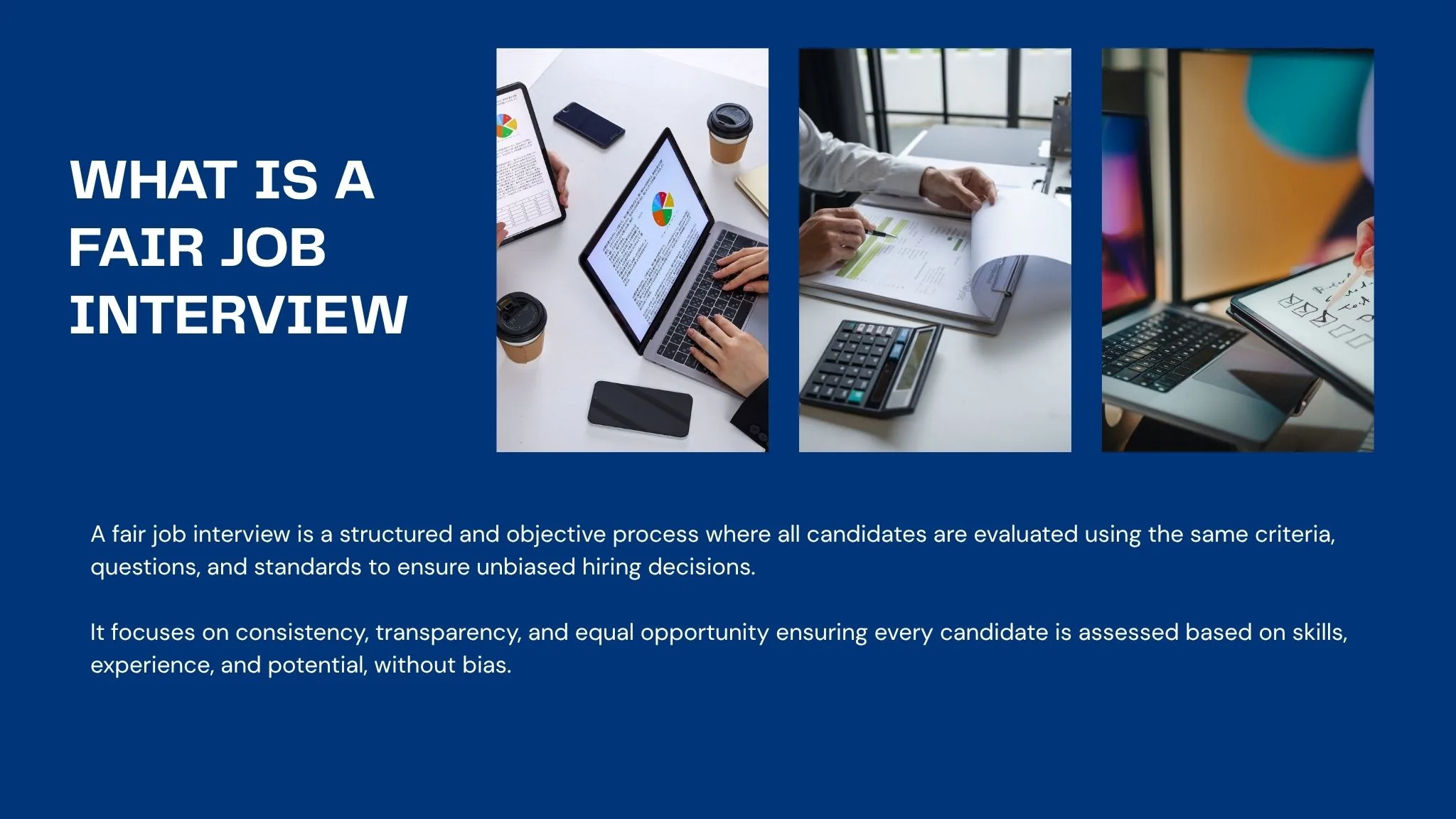
A fair job interviews is a structured and objective evaluation process where all candidates are assessed using the same criteria, questions, and standards. The goal is to ensure that hiring decisions are based solely on job-relevant factors such as skills, experience, and potential, rather than personal biases or inconsistent judgment.
At its core, fairness in interviews means consistency, objectivity, and transparency. Every candidate applying for the same role should go through a similar interview experience. This includes being asked the same set of questions, evaluated using the same scoring system, and judged against clearly defined job requirements.
In modern hiring workflows, Sherlock AI ensures fair interviews through standardized question delivery, structured scoring rubrics, and consistent evaluation across all candidates.
It also provides real-time interview integrity checks such as identity verification, proxy candidate detection, behavioral anomaly tracking, and signals of external or AI-assisted help during the interview.
However, a truly fair interview goes beyond structure. It also ensures that candidates are given equal opportunity to perform at their best. This means providing clear communication before the interview, creating a comfortable environment during the interaction, and evaluating responses without external influence. Fairness is not just about process design. It is about execution at every stage of the interview lifecycle.
Organizations that adopt fair interview practices are better positioned to identify top talent, reduce hiring risks, and build diverse and high-performing teams. It also strengthens employer branding, as candidates are more likely to trust and engage with companies that demonstrate transparency and consistency in their hiring approach.
Key Characteristics of a Fair Job Interviews
The key characteristics of a fair job interview outline the essential principles that ensure consistency, objectivity, and unbiased evaluation across all candidates.
1. Standardized Questions
All candidates are asked the same or very similar questions in the same order. This eliminates the risk of giving one candidate an unfair advantage over another.
Standardized questions create a consistent foundation for evaluating candidates. When everyone responds to the same set of questions, it becomes easier to compare answers objectively and fairly across the board.
A fair interview ensures standardization by focusing on:
Predefined question sets aligned with the job role
Consistent order and structure of questions
Controlled and relevant follow-up questions
This ensures that every candidate is evaluated under the same conditions, improving both fairness and reliability in decision-making.
2. Job-Relevant Evaluation
Questions and assessments are directly tied to the role. For example, behavioral and situational questions are designed to evaluate how a candidate will perform in real job scenarios.
A fair interview avoids irrelevant or personal questions that do not contribute to assessing job performance. Instead, it focuses on:
Core competencies required for the role
Past experiences that demonstrate capability
Practical problem-solving skills
This ensures that candidates are judged only on factors that impact their ability to succeed in the role.
3. Structured Interview Format
A structured interview follows a predefined framework that includes question sets, scoring rubrics, and evaluation guidelines. This reduces subjectivity and improves consistency across interviewers.
Without a structured format, interviews can vary widely depending on the interviewer, leading to inconsistent evaluations. Structure ensures that every interview follows the same flow and standards.
A fair structured interview typically includes:
A fixed interview process and flow
Defined time allocation for each section
Pre-established evaluation guidelines
This ensures consistency across interviews and allows organizations to scale hiring without compromising fairness.
4. Objective Scoring System
Each response is rated using a standardized scale. Instead of relying on memory or intuition, interviewers assign scores based on predefined criteria.
Objective scoring transforms opinions into measurable data, making hiring decisions more evidence-based and transparent.
A fair scoring system includes:
Clear rating scales such as 1 to 5 or 1 to 10
Defined benchmarks for each score level
Written feedback to justify ratings
This ensures that candidate evaluations are consistent, comparable, and backed by data rather than subjective judgment.
5. Bias Mitigation
Fair interviews actively reduce unconscious bias by focusing only on relevant qualifications. This includes avoiding personal or discriminatory questions and ensuring balanced evaluation practices.
Bias can unintentionally influence decisions, even in well-structured interviews. A fair process actively works to minimize these risks.
Effective bias mitigation focuses on:
Awareness of common biases like similarity bias and halo effect
Use of structured questions and scoring systems
Involvement of diverse interview panels where possible
This ensures that all candidates are evaluated fairly, regardless of background or personal characteristics.
6. Clear Evaluation Criteria
Before interviews begin, hiring teams must define what success looks like for the role. This ensures that all candidates are assessed against the same expectations.
Without clear criteria, interviewers may rely on personal interpretations, leading to inconsistent and unfair decisions.
A fair interview process defines:
Must-have and good-to-have skills
Key competencies required for success
Specific performance indicators
This ensures alignment across interviewers and helps organizations make consistent, merit-based hiring decisions.
Why Fair Job Interviews Are Important in Hiring
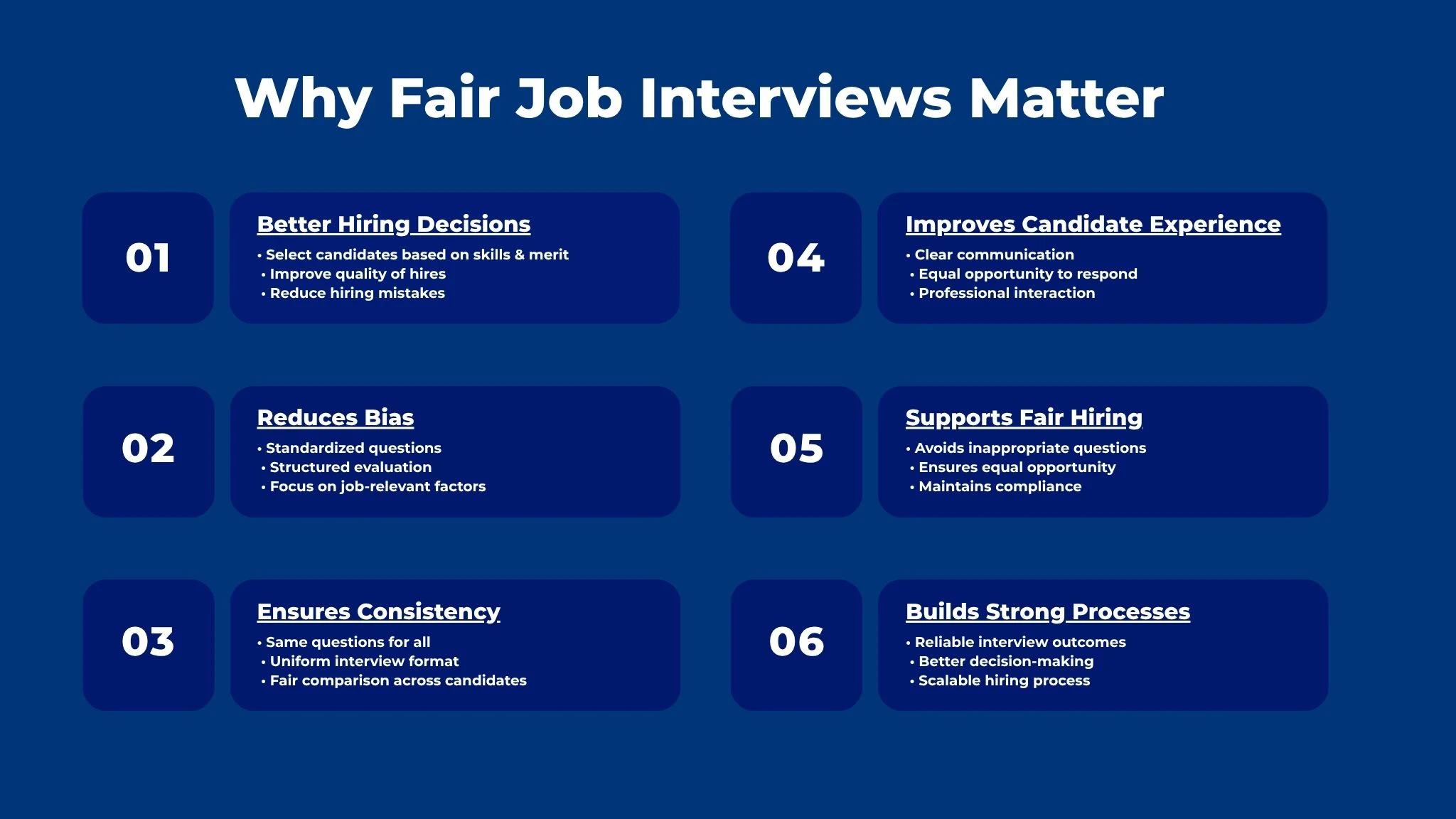
Fair job interviews are essential for ensuring that hiring decisions are consistent, objective, and based on job-relevant criteria. Organizations that follow fair job interviews practices are more likely to hire the right candidates, reduce bias, and maintain compliance with hiring standards.
Improves Hiring Decisions
Fair job interviews focus on evaluating candidates based on their skills, experience, and ability to perform in the role.
This helps organizations:
Select candidates based on merit
Improve overall quality of hires
Reduce costly hiring mistakes
Reduces Bias in Interviews
Unstructured interviews often lead to unconscious bias, where decisions are influenced by personal preferences rather than objective evaluation.
Fair job interviews help reduce bias by:
Using standardized questions
Following structured evaluation methods
Focusing only on job-related factors
Ensures Consistency Across Candidates
Consistency is a key element of fair job interviews. When each candidate is assessed differently, it becomes difficult to compare them accurately.
A fair process ensures:
The same questions are asked to all candidates
Interviews follow a similar format
Evaluation criteria remain consistent
Enhances Candidate Experience
Candidates are more likely to trust and engage with organizations that provide fair job interviews and a transparent hiring process.
A positive experience includes:
Clear communication throughout the process
Equal opportunity to respond
Professional and respectful interaction
Supports Compliance and Fair Hiring Practices
Fair job interviews help organizations follow hiring guidelines and avoid legal risks associated with discrimination or unfair treatment.
This includes:
Avoiding inappropriate or irrelevant questions
Maintaining proper documentation
Ensuring equal opportunity for all candidates
Strengthens Structured Interviewing
Fair job interviews are the foundation of structured interviews, which are widely recognized as a best practice in hiring.
By focusing on fairness, organizations can:
Improve reliability of interview outcomes
Make better hiring decisions
Build a scalable and repeatable hiring process
Good vs Bad Interviews
Understanding the difference between good and bad interviews is essential for conducting fair job interviews. The way interviews are structured and conducted directly affects hiring accuracy, consistency, and candidate experience.
Aspect | Good Interview | Bad Interview |
|---|---|---|
Structure | Follows a structured and predefined format | No clear structure or process |
Questions | Same questions asked to all candidates | Different questions for each candidate |
Evaluation | Uses clear scoring criteria and evaluation forms | Relies on gut feeling or memory |
Bias Control | Actively reduces bias using structured methods | High risk of unconscious bias |
Consistency | Ensures equal experience for all candidates | Inconsistent candidate experience |
Focus | Focuses on job-related skills and competencies | Includes irrelevant or personal topics |
Decision Making | Based on data and documented feedback | Based on subjective opinions |
Candidate Experience | Professional, respectful, and transparent | Disorganized or unclear process |
How Bias Impacts Job Interviews
Bias is one of the biggest challenges in conducting fair job interviews. Even when interviewers have the best intentions, unconscious biases can influence how candidates are perceived, evaluated, and ultimately selected. Without structured processes, these biases can lead to unfair hiring decisions and missed opportunities to hire the best talent.
Types of Interview Bias
Interview bias can take many forms, often operating subconsciously and affecting decision-making without the interviewer realizing it.
Common types of bias include:
Similarity Bias: Favoring candidates who share similar backgrounds, interests, or experiences
First Impression Bias: Forming an opinion within the first few minutes and letting it influence the rest of the interview
Halo Effect: Allowing one strong quality to overshadow other aspects of the candidate’s profile
Horn Effect: Letting one negative trait disproportionately affect the overall evaluation
Confirmation Bias: Looking for information that supports an initial opinion while ignoring contradictory evidence
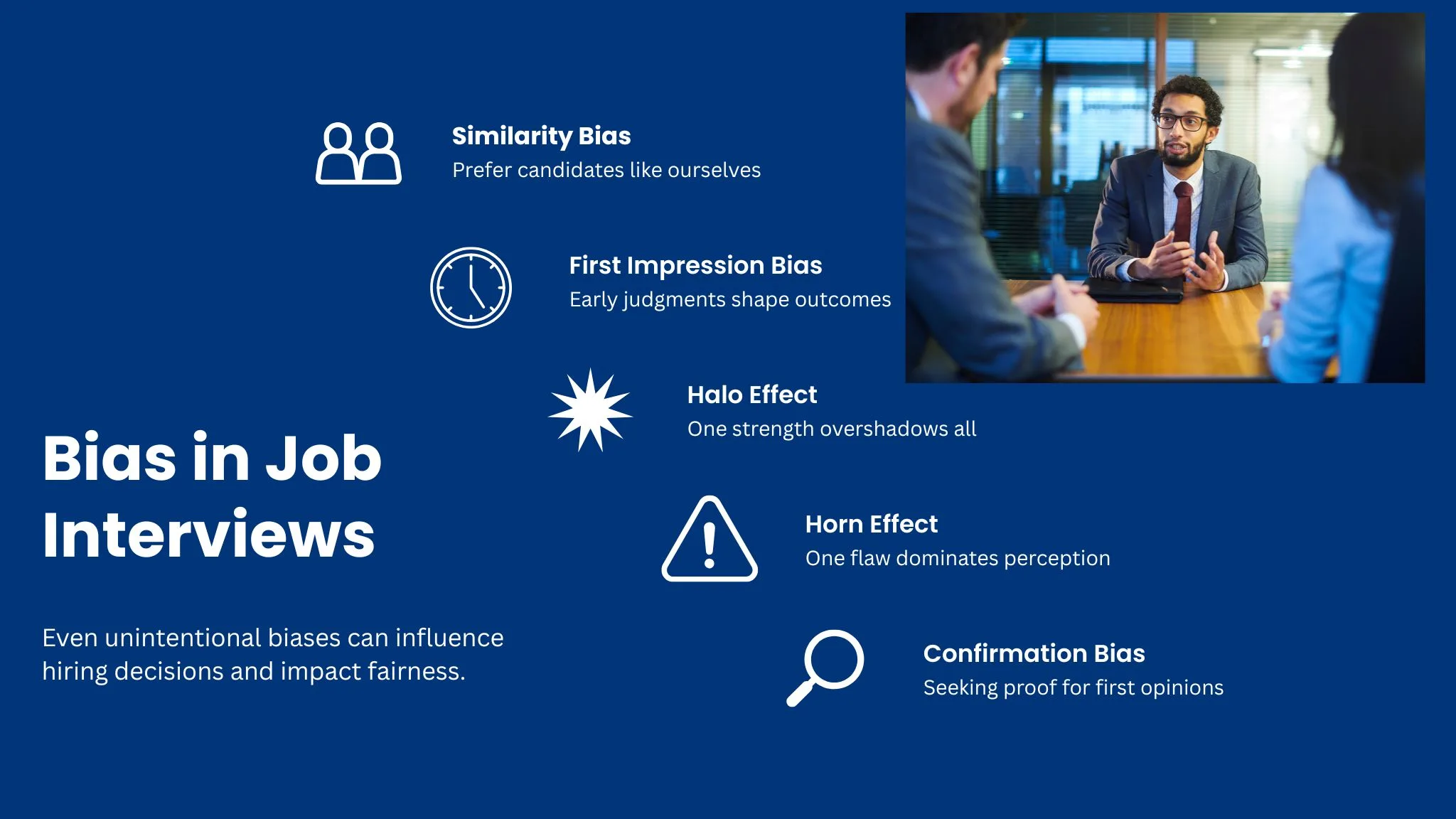
These biases can distort how responses are interpreted and lead to inconsistent evaluations across candidates.
Best Practices for Conducting Job Interviews
Following best practices is essential to ensure that interviews remain fair, consistent, and effective. These practices help interviewers evaluate candidates objectively while also creating a positive and professional experience.
1. Ask Each Candidate the Same Questions
Consistency is a key element of fair job interviews. Asking all candidates the same set of questions ensures that everyone is evaluated on equal grounds.
This approach helps to:
Create a level playing field
Enable accurate comparison between candidates
Reduce the influence of personal bias
2. Use a Structured Evaluation Method
A structured evaluation system ensures that candidate responses are assessed objectively rather than based on memory or intuition.
This includes:
Using predefined scoring criteria
Rating each response consistently
Documenting feedback during the interview
Structured evaluations improve reliability and fairness in decision-making.
3. Seek to Minimize Bias
Bias can influence even the most experienced interviewers. Actively working to reduce bias is essential for fair job interviews.
Best practices include:
Focusing only on job-related factors
Avoiding snap judgments
Being aware of unconscious bias
Taking these steps helps ensure more objective evaluations.
4. Create a Comfortable Environment for Candidates
The interview environment can significantly impact candidate performance. A comfortable and respectful setting allows candidates to perform at their best.
This involves:
Starting with a brief introduction
Maintaining a professional and friendly tone
Allowing candidates time to think and respond
A positive environment leads to more accurate assessments.
5. Assess Responses Objectively
Fair interviews rely on evaluating what candidates say, not how interviewers feel about them.
To ensure objectivity:
Focus on evidence in responses
Compare answers against predefined criteria
Avoid being influenced by non-relevant factors
This ensures that decisions are based on merit.
6. Listen More, Talk Less
Effective interviews are not just about asking questions but also about actively listening to candidates.
Good listening helps to:
Understand candidate responses better
Ask relevant follow-up questions
Avoid missing important details
7. Close the Interview Properly
Ending the interview in a structured way ensures clarity and professionalism.
A proper closing includes:
Allowing candidates to ask questions
Explaining next steps in the process
Thanking candidates for their time
This leaves a positive impression and improves candidate experience.
Applying these best practices ensures that interviews are not only fair but also effective in identifying the right talent.
Post-Interview Process in Fair Job Interviews
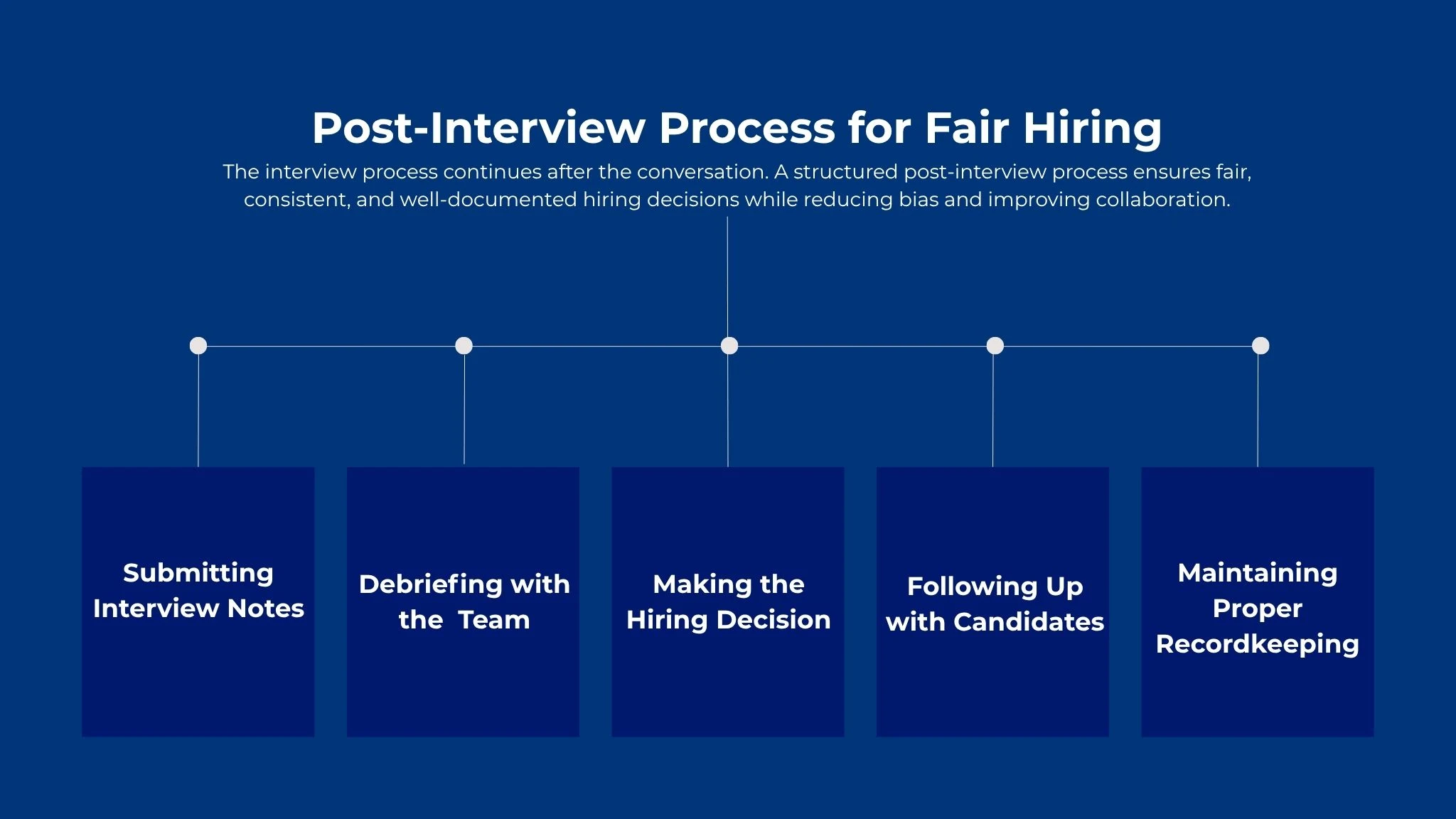
The interview process does not end when the conversation is over. What happens after the interview is just as important for ensuring fairness, consistency, and accuracy in hiring decisions. A structured post-interview process helps eliminate bias, improves collaboration, and ensures that decisions are well-documented.
Submitting Interview Notes
Documenting feedback immediately after the interview is essential. Delayed feedback can lead to memory bias and inaccurate evaluations.
Best practices include:
Recording responses and observations promptly
Using standardized evaluation forms
Focusing only on job-related criteria
This ensures that feedback remains accurate and consistent across candidates.
Debriefing with the Interview Team
A structured debrief helps bring together multiple perspectives while maintaining objectivity.
During debrief discussions:
Compare candidate evaluations using scoring criteria
Discuss differences in ratings objectively
Avoid being influenced by dominant opinions
This collaborative approach leads to more balanced decisions.
Making the Hiring Decision
Fair hiring decisions should always be based on data, not intuition. Using structured evaluation methods ensures that candidates are selected based on merit.
A fair decision-making process includes:
Reviewing scores and documented feedback
Comparing candidates against job requirements
Ensuring consistency in evaluation criteria
In many organizations, interview management platforms such as Sherlock AI are used at this stage to organize feedback and support more structured, data-driven decisions.
Following Up with Candidates
Timely and transparent communication is a key part of fair job interviews. Candidates should be informed about outcomes and next steps without unnecessary delays.
Effective follow-up includes:
Communicating results clearly
Providing timelines for next steps
Offering feedback where possible
This enhances candidate experience and builds trust.
Maintaining Proper Recordkeeping
Proper documentation is essential for both consistency and compliance. It also helps organizations review and improve their hiring processes over time.
Recordkeeping should include:
Interview notes and evaluation forms
Candidate scores and feedback
Final hiring decisions and rationale
This ensures transparency and accountability in the recruitment process.
A well-structured post-interview process ensures that fairness is maintained even after the interview ends.
Legal Considerations in Fair Job Interviews
Fair job interviews are not just about best practices. They are also about staying compliant with hiring laws and ensuring ethical treatment of candidates. A well-structured interview process helps organizations avoid legal risks while maintaining transparency and fairness.
What Interviewers Must Avoid
One of the most common legal mistakes in interviews is asking questions that are not relevant to the job. These questions can unintentionally lead to discrimination and should be strictly avoided.
For example, interviewers should not ask about a candidate’s age, religion, marital status, health conditions, or personal life unless it is directly related to the role and legally justified. Keeping conversations focused on skills and job requirements is essential for maintaining fairness.
Ensuring Equal Opportunity for Every Candidate
A fair hiring process requires that every candidate is given the same opportunity to succeed. This goes beyond just asking the same questions.
It includes creating an environment where candidates can perform at their best, providing reasonable accommodations when needed, and ensuring that no one is disadvantaged due to the format or structure of the interview. Equal opportunity is a core principle of fair job interviews and a key legal requirement.
Why Documentation Matters More Than You Think
Many organizations overlook documentation, but it plays a crucial role in legal compliance. Without proper records, it becomes difficult to justify hiring decisions if they are ever questioned.
Maintaining detailed notes, evaluation forms, and scoring records ensures that every decision is backed by evidence. It also helps organizations review and improve their hiring processes over time.
Consistency Is a Legal Requirement, Not Just a Best Practice
Inconsistent interviews can raise serious concerns about fairness. If different candidates are evaluated using different standards, it can lead to claims of bias or discrimination.
A consistent interview process ensures that every candidate is assessed using the same criteria, format, and evaluation methods. This not only improves hiring accuracy but also strengthens legal defensibility.
The Importance of Clear and Honest Communication
Transparency during the interview process is often underestimated. Candidates should clearly understand the role, expectations, and next steps.
Misleading information or unclear communication can create confusion and damage trust. Being upfront and honest helps build credibility and ensures a smoother hiring experience for both the organization and the candidate.
Bringing It All Together
Legal compliance in fair job interviews is about more than just avoiding mistakes. It is about creating a structured, transparent, and consistent process that treats every candidate fairly.
Organizations that take this seriously are better equipped to reduce risks, build trust, and create a hiring process that stands up to both scrutiny and scale.
Tools for Conducting Fair Job Interviews
Conducting fair job interviews requires more than just structured processes. The right tools help ensure consistency, improve evaluation accuracy, and reduce manual errors across the hiring process. They also make it easier to scale interviews while maintaining fairness and transparency.
1. Structured Interviewing Tools
Structured interviewing tools help standardize the way interviews are conducted. They ensure that every candidate is evaluated using the same framework and criteria.
These tools help with:
Creating role-specific question banks
Maintaining a consistent interview format
Aligning questions with job competencies
This ensures that all candidates are assessed on equal grounds.
2. Evaluation and Scoring Tools
Evaluation and scoring tools help interviewers assess candidate responses objectively rather than relying on memory or intuition.
These tools help with:
Rating candidate responses using structured rubrics
Comparing candidates based on scores
Recording feedback in a consistent format
This leads to more data-driven and fair hiring decisions.
3. Video Interview Software
Video interview software enables organizations to conduct interviews remotely while maintaining structure and consistency.
These tools help with:
Conducting interviews virtually across locations
Recording interviews for review
Ensuring a standardized interview experience
This is especially useful for remote and distributed hiring.
4. Interview Management Platforms
Interview management platforms help centralize and streamline the entire interview process, making it easier to manage candidates and evaluations.
These tools help with:
Organizing interview data in one place
Standardizing evaluation workflows
Supporting structured and consistent decision-making
For example, platforms like Sherlock AI help teams maintain consistency and structure across interviews without adding complexity.
5. Recordkeeping and Documentation Tools
Recordkeeping tools help organizations maintain accurate and consistent interview data for future reference and compliance.
These tools help with:
Storing interview notes and evaluations
Tracking candidate progress
Maintaining records for audits and compliance
This ensures transparency and accountability in the hiring process.
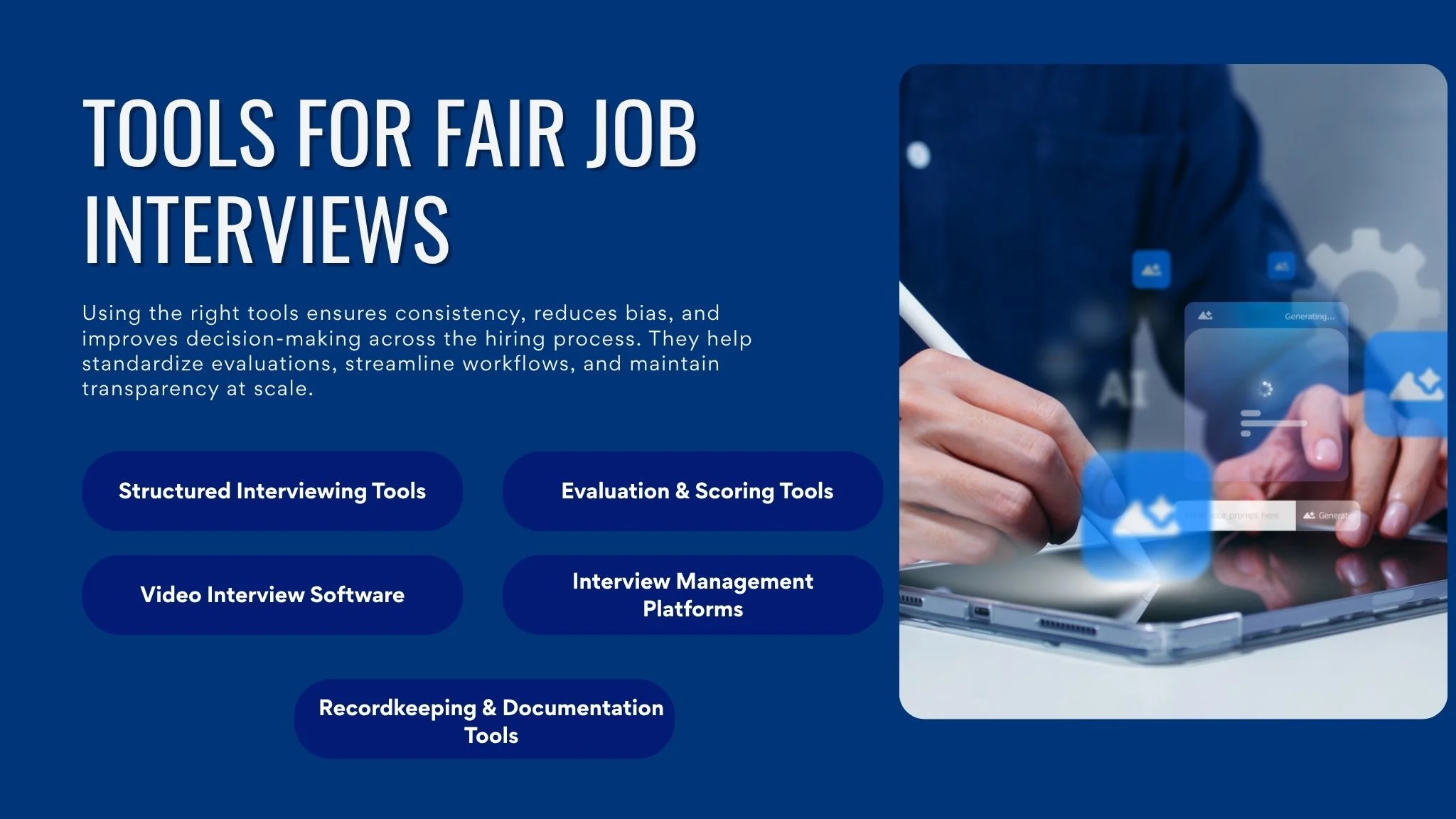
Using the right tools makes it easier to conduct fair job interviews at scale. While structured processes form the foundation, tools ensure that these processes are followed consistently.
Structured Interviews for Fairness and Equal Opportunity
Structured interviews are a standardized approach to interviewing where all candidates are asked the same set of questions in the same order and evaluated using a consistent scoring system. This method ensures that hiring decisions are based on job-related criteria rather than subjective judgment, making the process more fair, objective, and reliable.
Advantages of Structured Interviews
Below are the advantages of structured interviews:
1. Reducing Bias
One of the primary benefits of structured interviews is their ability to reduce unconscious biases. By asking all candidates the same questions, interviewers are less likely to make judgments based on irrelevant personal details such as background, gender, ethnicity, or appearance. This helps keep the evaluation focused on skills and job suitability.
2. Ensuring Consistency
Structured interviews create a consistent experience for every candidate. Since each candidate is asked the same questions in the same order, it becomes easier to compare responses fairly. This consistency reduces variation in how interviews are conducted and improves the reliability of the process.
3. Enhancing Predictive Validity
Structured interviews are more effective at predicting job performance because they are based on job-related competencies. By focusing on behavioral and situational questions, interviewers can better assess how candidates are likely to perform in real work scenarios.
4. Promoting Legal Defensibility
A structured and well-documented interview process makes it easier for organizations to justify their hiring decisions. Since all candidates are evaluated using the same criteria, it reduces the risk of discrimination claims and supports compliance with hiring regulations.
5. Improving Candidate Experience
Structured interviews provide a clear and organized process for candidates. When interviews are consistent and transparent, candidates feel they are being evaluated fairly, which enhances their overall experience and perception of the organization.
How to Write Good Interview Questions
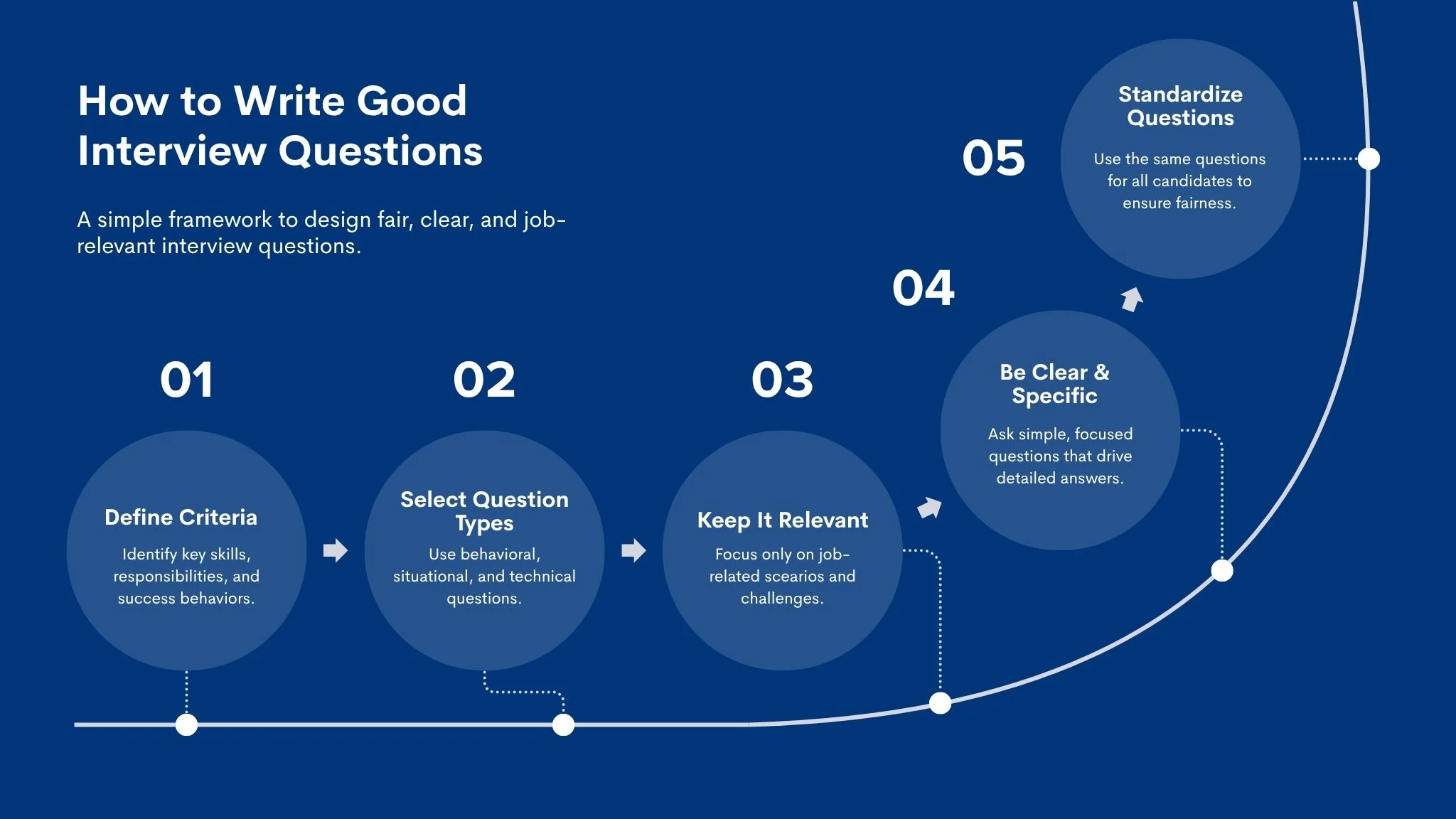
Writing effective interview questions is a critical part of conducting fair job interviews. Well-designed questions help interviewers evaluate candidates consistently, focus on job-related competencies, and reduce bias in decision-making.
Step 1: Define What You Want to Evaluate
Before writing questions, it is important to clearly identify what you want to learn from the interview. This should be based on the role requirements and key competencies.
Focus on:
Core skills required for the job
Key responsibilities of the role
Behaviors that indicate success
Example:
If you are hiring for a customer support role, you may want to evaluate communication, problem-solving, and conflict resolution skills.
Question example: “Can you describe a time when you handled a difficult customer and how you resolved the issue?”
Step 2: Choose the Right Type of Questions
Different types of questions help evaluate different aspects of a candidate’s abilities. Using a mix of question types improves the quality of the interview.
Common types include:
Behavioral Questions to understand past experiences
Situational Questions to assess decision-making
Technical Questions to evaluate job-specific skills
Example:
Behavioral: “Tell me about a time you worked under pressure.”
Situational: “What would you do if a client was unhappy with your solution?”
Technical: “How would you troubleshoot a system failure?”
Step 3: Keep Questions Job-Relevant
All interview questions should be directly related to the role. Irrelevant or personal questions can lead to bias and reduce the effectiveness of the interview.
Good questions focus on:
Real work scenarios
Problem-solving ability
Role-specific challenges
Example:
For a sales role: “How do you handle objections from potential clients?”
Avoid unrelated questions like: “What do you do in your free time?”
Step 4: Make Questions Clear and Specific
Vague or overly complex questions can confuse candidates and lead to unclear responses.
Effective questions should:
Be simple and easy to understand
Focus on one idea at a time
Encourage detailed responses
Example:
Instead of: “Tell me about your experience,”
Ask: “Can you walk me through a project where you had to meet a tight deadline?”
Step 5: Standardize Questions Across Candidates
To ensure fairness, the same set of questions should be asked to all candidates applying for the same role.
This helps to:
Maintain consistency in interviews
Enable fair comparison of responses
Reduce bias in evaluation
Example:
If interviewing three candidates for the same role, all of them should be asked:
“Describe a situation where you had to solve a complex problem. What approach did you take?”
Types of Interview Questions
Choosing the right type of interview questions is essential for conducting fair job interviews. At the same time, avoiding ineffective or biased questions is equally important. A balanced approach ensures that interviews remain structured, relevant, and objective.
Different types of questions serve different purposes in evaluating a candidate. Using a combination of these helps create a well-rounded assessment.
Behavioral Questions
These questions focus on past experiences to understand how a candidate has handled real situations.
Example:
“Tell me about a time you handled a difficult client. What was the situation and how did you resolve it?”
Situational Questions
These questions assess how a candidate would respond to hypothetical but job-relevant scenarios.
Example:
“What would you do if you missed an important deadline and your manager was unavailable?”
Technical Questions
These questions evaluate role-specific knowledge and skills required to perform the job.
Example:
“How would you optimize a database query to improve performance?”
How Sherlock AI Supports Fair Job Interviews
Maintaining fairness across interviews becomes increasingly challenging as hiring scales. While structured processes provide the foundation, tools help ensure those processes are followed consistently.
Platforms like Sherlock AI are designed to support structured, unbiased, and efficient interview workflows by bringing consistency and visibility into every stage of the hiring process.
Standardized Interview Workflows
One of the key challenges in hiring is ensuring that every interviewer follows the same process. Sherlock AI helps standardize interview workflows so that all candidates are evaluated using the same structure.
Key capabilities include:
Predefined interview frameworks and question sets
Consistent interview flow across candidates
Alignment with role-specific competencies
This helps reduce inconsistencies and ensures fairness.
Structured Evaluation and Scoring
Fair job interviews require objective evaluation. Sherlock AI enables teams to move away from subjective judgment by using structured scoring systems.
This includes:
Predefined evaluation criteria and scorecards
Consistent rating across interviewers
Easy comparison of candidate performance
This ensures decisions are based on data rather than intuition.
Centralized Interview Data and Insights
Managing interview data across multiple candidates and interviewers can be complex. Sherlock AI centralizes all interview-related information in one place.
This helps teams to:
Access interview notes and feedback easily
Track candidate progress across stages
Maintain complete visibility into hiring decisions
Centralization improves transparency and collaboration.
Bias Reduction Through Structured Processes
By enforcing standardized questions and evaluation methods, Sherlock AI helps reduce the impact of unconscious bias in interviews.
It supports fairness by:
Keeping interviews focused on job-relevant criteria
Eliminating ad hoc or inconsistent questioning
Ensuring equal evaluation standards for all candidates
Improved Efficiency Without Compromising Fairness
Hiring teams often struggle to balance speed and quality. Sherlock AI helps streamline the interview process without compromising fairness.
It enables:
Faster coordination between interviewers
Reduced manual effort in documentation
More efficient decision-making
While fair job interviews start with the right intent and structure, tools like Sherlock AI ensure that these practices are consistently followed. This makes it easier for organizations to scale hiring while maintaining fairness, transparency, and accuracy.
Key Takeaways on Fair Job Interviews
Conducting fair job interviews is no longer optional. It is a critical part of building a strong, diverse, and high-performing workforce. Organizations that prioritize fairness in interviews are better positioned to make accurate hiring decisions, reduce bias, and create a positive experience for every candidate.
Throughout this guide, we explored how structured interviews, standardized questions, and objective evaluation methods form the foundation of fair hiring. From preparing for interviews to making final decisions, every step plays a role in ensuring consistency and transparency.
Fair job interviews are not just about following a process. They are about making deliberate choices to focus on job-relevant criteria, treat every candidate equally, and rely on data rather than assumptions. When done right, this approach leads to better hiring outcomes and stronger teams.
As hiring continues to evolve, combining structured practices with the right tools can help organizations maintain fairness at scale. Platforms like Sherlock AI support this shift by helping teams standardize interview workflows, organize evaluations, and maintain consistency across hiring decisions.
By building a consistent and well-documented interview process, companies can improve both the quality and integrity of their hiring decisions.
In the end, fair job interviews benefit everyone. Organizations hire the right talent, candidates receive equal opportunities, and the overall hiring process becomes more reliable, transparent, and effective.