Back to all blogs
Learn how AI detects cheating in live interviews using behavioral patterns and ethical monitoring without harming candidate trust.

Abhishek Kaushik
Jan 8, 2026
Live remote interviews have made hiring faster and more global, but they’ve also created new opportunities for cheating. From AI-generated answers to real-time coaching and proxy interviews, traditional interview methods are no longer enough to ensure fairness.
This trend isn’t limited to small companies. Surveys show that more than half of recruiting leaders are reevaluating remote interview formats due to concerns about AI-assisted cheating, with some major firms reintroducing in-person assessment rounds to safeguard competency evaluations.
To solve this, modern hiring platforms are turning to artificial intelligence. AI does not “spy” on candidates. Instead, it analyzes patterns, inconsistencies, and context to help recruiters understand whether a candidate is genuinely demonstrating their skills without relying on guesswork or invasive practices.
In this article, we explain how AI is used to detect cheating in live interviews, what signals matter, where AI has limitations, and how platforms like Sherlock AI balance interview integrity with candidate trust.
Why Cheating in Live Interviews Is Increasing
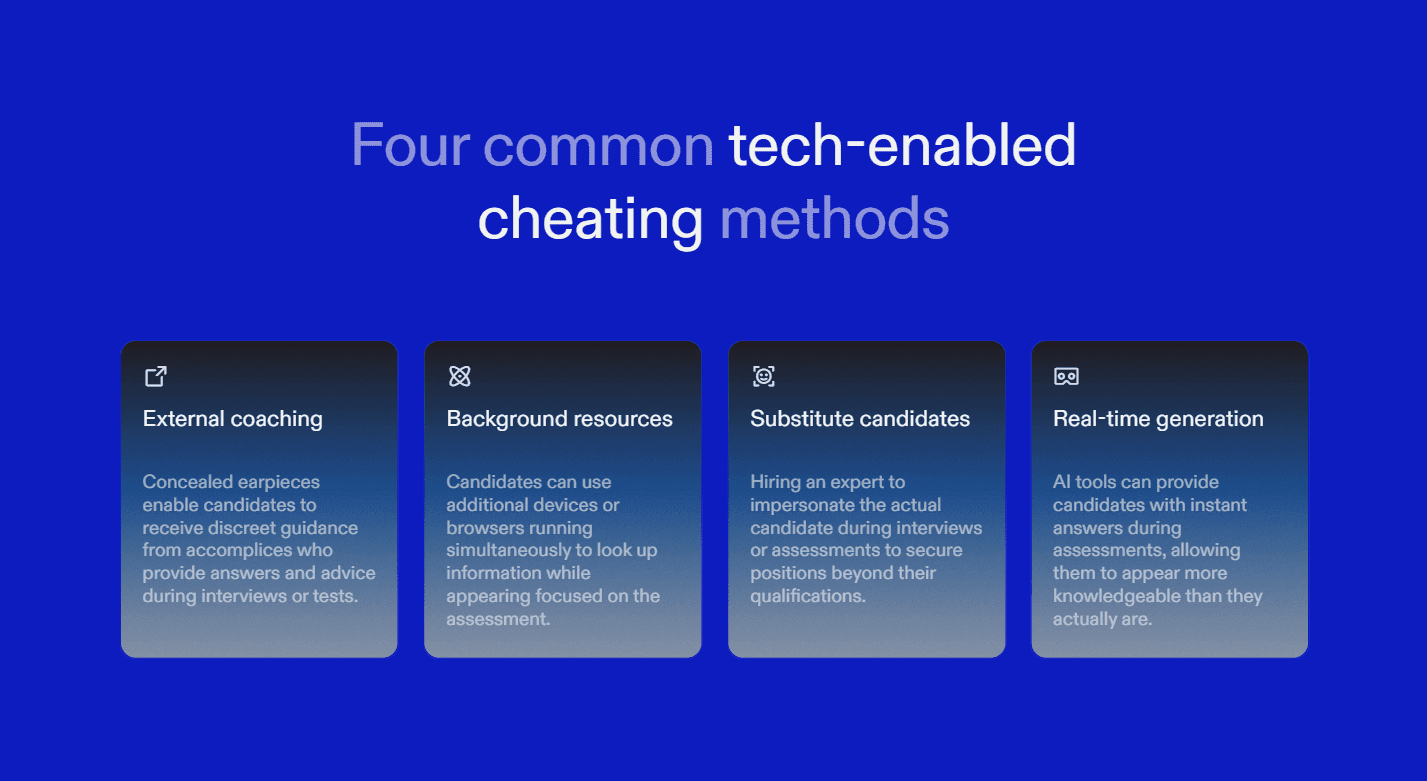
Cheating in interviews today looks very different from the past. Candidates no longer need notes taped to a wall. Instead, they may rely on:
Real-time AI tools generating answers
Hidden earpieces with external coaching
Second devices or browsers running in parallel
Someone else taking the interview on their behalf
Because these behaviors are subtle, human interviewers alone often miss them especially at scale. This is where AI becomes essential: not as an enforcer, but as an early-warning system.
How AI Detects Cheating in Live Interviews
AI-based interview monitoring works best when it uses multiple layers of analysis rather than a single signal. Sherlock AI, for example, combines behavioral intelligence, contextual awareness, and system-level insights to build a complete picture.
1. Real-Time Identity and Continuity Verification
One of the most common forms of interview fraud is proxy interviewing, where someone else takes the interview for the candidate. AI helps prevent this by verifying that the same person remains present throughout the session.
Instead of relying on intrusive ID scans, AI analyzes facial consistency, voice patterns, and presence continuity over time. If the person on screen changes even briefly, AI can detect anomalies in facial structure or vocal characteristics.
This approach protects interview integrity while avoiding unnecessary friction for honest candidates.
2. Gaze, Face, and Attention Pattern Analysis
Contrary to popular belief, AI does not flag candidates simply for looking away from the screen. Natural movement, thinking pauses, and eye shifts are normal.
What AI looks for are repeated, structured patterns, such as a candidate consistently glancing to the same off-screen location right before delivering complex answers. Over time, these patterns may suggest external assistance rather than independent thinking.
Sherlock AI’s approach emphasizes pattern recognition over momentary behavior, which significantly reduces false positives.
3. Speech and Language Consistency Analysis
AI also evaluates how answers are delivered, not just what is said.
For example, sudden changes in vocabulary complexity, sentence structure, or tone may indicate that a response is being externally generated. Similarly, long response delays followed by unusually polished answers can suggest real-time AI assistance.
By comparing speech patterns across the interview, AI can detect inconsistencies that are difficult to fake over time, especially when answers are spontaneous.
4. Dynamic Questioning to Validate Authenticity
One of the most effective ways AI detects cheating is by changing the interview flow dynamically.
If a candidate gives a strong response, the system may introduce follow-up questions that require personal reasoning, explanation of thought process, or application to a new scenario. These questions are difficult to answer using pre-written scripts or AI tools.
Candidates who truly understand the subject maintain coherence. Those relying on assistance often struggle with continuity.
5. Environmental and Audio Context Awareness
Rather than continuously recording a candidate’s surroundings, AI looks for environmental inconsistencies.
This can include unusual background audio patterns, sudden changes in sound quality, or overlapping voices. These signals don’t automatically mean cheating, but when combined with other indicators, they help build context.
Sherlock AI uses this information responsibly, focusing on signals rather than surveillance.
6. System-Level Behavioral Monitoring
AI can also analyze technical behavior during the interview, such as unusual timing patterns, repeated interruptions, or inconsistencies in interaction flow.
For example, frequent pauses that align with external activity or structured delays before certain questions may indicate external help. Importantly, these signals are used in combination, not isolation.
This layered approach ensures accuracy without penalizing normal technical glitches or nervousness.
What AI Does Not Do in Live Interviews
AI does not automatically reject candidates
AI-generated signals never lead to instant disqualification. They are meant to highlight areas for human review, not make final hiring decisions.AI does not rely on a single behavior
Isolated actions like looking away, pausing, or nervous speech are not treated as indicators of cheating. AI evaluates patterns over time and in context.AI does not replace human judgment
Final decisions always remain with recruiters. AI supports interviewers by providing insights, helping them make fair and informed choices.
How Sherlock AI Takes a Trust-First Approach to Interview Integrity
1. Behavioral Intelligence Over Surveillance
Sherlock AI focuses on how candidates think, respond, and communicate during interviews rather than relying on invasive monitoring or rigid proctoring rules. This ensures integrity checks feel natural and non-intrusive.
2. Pattern-Based Detection, Not Single Signals
Instead of flagging isolated actions, Sherlock analyzes behavioral and linguistic patterns across the entire interview. This reduces false positives caused by stress, cultural differences, or individual communication styles.
3. Privacy-First by Design
Sherlock AI avoids excessive data collection and intrusive practices like constant screen recording. It uses only high-signal interview data, helping organizations stay compliant while protecting candidate trust.
4. Human-in-the-Loop Decision Making
Sherlock AI provides contextual insights to recruiters but never makes automatic hiring decisions. Human reviewers assess AI signals, ensuring fairness and informed judgment.
5. Scalable Integrity Without Harming Experience
Sherlock AI enables companies to secure high-volume remote interviews while preserving a smooth and respectful candidate experience, making it suitable for modern, distributed hiring.
The Future of AI in Interview Cheating Detection
The future of interview security is not driven by more surveillance, but by smarter and more thoughtful interview design. AI will play a critical role in improving how candidates are evaluated while maintaining fairness and trust.
1. Reasoning-Based Evaluation
Future interview systems will focus more on assessing how candidates think rather than what they memorize. By evaluating reasoning, problem-solving, and decision-making processes, AI reduces the effectiveness of real-time assistance tools. Candidates who truly understand their domain are able to explain their logic clearly, making authenticity easier to verify.
2. Adaptive Interviews
AI-powered interviews will become increasingly adaptive, with questions evolving based on earlier responses. This dynamic structure makes it difficult for scripted or AI-generated answers to stay consistent, while rewarding candidates who can think on their feet and maintain continuity in their explanations.
3. Privacy-Preserving Detection Models
As AI adoption grows, so does the need for ethical and compliant data practices. Future detection models will rely on high-quality behavioral signals rather than intrusive monitoring. This ensures interview security remains effective while respecting candidate privacy and regulatory requirements.
4. Skill Validation Over Trick Detection
The focus of interview security will shift from catching candidates doing something wrong to validating whether they possess the skills required for the role. By emphasizing real-world problem solving and applied knowledge, AI helps create a fairer hiring process that benefits both employers and candidates.
Final Thoughts
AI is not meant to turn interviews into interrogations. Its real value lies in creating a fair playing field where every candidate is evaluated on their true abilities.
When applied responsibly, AI helps hiring teams reduce bias, identify genuine talent, and make more confident decisions, especially in remote and high-volume hiring environments. It protects honest candidates from being disadvantaged while ensuring organizations can trust the outcomes of their interviews.
As remote hiring becomes the norm, interview integrity will no longer be optional, it will be foundational. The companies that succeed will be those that adopt AI thoughtfully, transparently, and ethically.
Sherlock AI represents this new standard: secure interviews built on trust, intelligence, and respect for the human behind the screen.