Back to all blogs
Learn how to detect interview fraud at scale, prevent AI-assisted cheating, and protect hiring integrity with automated systems like Sherlock AI.

Abhishek Kaushik
Jan 27, 2026
Interview fraud has shifted from an occasional risk to a systemic threat for organizations of all sizes. Modern AI tools are being used to fabricate identities, fake responses, and even impersonate candidates in live interviews, creating a growing blind spot for hiring teams. According to recent research, nearly 6 in 10 managers suspect job candidates of using AI to misrepresent themselves, and more than 30 % have actually encountered fake identities or proxy interviewees during the hiring process.
About 72 % of recruiters reporting encounters with AI‑generated fake credentials or work samples. These trends are accelerating, by 2028, research predicts that up to 1 in 4 job candidate profiles worldwide could be fake, driven in part by the rise of deepfakes and AI‑generated identities.
Yet despite the growing scale of fraud, most employers lack the tools or confidence to catch it.
In this blog, we’ll explore how interview fraud manifests at scale, the limitations of traditional detection approaches, and what purpose‑built systems must do to identify and stop sophisticated fraud in hiring before it becomes a business risk.
Why Interview Fraud Can No Longer Be Detected Manually
Interview fraud is evolving fast and outpacing traditional detection methods. Today, recruiters face:
AI copilots that generate answers in real time
Deepfake video and voice impersonations
Proxy candidates taking interviews on someone’s behalf
Scripted responses that appear perfectly human
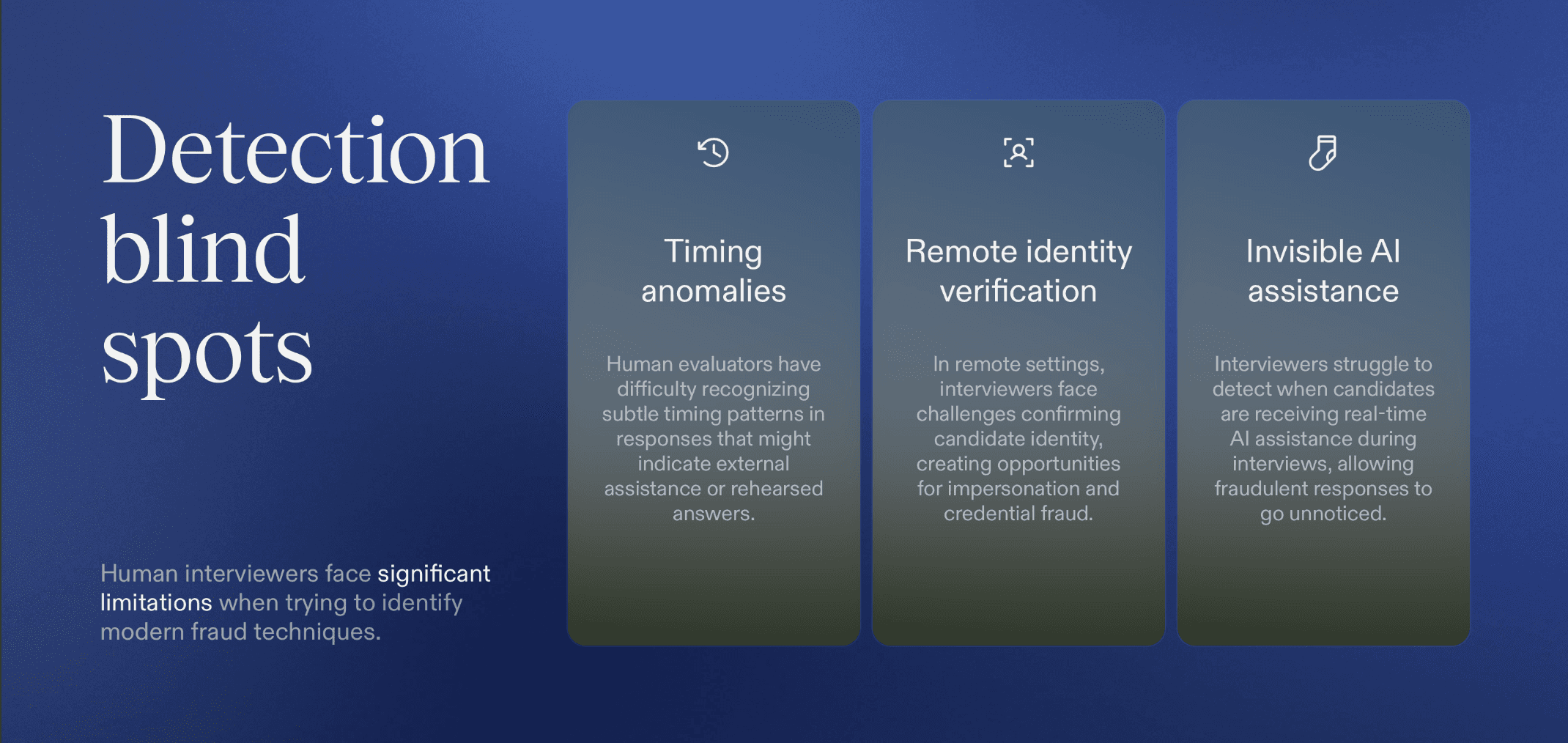
Human interviewers struggle to detect:
Invisible AI assistance
Subtle timing anomalies
Identity mismatches
Traditional methods like intuition, spot checks, and random audits weren’t designed for this scale. Remote and high-volume interviews remove the natural safeguards of in-person hiring, making human judgment alone insufficient to detect fraud.
What Detection at Scale Actually Requires
As interview fraud becomes more sophisticated and AI-assisted, traditional detection methods fail at scale. Spot checks, intuition, and random audits can no longer keep pace with fast, high-volume, remote hiring. Detecting fraud at scale requires purpose-built systems designed for real-time, continuous, and organization-wide monitoring.
1. Continuous, Real-Time Monitoring
Fraud detection cannot be episodic. Systems must operate continuously, observing every interview as it happens.
Tracks behavioral and interaction signals in real time
Detects subtle anomalies that human interviewers often miss
Flags potential AI assistance, deepfake attempts, or proxy participation
Prevents fraudulent candidates from advancing unnoticed
Continuous monitoring ensures that fraud is caught before it impacts hiring decisions, not after a bad hire occurs.
2. Automated, Not Manual
Relying on humans to detect fraud at scale is impractical. Automation is key to handle high volumes and subtle patterns.
Uses AI to analyze speech, timing, and response patterns
Reduces human error and subjectivity
Provides consistent evaluation across all interviews
Frees recruiters to focus on assessing real skills rather than spotting fraud
Automation transforms detection from reactive to proactive, enabling teams to act on red flags immediately.
3. System-Wide, Not Interviewer-Dependent
Fraud can span multiple interviews or stages, making isolated checks insufficient. Detection systems must operate across the entire hiring ecosystem.
Monitors candidates across all interview rounds
Correlates patterns between different interviewers and panels
Detects identity mismatches, contradictions, and memory drift
Standardizes fraud detection across locations and teams
A system-wide approach ensures no stage of the hiring process becomes a weak link.
4. Core Capabilities Required for Scalable Detection
To detect sophisticated fraud reliably, systems need several critical capabilities:
Real-time behavioral monitoring: Tracks eye movements, micro expressions, and off-screen cues
Identity consistency checks: Verifies that the same candidate is present across all rounds
AI-assisted response pattern analysis: Flags unnatural fluency, scripted answers, or AI-generated responses
Cross-round correlation: Detects contradictions, memory drift, or capability inflation across interviews
These capabilities allow recruiters to focus on genuine candidate skills rather than trying to infer authenticity manually.
5. Prevention Over Post-Hire Detection
Finding fraud after hiring is too late - it costs time, money, and team performance.
Early detection prevents bad hires from joining
Reduces time-to-productivity loss caused by skill gaps
Protects team morale and customer outcomes
Ensures compliance with internal policies and regulatory requirements
At scale, detection must prevent systemic risk rather than just catch individual incidents.
6. Catching Incidents vs. Preventing Systemic Risk
There’s a big difference between reactive incident detection and proactive risk management:
Catching incidents: Spotting fraud after it occurs; limited, inconsistent, and human-dependent
Preventing systemic risk: Building systems and processes that make fraud extremely difficult to commit or scale
Scalable fraud detection transforms hiring from a reactive HR task into an engineering problem solved by intelligent systems.
Continuous monitoring, automation, system-wide coverage, and AI-assisted analysis are essential to ensure hiring integrity, protect organizations from risk, and maintain trust in remote interviews.
How Sherlock AI Enables Detection at Scale
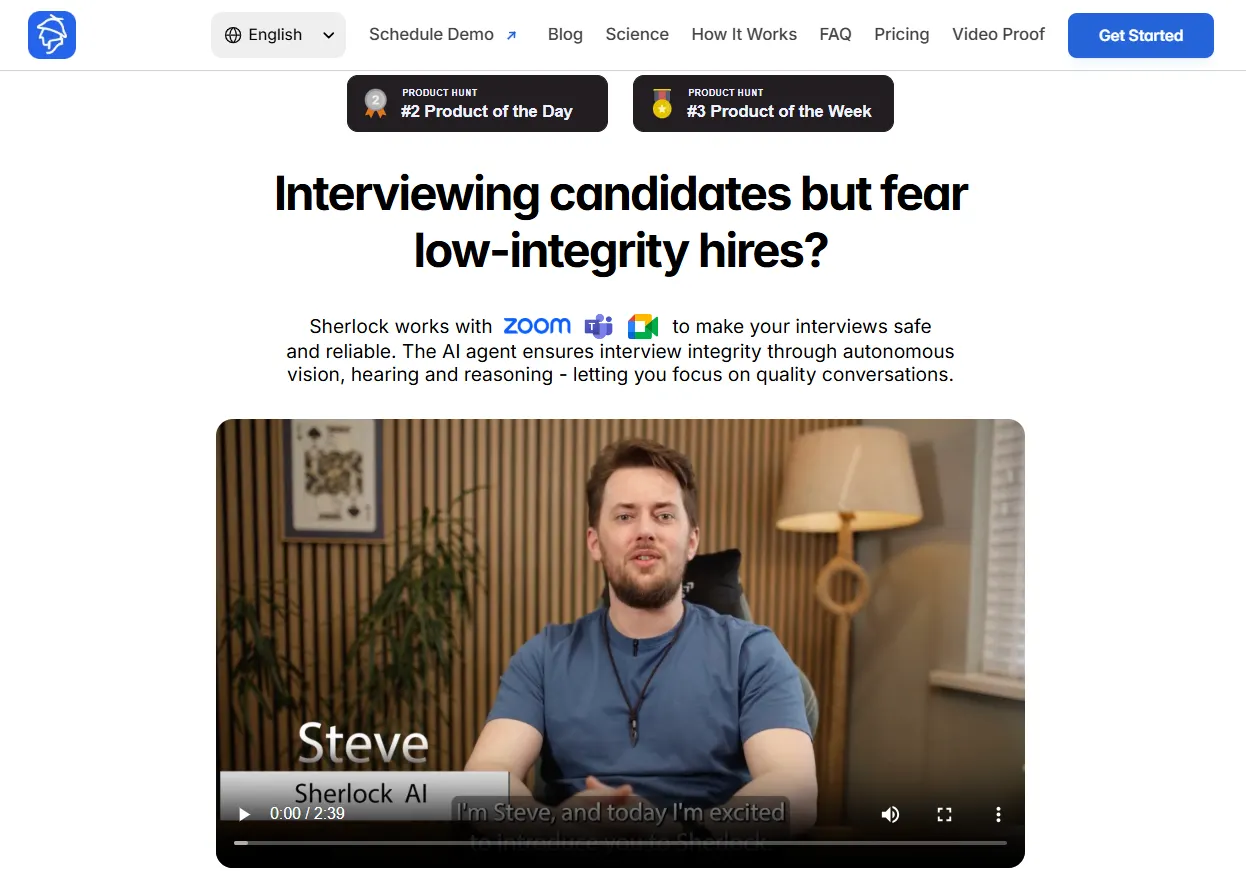
Scaling interview fraud detection requires purpose-built systems that operate continuously, analyze behavior, and enforce integrity across multiple rounds.
Traditional methods fail when interviews are remote, high-volume, and AI-assisted, leaving gaps that humans cannot reliably fill. Platforms like
Sherlock AI bridge this gap, turning each interview into a monitored, secure, and trustworthy process. The following key features illustrate how it works:
1. Real-Time Behavioral Monitoring
Sherlock AI observes candidates during interviews to detect subtle fraud signals that humans can’t reliably see.
Tracks eye movement, gaze patterns, and off-screen behavior
Flags unusual response timing consistent with AI assistance
Detects overly polished or scripted answers
Real-time monitoring ensures potential fraud is identified as it happens, not after the fact.
2. Identity Verification Across Rounds
Candidates may attempt impersonation or proxy participation. Sherlock AI ensures the same person is interviewed across all stages.
Compares facial and voice biometric patterns to confirm identity
Detects impersonation or deepfake attempts
Flags mismatches across multiple interview rounds
Identity verification stops proxy candidates and ensures interview integrity.
3. Detection of AI-Assisted Responses
AI copilots and pre-written answers are increasingly common. Sherlock AI identifies patterns typical of AI-generated responses.
Flags overly fluent or “too perfect” answers
Detects repetitive phrasing and pre-generated content
Monitors reasoning depth and consistency under follow-up questions
This ensures recruiters assess real human cognition, not AI-generated polish.
4. Cross-Round Correlation
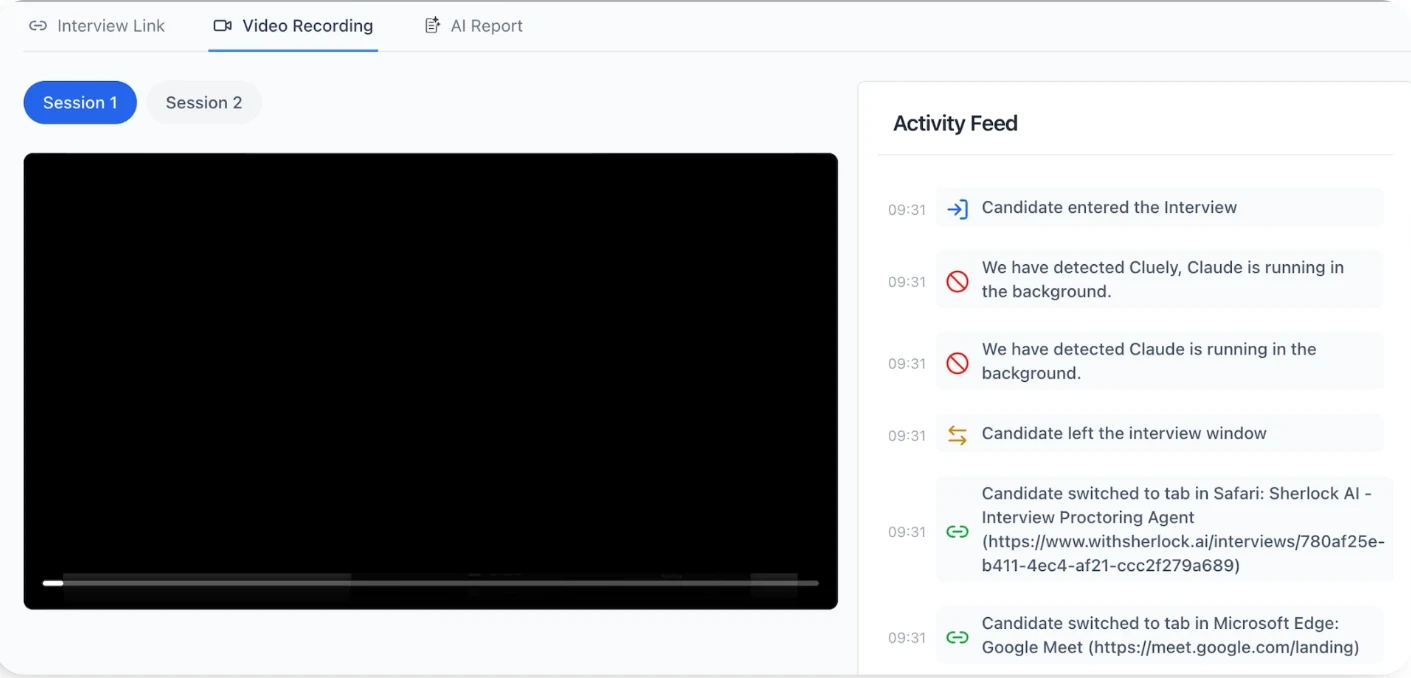
Fraud often spans multiple interviews. Sherlock AI tracks candidate behavior and responses across rounds.
Highlights contradictions or memory drift
Tracks capability inflation between interviews
Correlates behavioral anomalies and identity signals
Cross-round correlation makes it nearly impossible for fraudulent candidates to slip through undetected.
5. Audit-Ready Reporting & Compliance
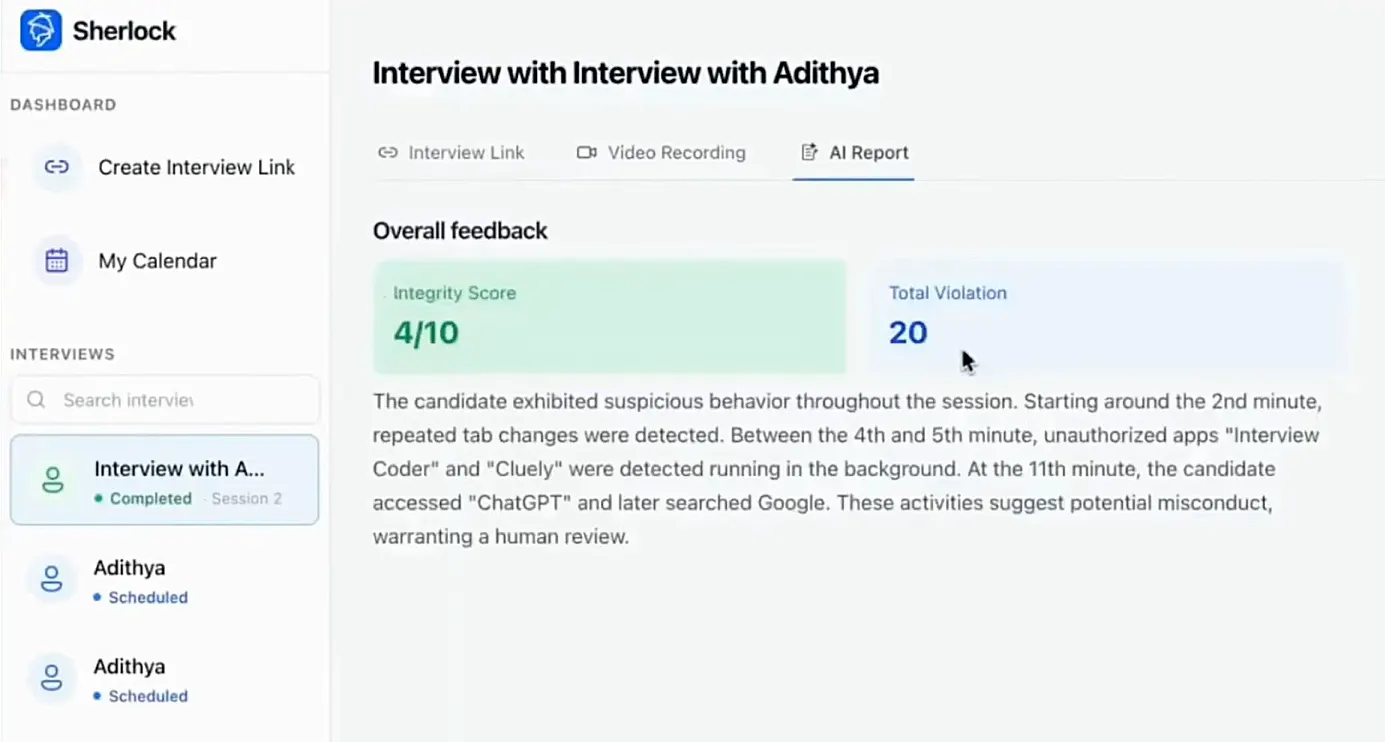
Sherlock AI generates reports to support accountability and regulatory compliance.
Produces detailed evidence of anomalies and flagged behavior
Tracks patterns over time for continuous improvement
Supports defensible hiring decisions and internal audits
Audit-ready reporting protects organizations from risk while reinforcing trust.
6. Enhancing Recruiter Efficiency
By automating fraud detection, Sherlock AI amplifies recruiter effectiveness rather than replacing human judgment.
Prioritizes interviews requiring closer scrutiny
Reduces time spent manually spotting fraud
Provides actionable insights in real time
Recruiters can focus on evaluating skills, not detecting deception.
Sherlock AI enables real-time, system-wide, and automated fraud detection, making interviews scalable, trustworthy, and resistant to AI-assisted cheating. By integrating behavioral monitoring, identity verification, AI pattern analysis, and audit-ready reporting, organizations can protect hiring integrity at scale.
Conclusion
As AI-assisted cheating becomes more sophisticated, traditional interview methods are no longer sufficient to ensure hiring integrity. Hidden prompts, deepfakes, and proxy candidates make human detection unreliable, especially at scale.
Platforms like Sherlock AI provide a structured, automated approach by monitoring behavior in real time, verifying identity across rounds, and analyzing answers for authenticity. By integrating these systems, organizations can maintain fair, trustworthy, and efficient hiring processes.
The future of hiring is interview systems that are resilient to deception, ensuring every decision is based on real skills, not illusions.