Back to all blogs
Ensure hiring integrity at scale. Learn how to design interviews that reveal true skills and use tools like Sherlock AI to detect assisted performance in high-volume hiring.

Abhishek Kaushik
Mar 18, 2026

Hiring integrity becomes significantly harder as hiring volume grows. Remote interviews, high application volumes, and widespread use of AI tools mean polished responses can easily mask true ability. According to Gartner research, 39% of job candidates used AI during the hiring process, and 6% admitted to interview fraud such as impersonation, making authentic evaluation more difficult than ever.
At the same time, hiring managers are increasingly alarmed: 59% suspect candidates used AI to misrepresent themselves, and only 19% feel confident their process would catch fraudulent applicants. These trends erode trust in hiring systems and inflate costs through mis‑hires, longer interview loops, and lower productivity.
Building hiring integrity at scale is about designing interview systems that continue to reveal true capability even under high volume, with clear definitions of integrity and feedback loops linking hiring decisions to performance. This guide explains why traditional approaches fail under scale, how modern teams safeguard authenticity, and what it takes to maintain trust as organizations grow.
Why Hiring Integrity Breaks Down at Scale
Hiring processes that seem to work at low volume often fail once hiring scales. The reason is simple: scale amplifies weak signals.
When teams hire in volume, interviews become faster, more standardized, and more repetitive. This makes small flaws harder to spot and easier to repeat.
How volume hiring amplifies weak interview signals:
Predictable questions get reused across roles and teams
Interviewers rely more on checklists than judgment
Polished answers are rewarded because they are easier to score quickly
Why small integrity gaps turn into large hiring failures:
One weak hire becomes many when the same process is reused
Assisted or rehearsed performance slips through repeatedly
Early mistakes compound across teams and quarters
The hidden cost of scaling flawed interview processes:
Higher mis-hire rates and early attrition
Longer interview loops added to “fix” quality issues
Managers lose confidence in hiring decisions
At scale, hiring integrity is not about catching individual failures. It is about fixing the process before small gaps become systemic problems.
Design Interviews That Scale Without Losing Signal
When hiring volume increases, interviews often shift toward speed and standardization. That shift is necessary, but risky. Most signal loss at scale does not come from bad intent. It comes from processes optimized for throughput instead of judgment.
1. Evaluate reasoning, not how polished the answer sounds
In high-volume hiring, interviewers often score clarity and confidence because those traits are quick to assess. This quietly favors candidates who present well over those who can operate well on the job.
What strong hiring teams do differently:
Candidates are asked to reason through incomplete or messy scenarios
Tradeoffs and assumptions are explored, not just final answers
Edge cases are introduced, where memorized responses tend to break
Instead of asking “How would you design X?”, more revealing questions include:
“What would break first if this went live?”
“What would be deprioritized if resources were cut in half?”
These questions expose judgment, not polish.
2. Use dynamic questioning that fits real interview constraints
Dynamic interviewing does not require longer or more complex sessions. Small disruptions are enough to reveal real thinking within standard time limits.
Effective techniques in scaled hiring include:
Interrupting an answer and changing a key assumption
Asking for the same explanation at a different level of detail
Introducing a realistic failure scenario and observing recovery
These moments require adaptation rather than recall and fit easily into 30–45 minute interviews.
3. Avoid predictable formats that scale poorly
Predictability becomes a liability as hiring volume grows. Reused questions across teams and quarters allow candidates to optimize for passing interviews instead of doing the work.
Common breakdowns at scale include:
Static question banks reused across roles
Rubrics that reward structure more than reasoning
Identical interview loops applied to very different teams
Hiring processes that preserve signal focus on:
Standardizing evaluation goals, not exact questions
Rotating scenarios while testing the same skills
Allowing flexibility in follow-up questions while keeping scoring consistent
Designing interviews that scale without losing signal is not about adding more rounds or tighter scoring. It is about protecting the moments where real thinking appears.
How Modern Tools Help Restore Interview Integrity at Scale
When hiring scales, integrity problems cannot be solved through process design alone. Even well-structured interviews break down when interviewers lack visibility into how responses are being produced. This is where modern monitoring and detection tools play a critical role.
The purpose of interview integrity tooling is not enforcement. It is signal recovery.
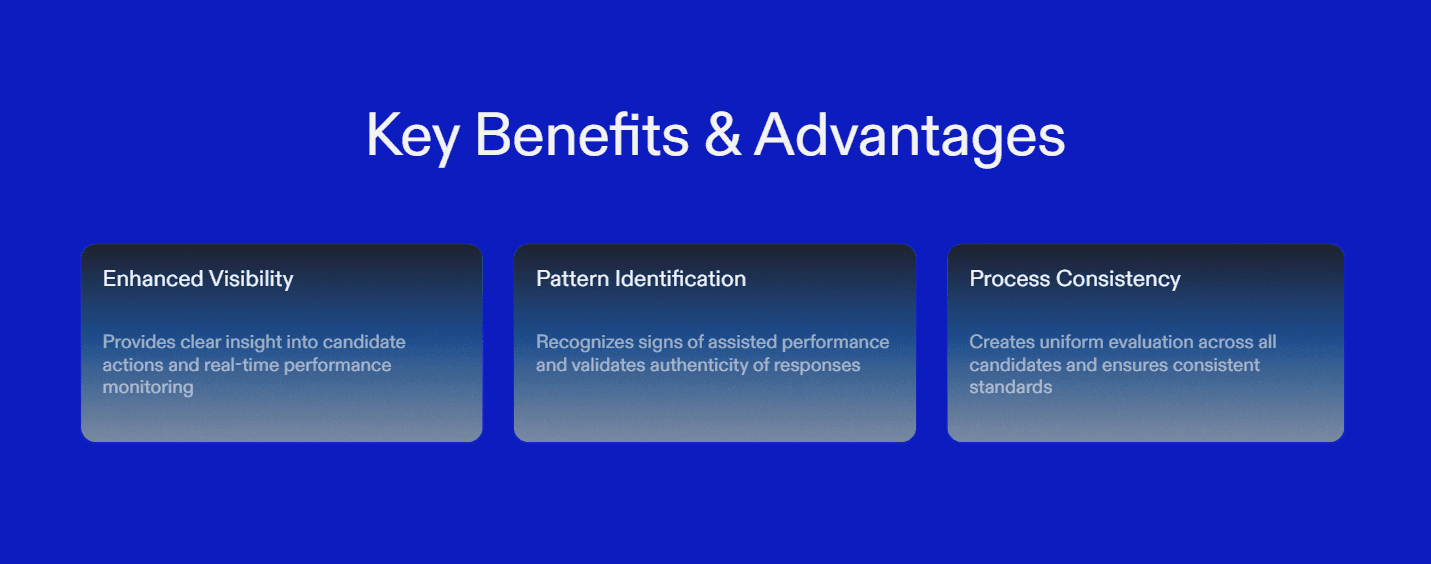
Restoring visibility into candidate behavior during critical moments
Identifying patterns that indicate assisted performance rather than independent reasoning
Creating consistency across interviews, teams, and time zones
Without tooling, these signals remain fragmented and subjective.
Why Sherlock AI is the complete solution
Most tools either block candidates or overload interviewers with raw data. Sherlock AI is built differently. It is designed to support interviewers, not replace judgment.
Key benefits include:
Behavioral signal detection that highlights moments worth probing further
Environmental awareness to surface off-screen assistance patterns without interrupting the interview
Interviewer-friendly insights that guide follow-up questions instead of making decisions automatically
Scalability by design, enabling consistent integrity checks across high-volume hiring
By integrating directly into the interview flow, Sherlock helps teams regain confidence in interview outcomes without adding friction or compromising candidate experience.
Modern hiring needs more than better questions. It needs visibility, consistency, and context. Tools like Sherlock AI make interview integrity operational at scale rather than aspirational.
Read more: Top 5 ways companies can stop AI fraud in interviews without damaging candidate experience.
Conclusion
Building hiring integrity at scale is no longer optional, it is essential for quality, speed, and cost-effective hiring. Traditional interviews, even well-structured ones, struggle to reveal genuine candidate capability when volume increases and polished or AI-assisted answers become common.
The solution is a combination of thoughtful process design and intelligent support tools. Interviews must reward reasoning, adaptability, and problem-solving, while modern platforms provide visibility into behavioral and environmental signals that are impossible to track manually.
Sherlock AI exemplifies this approach, helping teams identify integrity risks in real time, guide probing questions, and maintain consistency across high-volume hiring, all without turning interviews into surveillance.
When processes and tools work together, organizations can hire confidently, minimize mis-hires, and ensure that scale does not come at the cost of trust or performance.