Back to all blogs
Learn how recruiters can spot and prevent candidate fraud in modern hiring. Identify red flags, understand common fraud tactics, and use smarter tools to protect hiring integrity.

Abhishek Kaushik
Mar 24, 2026
Recruiter teams around the world are facing a serious and growing threat of candidate fraud. In recent employer survey, more than half of hiring managers reported uncovering applicants misrepresenting their qualifications or experience, while nearly 60% say they have suspected candidates of using deceptive tools or identities during the hiring process.
Research shows that fake profiles and fabricated credentials are expected to become even more common, with Gartner predicting that by 2028, as many as one in four candidate profiles could be fake. Other studies find that 72% of recruiters report encountering fake resumes, portfolios, or credentials during screening, and deepfake-style manipulations are now appearing in live interviews.
These trends make it critical for recruiters to sharpen their approach. The cost of a fraudulent hire goes beyond wasted time and money. It can damage team performance, weaken trust in your hiring process, and expose the business to compliance risks.
What Candidate Fraud Looks Like Today
Deception in hiring has become more frequent and more sophisticated, especially in remote hiring environments where traditional in-person checks are limited. Recruiters must understand the main ways fraud shows up so they can adjust screening and interviewing practices effectively.
1. AI-Generated and Fake Resumes
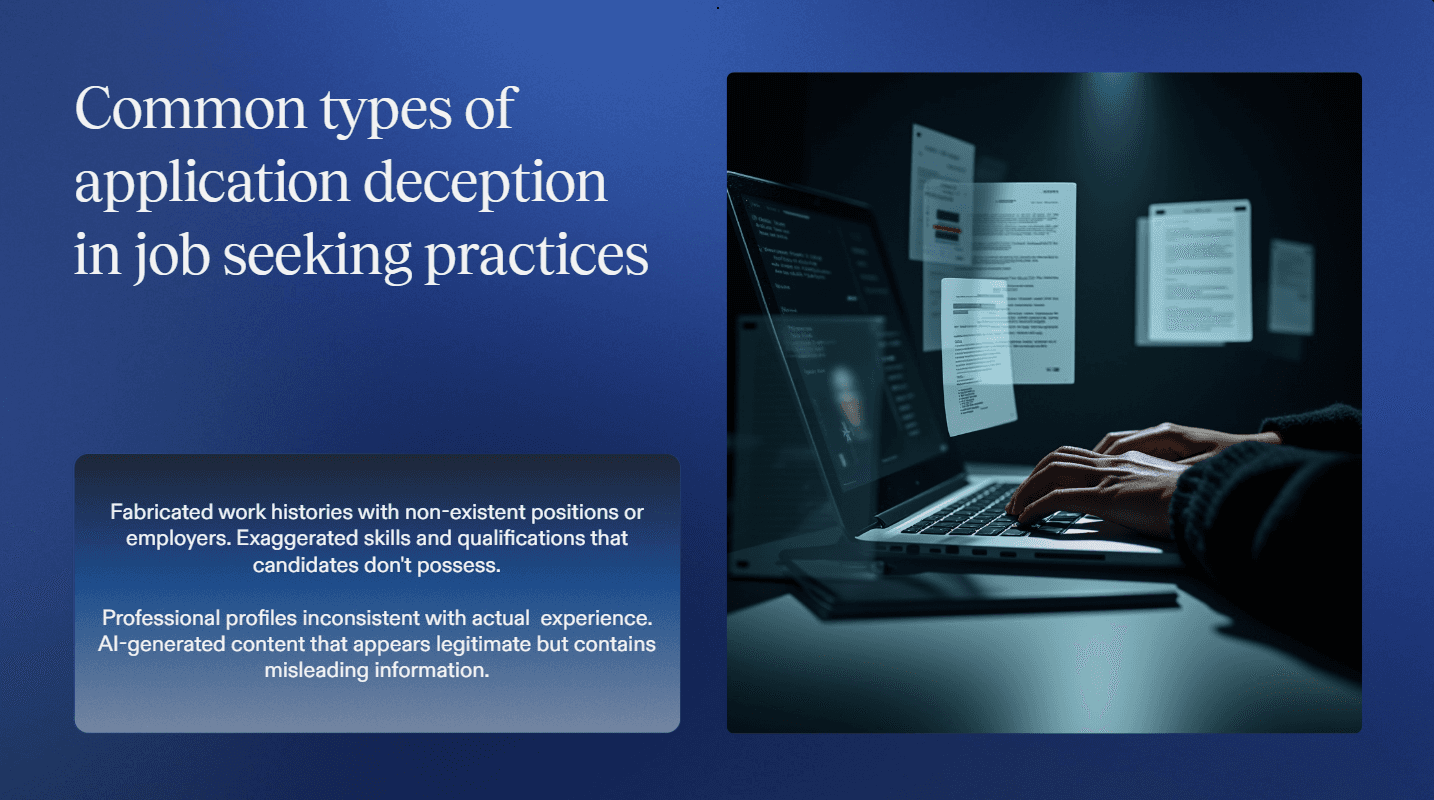
Many applicants use automated tools to produce polished resumes, cover letters, and portfolios designed to pass applicant tracking systems and impress recruiters.
A 2025 survey found that 71% of HR professionals reported encountering fake or misleading AI generated candidate information during hiring. Only about 20% of HR teams felt very confident they could spot these issues.
Recruiters are increasingly seeing fabricated work histories, exaggerated skills, and professional profiles that don’t match real experience.
2. Identity Misrepresentation
Beyond embellishing experience, some candidates go as far as misrepresenting their identity entirely. According to a major industry survey, nearly 60% of hiring managers have suspected candidates of using AI to misrepresent themselves, and almost one in three said they have interviewed someone who later turned out to be using a false identity.
These tactics include fake photo IDs, altered documents, or completely invented profiles.
3. Deepfakes and Synthetic Interviews
Deepfake technology is now being reported in real hiring scenarios. Some candidates have used AI-generated video or voice manipulation to appear as legitimate interviewees.
A cybersecurity startup discovered a job applicant dubbed “Ivan X” who used deepfake face and voice technology combined with fabricated credentials to get past multiple interview rounds. The fraud was only uncovered when facial expressions and video cues didn’t sync naturally.
Around 15% of recruiters have seen face-swapping or voice-cloning used in interviews, and this technology can make it hard to tell whether the person on screen is legitimate.
4. Proxy Interviews and Second-Screen Assistance
Some fraudulent candidates will use a stand-in or second person to answer questions on their behalf during interviews, or receive real-time help via hidden screens, chat prompts, or earpieces.
Recruiters sometimes report pauses, scripted responses, or communication that doesn’t match the claimed experience, suggesting that someone other than the applicant is providing the answers.
5. Fabricated Credentials and References
Fake degrees, certificates, or references are common fraud tactics. In many cases, candidates list unverifiable schools or companies, or provide contacts that are not genuine supervisors. In the UK, a recruitment industry article reported that approximately 60% of CVs contain errors, with around 20% involving deliberate falsehoods such as fabricated job titles or qualifications.
These modern forms of candidate fraud reflect evolving risks in digital hiring and highlight why recruiters need updated tools and methods to maintain hiring integrity. Without careful screening and verification, fraudulent candidates can waste time, inflate costs, and even pose security risks to organizations.
Common Red Flags Recruiters Miss During Interviews
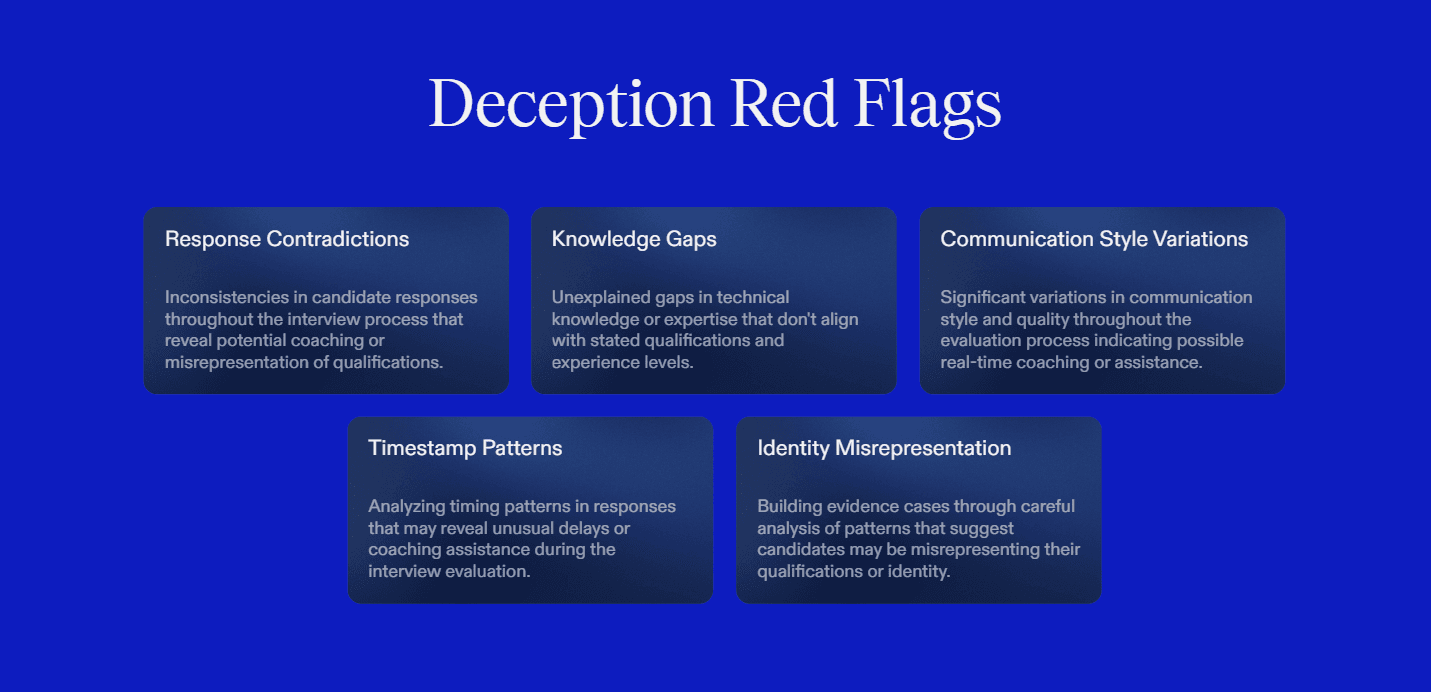
Many signs of candidate fraud appear during interviews but are easy to overlook, especially when hiring teams are under time pressure or conducting remote interviews. These red flags usually fall into three areas: behavior, technical consistency, and performance alignment.
Behavioral Red Flags
Scripted or overly polished answers that sound rehearsed rather than natural
Long pauses before answering simple or role-specific questions
Repeating the question out loud to buy time before responding
Unnatural speaking rhythm or tone that changes mid-interview
Unusual eye movement, such as frequently looking off-screen or avoiding the camera
Technical and Communication Red Flags
Voice lag or audio that does not sync properly with lip movement
Sudden changes in audio clarity, accent, or speaking style
Difficulty explaining past work, tools, or projects in simple terms
Overuse of generic explanations that lack real-world detail
Inability to answer follow-up questions on topics listed on the resume
Consistency and Performance Red Flags
Strong performance in early screening followed by a sharp drop in later interview rounds
Skill levels that do not match the complexity of claimed experience
Inconsistent examples when describing past roles or achievements
Changing timelines, job responsibilities, or project details across interviews
Discrepancies between resume claims and live problem-solving ability
These signals are often subtle on their own, but patterns across multiple red flags can indicate interview assistance, identity misrepresentation, or skill fabrication.
Tools and Techniques to Detect Candidate Fraud
Detecting candidate fraud requires a layered approach. No single tool can catch every issue, but when used together, structured processes and modern technology significantly reduce risk while still preserving recruiter judgment.
1. Structured Interviews and Consistent Questioning
Structured interviews help remove guesswork and make inconsistencies easier to spot.
Use the same core questions for all candidates applying for the same role
Ask experience-based questions that require candidates to explain how they solved real problems
Introduce follow-up questions that probe deeper into tools, decisions, and outcomes
Compare responses across interview rounds to identify changes in detail or confidence
This consistency makes it easier to detect rehearsed answers, proxy participation, or inflated experience.
2. Skill Validation and Real-World Assessments
Validating skills beyond verbal answers is one of the most effective ways to uncover fraud.
Use role-specific tasks that reflect actual work, not generic tests
Ask candidates to explain their approach while solving a problem
Include short live exercises to confirm ownership of skills
Review work samples and ask candidates to walk through how they created them
Candidates who rely on fake resumes or interview assistance often struggle to perform when skills must be demonstrated in real time.
3. Proctoring and Interview Monitoring
Proctoring and monitoring tools add visibility into how interviews and assessments are conducted.
Detect multiple faces, screen switching, or unauthorized devices
Monitor browser activity and application switching during assessments
Flag unusual patterns such as repeated off-screen glances or sudden inactivity
Help ensure the same candidate participates throughout the interview process
These tools are especially valuable for remote hiring, where physical supervision is not possible.
4. Behavioral and Pattern-Based Analysis
Fraud often reveals itself through patterns rather than single moments.
Compare speech patterns, response timing, and engagement levels across rounds
Identify sudden shifts in performance, confidence, or communication style
Look for mismatches between claimed experience and decision-making depth
Flag repeated pauses or scripted phrasing that appears across multiple answers
Behavioral analysis helps recruiters focus follow-up questions where risk is highest.
5. Combining Tools with Human Judgment
Technology works best when paired with recruiter expertise.
Use tools to surface signals, not make final decisions
Train interviewers to interpret data alongside human observation
Document findings across stages to build a clear candidate profile
Escalate only when multiple indicators point to potential fraud
A balanced approach ensures stronger hiring outcomes without creating unnecessary friction for genuine candidates.
Sherlock AI: A Smarter Way to Detect and Prevent Candidate Fraud
Sherlock AI is designed to support hiring teams by adding intelligence, visibility, and consistency to interviews and assessments, without disrupting the candidate experience or replacing human judgment.
1. Built for Modern Interview Fraud Risks
Sherlock AI is purpose-built to address the realities of remote and AI-assisted hiring.
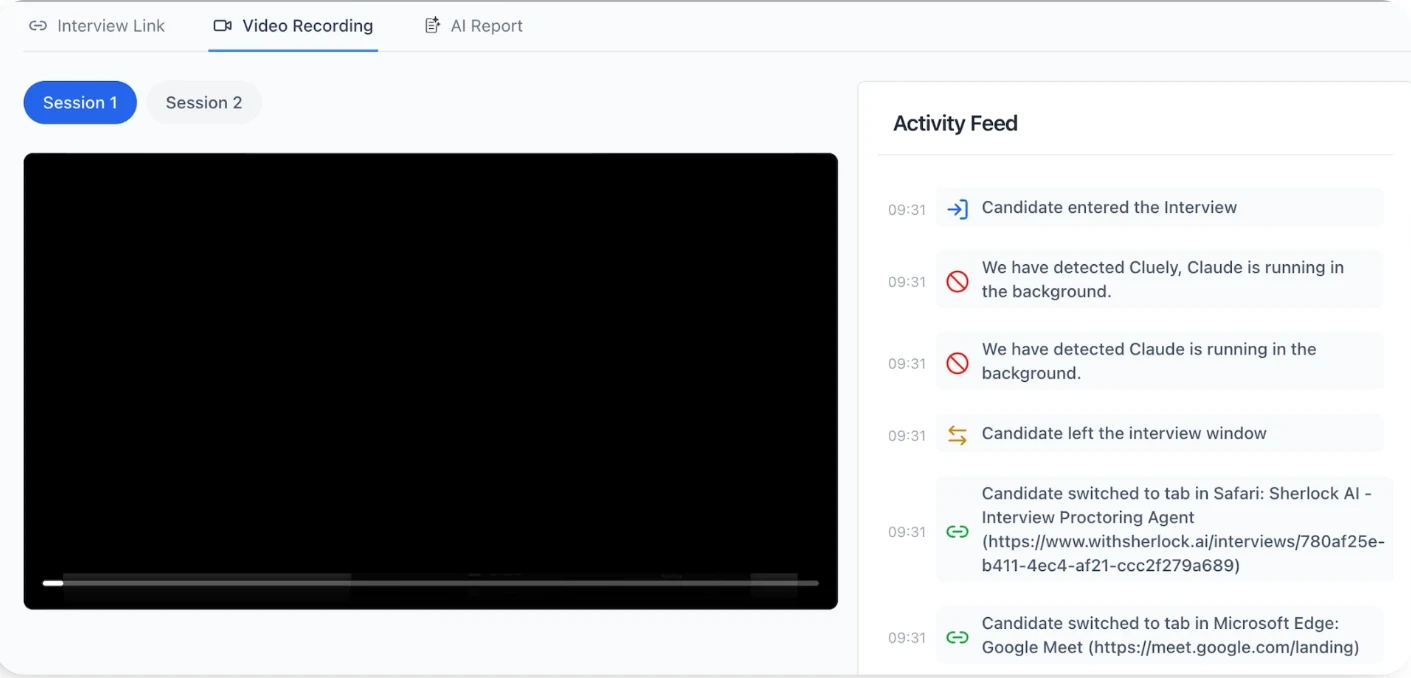
Detects patterns linked to AI-generated answers and scripted responses
Flags unusual behavior that may indicate second-screen usage or live assistance
Helps identify proxy interviews and identity inconsistencies across stages
Designed to work in real interview conditions, not just controlled test environments
2. Behavioral and Pattern-Based Intelligence
Rather than relying on a single signal, Sherlock AI focuses on patterns across the interview journey.
Analyzes response timing, pauses, and engagement levels
Identifies sudden shifts in confidence or performance between rounds
Highlights inconsistencies between resume claims and interview behavior
Surfaces anomalies that warrant deeper follow-up by recruiters
This approach helps recruiters focus their attention where risk is highest, instead of reviewing every interview manually.
3. Interview Monitoring Without Disruption
Sherlock AI provides visibility while keeping interviews natural and candidate-friendly.
Monitors interview behavior for signs of unauthorized assistance
Detects abnormal activity without intrusive interventions
Supports both live and recorded interview formats
Helps confirm that the same individual is present throughout the process
Recruiters gain added assurance without turning interviews into high-friction experiences.
4. Scalable Protection for Growing Hiring Teams
As hiring volume increases, so does fraud risk. Sherlock AI scales with your process.
Works across roles, regions, and interview formats
Reduces manual review time for recruiting teams
Helps standardize fraud detection across interviewers
Supports faster, more confident hiring at scale
This makes Sherlock AI particularly valuable for fast-growing companies, distributed teams, and high-volume hiring environments.
Conclusion
Candidate fraud is evolving fast, and traditional hiring methods alone are no longer enough. By recognizing red flags early, using structured interviews, and supporting recruiter judgment with tools like Sherlock AI, organizations can protect hiring integrity without compromising speed or candidate experience. Strong hiring today is not about mistrust, but about smarter, more informed decision-making.
Read: 5 Ways to Stop AI Fraud in Interviews Without Harming Candidate Experience